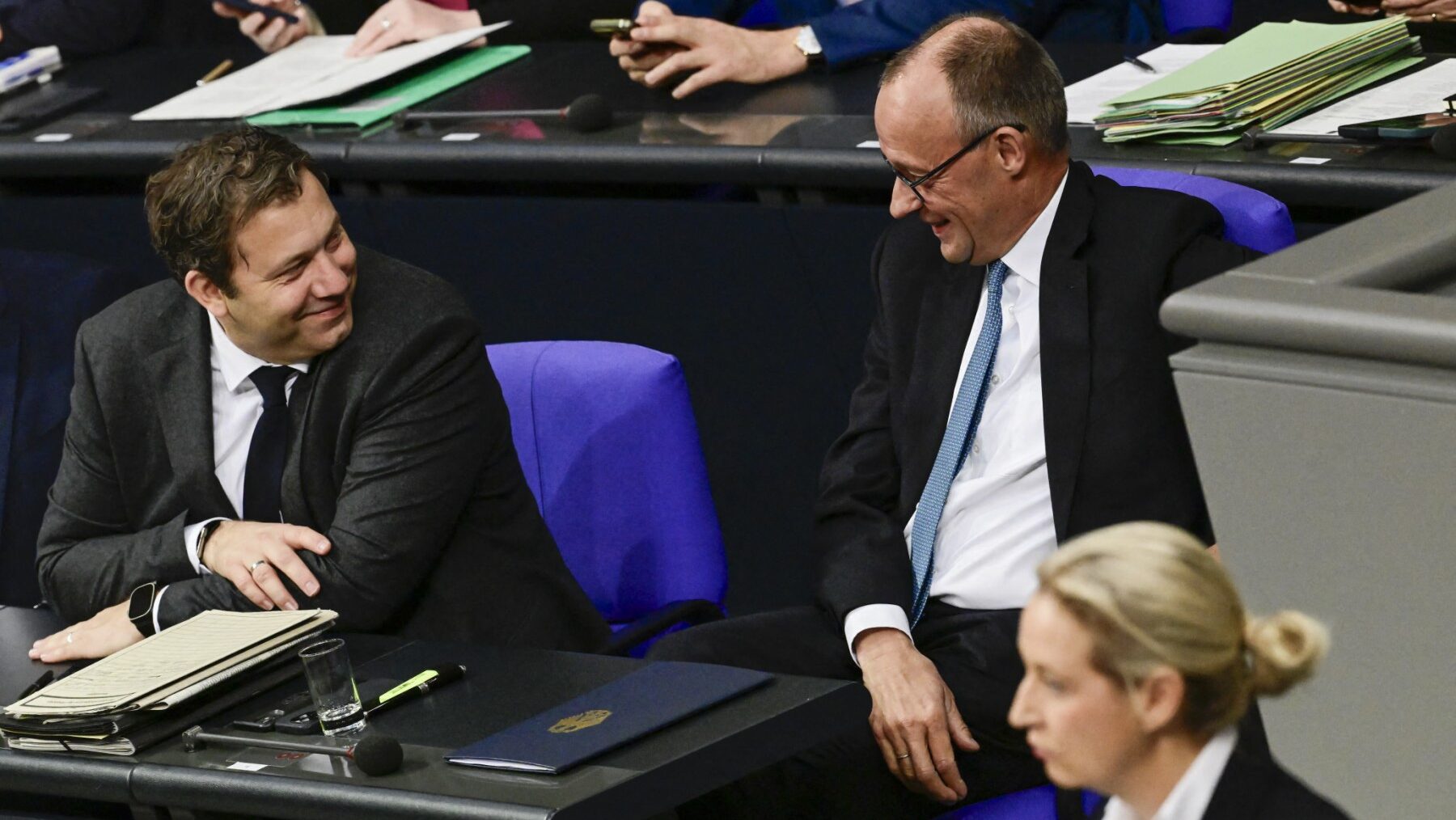
Vice Chancellor Lars Klingbeil (SPD) and Chancellor Friedrich Merz (CDU) joke during a speech by AfD co-president Alice Weidel in the Bundestag.
Tobias SCHWARZ / AFP
The long-standing political push to ban the national conservative AfD—Germany’s most popular party—has gained new traction after a leftist NGO published a legal report claiming the party is unconstitutional, only for opponents to reveal that it relied on AI in preparing its legal case.
The report was published by the Society for Civil Rights (GFF), an NGO founded by a Green party politician who remains its secretary-general. It concluded that the AfD was “demonstrably unconstitutional” and therefore a renewed attempt to ban it would likely succeed before the German Constitutional Court.
The NGO’s legal team spent a year scouring 77,000 parliamentary documents, 55,000 press releases, and 2.9 million social media posts to formulate legal arguments for the ban on Germany’s largest opposition party. Opponents later pointed to a disclosure buried deep in the report revealing that Claude AI had been used to analyse evidence and help formulate its legal arguments.
“What an absolute joke,” AfD co-president Alice Weidel said about the AI revelations. “Instead of pursuing good policies, the other parties are obsessively targeting us in a scandalously amateurish manner.”
Wie bereits vermutet, wurde das NGO-„Gutachten“ mit KI erstellt und die Anwürfe sind an den Haaren herbeigezogen. Ein Witz sondergleichen. Anstatt gute Politik zu machen, arbeiten sich die anderen Parteien an uns in einer skandalös-stümperhaften Art und Weise ab. https://t.co/lHvpx0TaQZ
— Alice Weidel (@Alice_Weidel) June 26, 2026
However, according to GFF’s research team, the finished report is “the first comprehensive assessment on the unconstitutionality of the AfD,” and they hope it will “significantly improve the basis for a discussion on a ban.”
Others in the German NGO scene also came out in full support of the ban, placing pressure on both the federal government and the Bundestag, the two entities capable of triggering the process.
According to Rolf Frankenberger, director of the Institute for Right-Wing Extremism Research at Tübingen University, the GFF report “provides more than sufficient evidence of the ideologies driving AfD and that these are incompatible” with the German constitution.
However, right-wing media and commentators were quick to call out GFF’s use of AI, buried 149-pages deep, arguing that it makes the entire report methodically flawed and unusable as an expert legal opinion.
The discussion itself, however, is nothing new. Left-wing parties in the federal parliament submitted a motion to initiate the banning process in January 2025, only to be voted down by the two big establishment parties (the centrist CDU and the socialist SPD).
But now that AfD has gained a significant advantage in the polls (29%, in contrast to CDU’s 21% and SPD’s 12%), with a real chance of winning outright majorities in state elections as well as coming in first in the next federal election, the ruling parties might start to look at the question differently.
The SPD is already on board (along with the Greens and the far-left Linke) after calling for a federal working group to collect evidence of AfD’s unconstitutionality, meaning that the Bundestag is only 46 votes away from triggering the procedure that would allow the Constitutional Court to decide the fate of AfD.
Those votes could easily come from CDU. Even though the party officially maintains an anti-ban position, significant factions of it would likely support such a motion.
“We have every reason to allow the Court to conduct this review,” said Elisabeth Winkelmeier-Becker, a CDU MP and former chair of the Bundestag’s Legal Affairs Committee. If she can convince 45 others to rebel against Chancellor Merz and the rest of the party, a second and now successful attempt to initiate the banning process could be imminent.