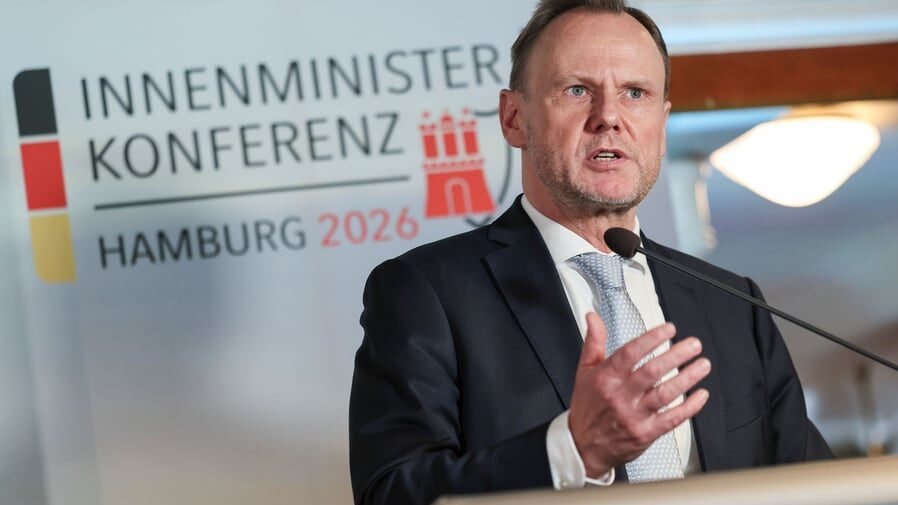
Hamburg Interior Minister Andy Grote (SPD) opening the IMK 2026.
@arnaudmercier on X, 17 June 2026
Germany has proven again that there is nothing it is more afraid of than democracy itself, especially when people vote the ‘wrong way.’
The country’s state interior ministers are discussing plans that could block future AfD-led state governments from accessing sensitive intelligence and criminal investigation data, according to Junge Freiheit.
The discussions are taking place within the Conference of Interior Ministers, a body that brings together the interior ministers of Germany’s 16 federal states.
They are also discussing abolishing states’ veto rights within the Conference—lest they risk right-wing voters having any say in federal issues.
The reason for the panic is simple: AfD is currently polling at 42% in the state of Saxony-Anhalt, 18 points ahead of the establishment conservative CDU and enough to win an outright majority and form a government alone after the September 6th election. The party is also in first place in Mecklenburg-Vorpommern with 36%, although a CDU-SPD coalition could still keep it out of government.
Under current laws, each of the 16 German states’ interior ministers has access to the databases of the country’s federal domestic intelligence agency (BfV), as well as to each other’s national security files.
The real concern is what would happen if one or more of those ministers came from AfD. A party that has spent years under surveillance by Germany’s domestic intelligence agencies could suddenly have insight into just how anti-democratic and politically motivated the investigations against it—aiming to ultimately get it banned from politics—truly were.
That’s why the interior ministers—who all come from the ruling CDU and socialist SPD—are trying to find a way to cut off entire states from the federal structure that ensures this information flow, even at the cost of significantly weakening interstate cooperation in counterterrorism and other fields relating to national security.
This could go as far as to cut off information sharing between federal and state police forces. This would mean the police in AfD-led states would no longer receive information about federal manhunts, investigations, or raids, leaving them to deal with serious security threats on their own.
Chancellor Friedrich Merz’s CDU appears not to have considered how deeply undemocratic and dangerous to national security these changes could be. The party says they are simply “technical” measures needed to “protect the constitution” from AfD.
“Should it ever be necessary and desired to decouple a state office from the Federal Office for the Protection of the Constitution [BfV] for the protection of the constitution, rapid implementation would be possible from a purely technical point of view,” according to Marc Henrichmann, the chairman of the intelligence oversight committee in the federal parliament.
Similarly, state interior ministers are reportedly debating the quick abolition of the unanimity principle, which requires all members to agree on a decision before it can be adopted. The aim is to stop future AfD ministers vetoing measures that do not align with the wishes of their voters, even if that means other states must give up their most important democratic safeguard against federal overreach.
Obviously, the abolition of veto powers within the Conference is not an easy decision to make, and ministers would like to keep it as a last resort only. That is why the IMK plans to convene one last, unscheduled meeting after the Saxony-Anhalt election but before the new AfD government takes office, to abolish unanimity only if it’s absolutely needed.
Again, a “technical” solution, but one that’s hardly democratic in any sense. The idea is very similar to the constitutional reform on sovereign debt the previous Scholz government enacted after losing the 2025 parliamentary election, but before the new Bundestag, with the AfD as the second-largest party, could convene to stop it.
Similar rule changes have appeared elsewhere. In Rhineland-Palatinate, lawmakers raised the threshold for launching parliamentary inquiries after AfD surpassed the previous limit in the most recent election.
What they may not realize is that many voters see attacks on the AfD as attacks on their own political preferences, and each such episode appears to deepen dissatisfaction with mainstream parties. The latest INSA poll from June 15th puts AfD’s popularity at 29% nationwide, well ahead of CDU (22%), the Greens (14.5%), the SPD (12%), and The Left (10.5%).