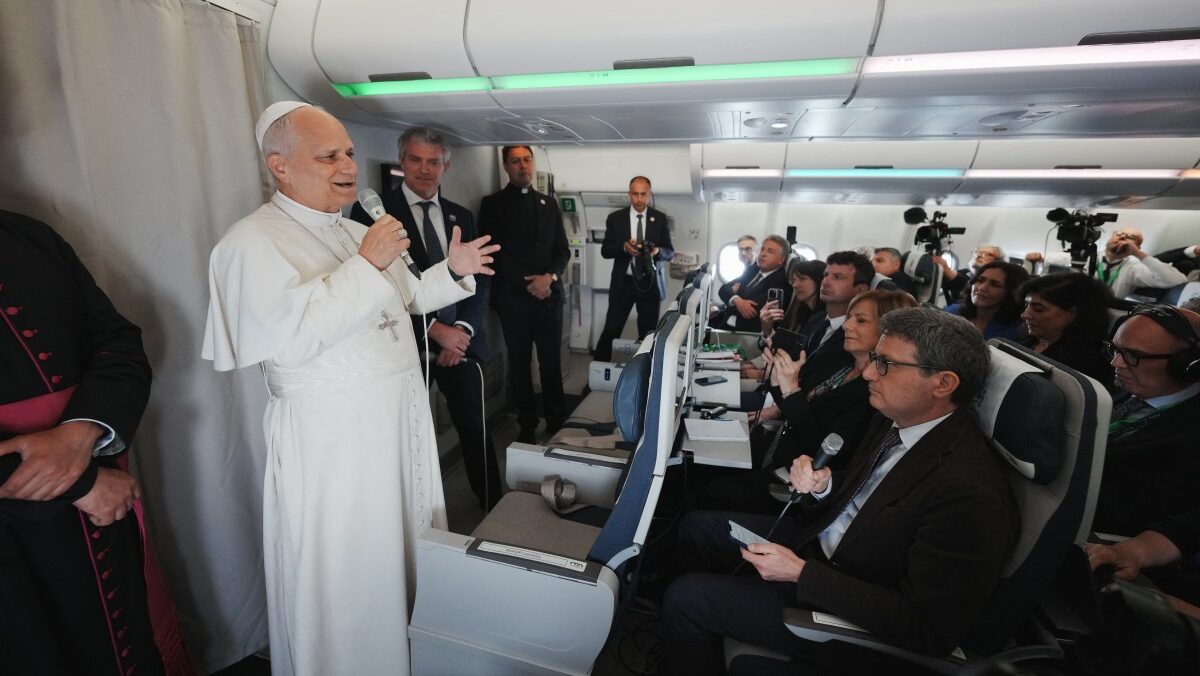
Pope Leo XIV speaks to journalists aboard the papal flight from Malabo to Rome, on April 23, 2026, at the end of his 11-day pastoral visit to Africa.
ANDREW MEDICHINI / POOL / AFP
At the end of a long tour of the African continent, Pope Leo XIV gave a press conference on the plane taking him back to Rome, emphasising the importance of national borders and controls regulating population movements to prevent the destabilisation of societies—a nuanced view, at odds with those who believe that the ‘universality’ of the Catholic Church must be accompanied by an unconditional welcome of the other.
Pope Leo spent around ten days on the African continent, undertaking a lengthy tour that took him to Algeria, Cameroon, Angola, and Equatorial Guinea. During his return flight on April 23, he outlined to journalists a vision of immigration that returns to the Catholic Church’s fundamental principles on the subject, contrasting with the positions defended by his predecessor, Pope Francis, who called on Western countries—Europe in particular—to throw their doors wide open to migrants to offer them, without any tangible quid pro quo, “a roof over their heads, a job, a school.”
The common-sense vision championed by Pope Leo rests on three main points. Leo XIV first recalled that countries have a legitimate right to maintain borders with access rules: the boundaries between states are not inherently bad, as the most extreme proponents of ‘openness to others’ might think. Far from presenting a one-sided view of the migration phenomenon, the pope pointed out that rich countries were not necessarily an El Dorado:
Everyone aspires to head north, but very often, the North has no solutions to offer them. Many suffer … The issue of human trafficking is also part of migration. Personally, I believe that a state has the right to impose rules at its borders.
Furthermore, the priority for rich countries—or “northern countries”—must not be to welcome migrants at any cost, but to assist southern countries so that people can live with dignity in their countries of origin without needing to migrate. Finally, the pontiff emphasised that countries receiving migrants must treat them in accordance with the principles of humanity. But this appeal to humanity comes last, as the final stage of a comprehensive approach that recognises there is much to be done, upstream, to prevent host countries from being overwhelmed without limit.
Pope Leo’s next scheduled trip is planned for Spain in June; there is no doubt that there, too, he will have the opportunity to reiterate the foundations of his vision of migration, which he wishes to be balanced.
During his discussion with journalists, the pope was led to address other sensitive current affairs. He reiterated that the Holy See was opposed to the formal blessing of same-sex couples and that the path recently taken by the German bishops in this direction could only cause “more disunity than unity.”
Without commenting on the balance of power in the current conflict between Israel and the United States on one side and Iran on the other, he reiterated that, as pastor of the Catholic Church, his position must be one of tirelessly promoting a “culture of peace.”