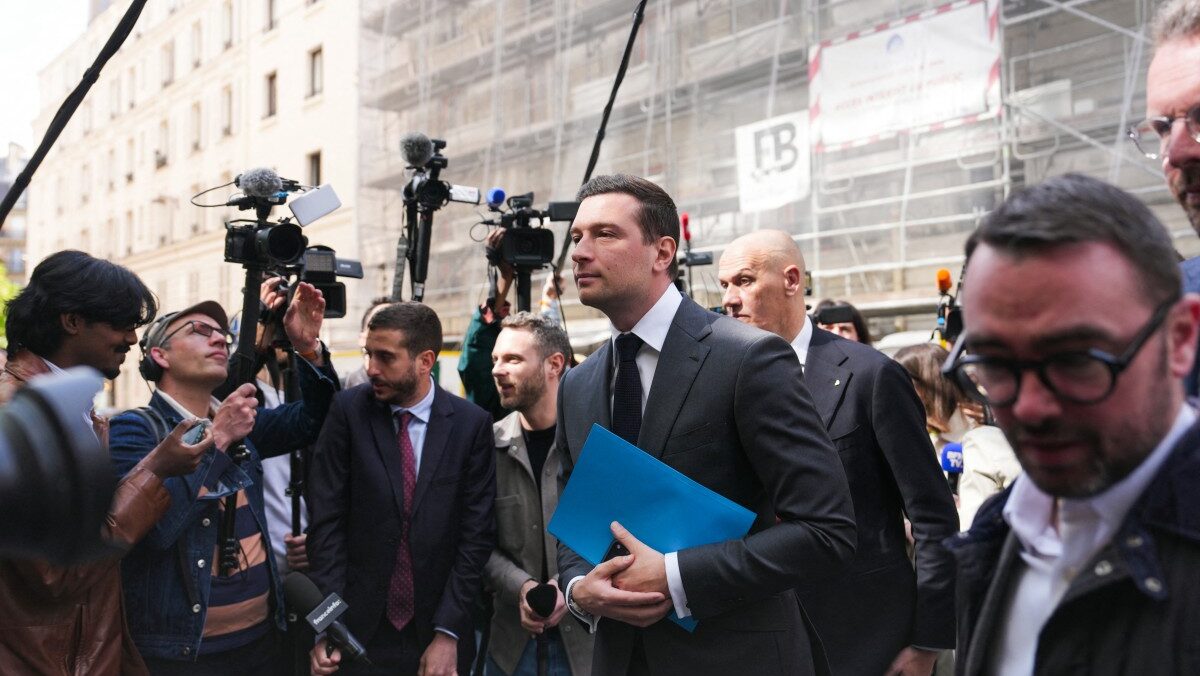
One of the biggest challenges Jordan Bardella must convincingly navigate if he is to definitively establish himself as a credible candidate for the presidential election is the economy. For years, the Rassemblement National (RN) has suffered from a poor reputation in this regard, being labelled a statist or socialist party that would scare off investors and entrepreneurs. Against this backdrop, a meeting with the MEDEF, France’s main employers’ organisation, was held in Paris on Monday, April 20.
Bardella is not receiving any special treatment in this regard. Traditionally, as major elections approach, MEDEF (Mouvement des Entreprises de France) takes the time to meet individually with all candidates to examine their platforms and assess the reforms to be expected in the event of a victory. Bardella was therefore invited to a lunch with MEDEF representatives, just days after an informal dinner between Marine Le Pen and several executives from CAC 40 companies on Tuesday, April 7th, in the name of “mutual curiosity.”
For the RN, this remains a delicate and somewhat nerve-wracking exercise, given the many preconceptions the business community holds about the party. However, in light of the poor results delivered over two terms by Emmanuel Macron—despite the promising pledges made regarding the French economy at the time of his election—the business world may now be more inclined to show greater openness to political alternatives.
The central issue revolves around the RN’s stance on economic liberalism: business leaders accuse the party of being overly interventionist and excessively statist and, therefore, in their view, “left-wing.” Opponents of the RN, including figures on the Right such as Éric Zemmour, are keen to perpetuate this label.
Bardella reaffirmed his commitment to “freedom of enterprise” before the business leaders: “I am not left-wing; I am not ashamed of business,” he explained. This is a recurring theme for the RN that has gained momentum since the lengthy series of debates preceding the budget vote: the party intends to present itself as resolutely liberal, in the classical and French sense of the term.
The meeting organised at MEDEF was accompanied by a letter addressed to business leaders and published simultaneously on X by Jordan Bardella and Marine Le Pen—with uncertainty still reigning, at least officially, over who will represent the party in the 2027 race. One of the central pillars of the economic programme consists of a vast simplification drive, aimed at freeing French businesses from the countless regulations that stifle them. The “simplification shock” was promised by Macron in his time but has still not been delivered.
In the preamble, the RN explains that it wants to involve business leaders in its “discussions aimed at identifying and removing the regulatory barriers that are holding back France’s economic development.” The details of the measures have yet to be announced, but their broad outlines are as follows: in the event of victory, implement the necessary simplifications by decree to ensure swift roll-out; limit the over-transposition of European regulations; and streamline administrative rules that hinder competitiveness and investment capacity. Several figures have been appointed to lead these meetings and discussions with business leaders: Alexandre Loubet (RN MP for Moselle), François Durvye (special adviser to the RN president, with a background in finance and close to the entrepreneur Pierre-Édouard Stérin) and Ambroise de Rancourt (chief of staff to Marine Le Pen).
The battle is not yet won, but contacts between the RN and the business world—which have long ignored one another—are becoming increasingly frequent. MEDEF denies any biased favouritism but explains that it wishes to approach the situation pragmatically and denies any promotional strategy. For Le Monde, this is a deliberate communication strategy accepted by both sides that contributes to the ‘de-demonisation’ of the RN: “As news of the leaked meeting spreads, business circles are taking to the press to denigrate their interlocutor, the RN is patting itself on the back for gaining access and for explaining its economic programme, and meetings continue to be arranged.”
On the Left and within the trade union movement, the bosses’ exchanges with the RN are making some people’s blood boil. The national secretary of the CFDT, one of the main trade unions, condemns the “cynicism” of business leaders who prioritise the economy above all else and care little for morality, thereby helping to turn the RN—the ultimate crime—into “a party like any other.”
The minister for the economy, Roland Lescure, also states that he wishes to keep his distance: “I don’t dine with the far right,” he told the press.
Several figures in the business world are seriously alarmed. One of them, Pascal Demurger, director of MAIF, one of France’s largest personal insurance groups, even wrote an opinion piece in Le Monde to condemn these repeated exchanges. The main risk, he argues, is that this could confer on the RN “respectability and technical credibility” capable of “accelerating its victory,” even though its rise to power would be “a disaster for France.”
These concerns might be taken seriously if the country were in a thriving economic situation that the RN’s rise to power would endanger. This is not the case, and we now know that Macron’s economic record in this regard is particularly disastrous.
On the Left, the issue of the RN’s rapprochement with big business is a sensitive one, likely to provoke a certain hysteria around the well-known historical theme: “It was the big bosses who enabled Hitler’s rise to power.” Johann Chapoutot, a historian of Nazism and professor at the Sorbonne—now an avowed far-left activist—has made this line of argument his stock-in-trade: “It was the authoritarian liberals who brought the Nazis to power,” he explained a few months ago in an interview with the communist newspaper L’Humanité.
Voters who, at the local level, tend to support the RN’s governance are certainly becoming less and less receptive to this sort of outlandish argument.