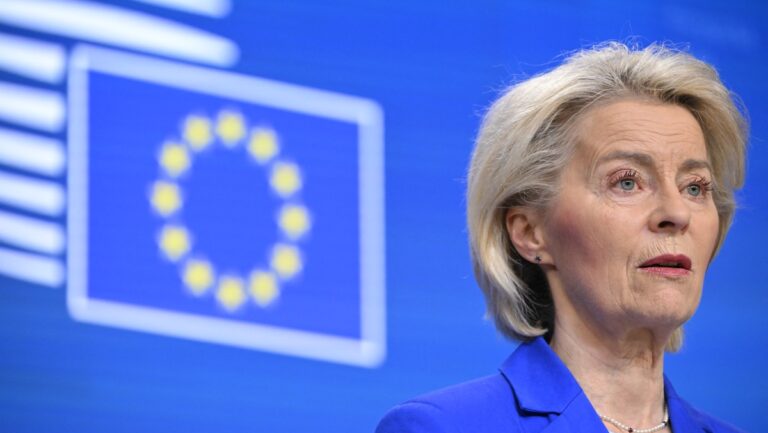
European Commission President Ursula von der Leyen delivers her speech during a debate on the new 2028-2034 Multi-annual Financial Framework at the European Parliament in Brussels on November 12, 2025.
Nicolas TUCAT / AFP
As debate intensifies over the next Multiannual Financial Framework (MFF), which will define the European Union’s spending priorities beyond 2027, political tensions are rising in Brussels.
The combination of massive funding for Ukraine, the possible use of new common debt mechanisms, and the restructuring of traditional budget lines is making the negotiations particularly sensitive.
In this context, Bernadett Petri, EU affairs expert and Hungarian ministerial commissioner responsible for direct EU funds, has issued a clear warning about the climate in which the new budget is being negotiated. “The lack of transparency has never been that high as it is currently,” she said, referring to the ongoing process. But it is not only a matter of transparency. Petri also warned about the pace of the negotiations: “The speed of the negotiations is also very worrying.” According to her, there is an evident intention to agree as quickly as possible. The reason? Fear of political shifts in several member states.
In her words, the EU “is trying to terminate the negotiation as fast as possible because they are afraid that in some countries, sovereign political forces will take over the power.”
She explicitly mentioned France, Germany, and Spain as countries where such a political shift could occur. If that happens, she warned, those governments might “just not accept what the initiative, what the condition has been on MFF.”
This political calculation adds a strategic dimension to the budget debate. The new MFF will not only determine figures but also long-term commitments in highly sensitive areas, including sustained financing for Ukraine.
The current budgetary framework ends in 2027, and many budget lines are already close to exhaustion. At the same time, financial and military support for Kyiv is emerging as a structural priority in the next cycle—so much so that it conditions much of the remaining debate.
Petri has pointed out that, according to the plans under discussion, the future budget could amount to around two trillion euros, with a substantial share already directed toward Ukraine through various instruments.
However, even that allocation would not fulfill all the promises made, opening the door to additional financing mechanisms.
The possibility of resorting once again to common debt is real. The EU is already carrying the burden of the Next Generation EU mechanism, whose debt servicing absorbs a significant portion of the budget. Expanding this approach would further increase the Union’s structural financial weight in the coming years.
THREAD
— The European Conservative (@EuroConOfficial) March 2, 2026
Petri Bernadett, EU expert and Hungarian Ministerial Commissioner responsible for direct EU funds, warns that the EU is considering new taxes at the community level, reopening the debate on subsidiarity and more powers for Brussels.
🧵 1/5 pic.twitter.com/Zg0O5dbgTN
Yet for Petri, the problem is not merely budgetary. It is also institutional and democratic. She argues that the room for genuine participation is increasingly limited: “There is really not too much room to maneuver for private or public organizations to come in because they are not doing enough consultation on this.”
By contrast, she noted that “obviously the big companies are already there,” even before the initiative was formally published. The result, in her view, is that “the real citizens cannot get their voices [heard]. They cannot really introduce their opinions, and they cannot really tell the EU what they are afraid [of].”
If the budget—which ultimately represents the material expression of the Union’s priorities—is perceived as the outcome of accelerated and insufficiently transparent negotiations, the political consequences could be significant.
The MFF is not a mere accounting instrument. It defines the balance between national contributions and own resources, between internal investment and external action, between common debt and budgetary discipline.
It also shapes the financing of competitiveness, innovation, and the internal market at a time of growing geopolitical pressure and global competition.
Petri’s remarks point precisely in that direction: the issue is not only how much money is allocated and to which headings, but also how decisions are made, under what level of debate, and according to which strategic premises.