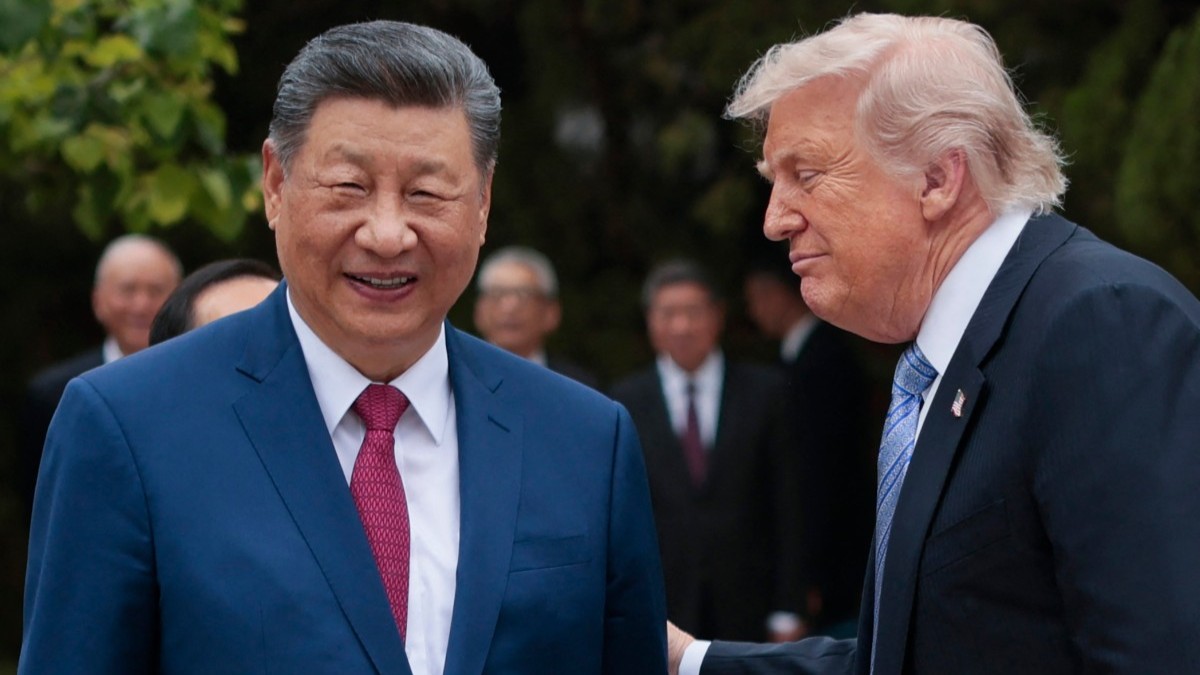
U.S. President Donald Trump (R) and China’s President Xi Jinping seen after Trump’s visit to Zhongnanhai Garden in Beijing on May 15, 2026.
EVAN VUCCI / POOL / AFP
In Brussels, the main concern surrounding the summit between Donald Trump and Xi Jinping is not Taiwan or Iran. The fear is that the United States and China could use strategic raw materials and market access to redefine part of their bilateral relationship while leaving the European Union out of the equation.
The concern is real. Although the summit has not yet produced formal agreements or concrete announcements, previous talks and preparatory contacts have already made clear where the real core of the negotiations lies: rare earths, tariffs, technology exports, artificial intelligence, and industrial market access.
Xi opened the meeting by warning about Taiwan and cautioning against the risk of confrontation between the two powers. Trump, by contrast, once again adopted a conciliatory tone and praised the Chinese president.
China maintains a dominant position in rare earths and materials essential for batteries, semiconductors, the technology industry, and defense systems. The United States is seeking to reduce its vulnerabilities and secure stable access to those resources.
European fears are focused on Washington obtaining guarantees on critical minerals and preferential access to certain industrial supply chains while Beijing secures trade relief or economic advantages in other sectors.
If this bilateral balance advances, Brussels risks finding itself facing rules negotiated by others and simply applied later on European territory.
The European Union has spent years talking about strategic autonomy, industrial sovereignty, and reducing dependencies. Yet, despite the ambitious rhetoric, Europe still depends on the United States for much of its security and continues to rely on China in critical industrial sectors. In Brussels, declarations often arrive before capabilities, and then positions have to be corrected afterward.
The EU–China relationship itself reflects those limitations. The latest bilateral summit produced barely any meaningful progress, while the European Commission has intensified investigations into Chinese industrial subsidies and “de-risking” measures aimed at reducing dependency risks.
There is also another parallel concern: the diversion effect. If Washington succeeds in stabilizing part of its economic relationship with Beijing while maintaining selective restrictions, a significant share of Chinese production could seek an outlet in the European market.
Brussels has been warning for months about that risk: products no longer entering the United States ending up placing even more pressure on already weakened European industries.