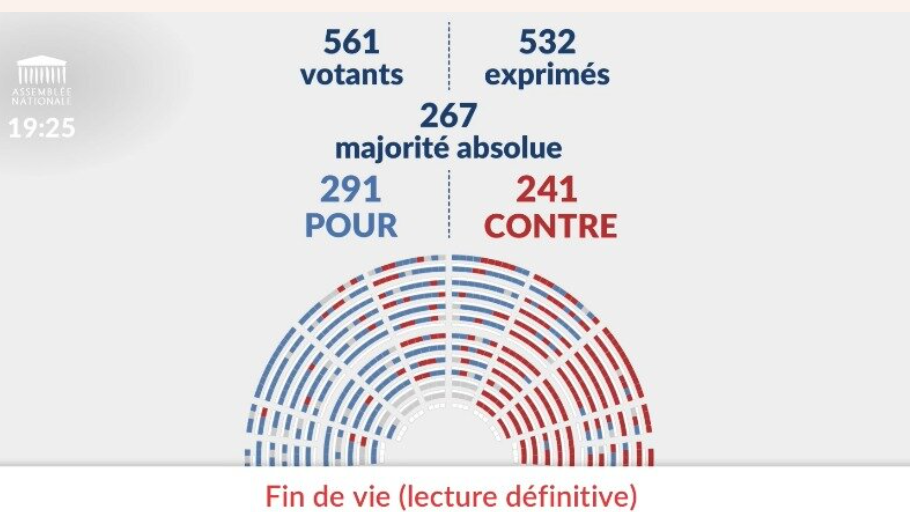
The result of the final vote on the euthanasia bill in the French National Assembly
Courtesy of Généthique
Emmanuel Macron will be able to boast of having fulfilled one of his campaign promises with the passage of the assisted suicide bill, which was set for a final vote in the National Assembly on July 15th.
The National Assembly adopted the “right to assisted dying” in its final reading by a vote of 291 in favour to 241 against. The bill had been adopted by a vote of 295 in favour to 232 against in a new reading on June 30th.
On the right, the bill was overwhelmingly rejected by lawmakers. In the Rassemblement National (RN), only 12 lawmakers voted in favour, while 106 voted against. Among Les Républicains, there were 5 supporters of the bill compared to 41 opponents. The allied group, the Union of the Rights for the Republic (UDR), rejected it in its entirety.
After several months of debate, lawmakers restored their original version of the bill, rejecting the Senate’s amendments intended to strengthen safeguards. Believing that no compromise was possible, senators had chosen to reject the bill without initiating another round of parliamentary back-and-forth.
Opponents denounce the law as one that will make France one of the most permissive countries in the world regarding euthanasia. Grégor Puppinck, of the European Center for Law and Justice, lists 27 provisions that are extremely concerning. A single doctor can decide on the entire procedure, with no requirement for a written request or witnesses; the doctor may meet the patient for the first time on the very day of the request, consult two people of his or her choice without them examining the patient, and then authorize euthanasia within a timeframe that can be reduced to three days. People under legal guardianship are not excluded; family members are not informed before death and have no recourse.
Religiously affiliated healthcare institutions are particularly concerned about the absence of an institutional conscience clause, which could compel them to perform euthanasia or to abandon their mission. This issue has led Senate President Gérard Larcher to announce that he will refer the matter to the Constitutional Council if the law is passed. He believes the bill raises serious questions regarding respect for human dignity, the right to life, equality before the law, and the protection of vulnerable individuals. Such a referral—an extremely rare move—would suspend the law’s entry into force until the Constitutional Council issues its decision.
Prime Minister Sébastien Lecornu, who personally opposed the bill, chose not to halt the legislative process—even though he had the power to do so—much to the dismay of opponents of this deadly law. But in a final attempt to resist, he announced in a press release on July 14th—France’s National Day—his intention to also refer the most controversial provisions of the bill to the Constitutional Council: the cooling-off period, the lack of protection for vulnerable individuals, and the collective conscience clause.
In the final stretch, several members of parliament across the political spectrum expressed their doubts and dismay. Some, who had voted in favour of legalizing euthanasia during the first or second reading, came to consider abstaining or voting against the bill in this final vote, aware of the gravity of the stakes and the dangerous nature of the anthropological shift that is taking shape. About ten of them ultimately switched to the “no” camp, but it was not enough to stop the bill from passing.