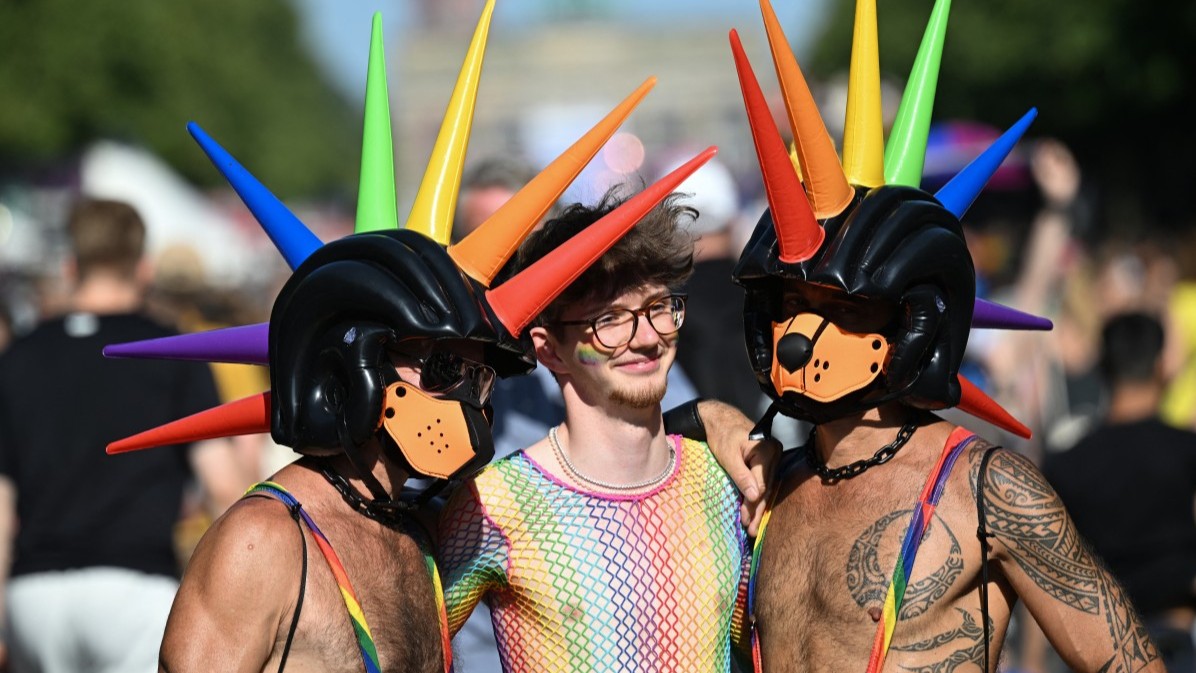
Participants of the Christopher Street Day (CSD) parade in Berlin on July 25, 2026
RALF HIRSCHBERGER / AFP
Four days after the attack on Berlin’s Christopher Street Day LGBT parade, the debate in Germany is moving away from empirical reality and descending into ideological demagoguery.
Queer Commissioner of the Berlin State Government, Social Democrat Alfonso Pantisano, has placed the “far right” and the Christian Democratic Union (CDU) at the centre of his criticism.
The ramming attack took place on the night of Saturday, July 25th, in Tiergarten park, near the LGBT Pride celebrations. The attacker drove a van into a group of people and then attacked them with a bladed weapon. A Polish woman in her sixties was killed, and another 29 people were injured.
The suspect, Abdul Ballout, was a 21-year-old German citizen of Lebanese origin. He was not a neo-Nazi, nor did he belong to a far-right organisation.
The authorities found a video on his phone in which a masked individual, identified by investigators as Ballout himself, pledged allegiance to Islamic State.
The young man had been convicted in May of preparing a serious act of violence against the state and was free under supervision. He was shot dead by police the day after the attack.
During an interview on July 28th with Democracy Now!, Pantisano acknowledged that there is a “huge problem” with Islamist organisations such as Islamic State. However, he immediately shifted the discussion towards the reaction of the German right.
According to the official appointed by Berlin’s regional government, the “far right” had been “waiting for an attack like this” to portray foreigners as the problem. He also compared his political opponents to birds approaching the carcass of an animal to tear it apart and feed on it.
Berlin's Queer Commissioner:
— End Wokeness (@EndWokeness) July 28, 2026
The real issue is the far-right, even if they do not mow us down pic.twitter.com/AFvTkoAhAU
The commissioner admitted that those parties might not take to the streets in a van to kill large numbers of people, as the attacker did. Even so, he argued that homophobia in Germany is being fuelled by the rhetoric of democratic parties such as the CDU. Pantisano cited Chancellor Friedrich Merz’s refusal to fly the rainbow flag over the Reichstag during Pride and his remark that the German parliament is not a “circus tent.” In his view, such statements promote hatred and insecurity within the LGBT community. There was no mention of Islam.
His analysis could hardly be further removed from reality.
Political criticism, however harsh some may consider it, is not equivalent to a van being used as a weapon or to a declaration of allegiance to the Islamic State.
Pantisano’s communications strategy consists of transforming an Islamist attack against people taking part in Pride into an accusation against those who point precisely to its Islamist component. The attacker was not motivated by CDU rhetoric. Nor did he attack in the name of Friedrich Merz. According to the evidence known so far, he acted in the name of Islamic State.