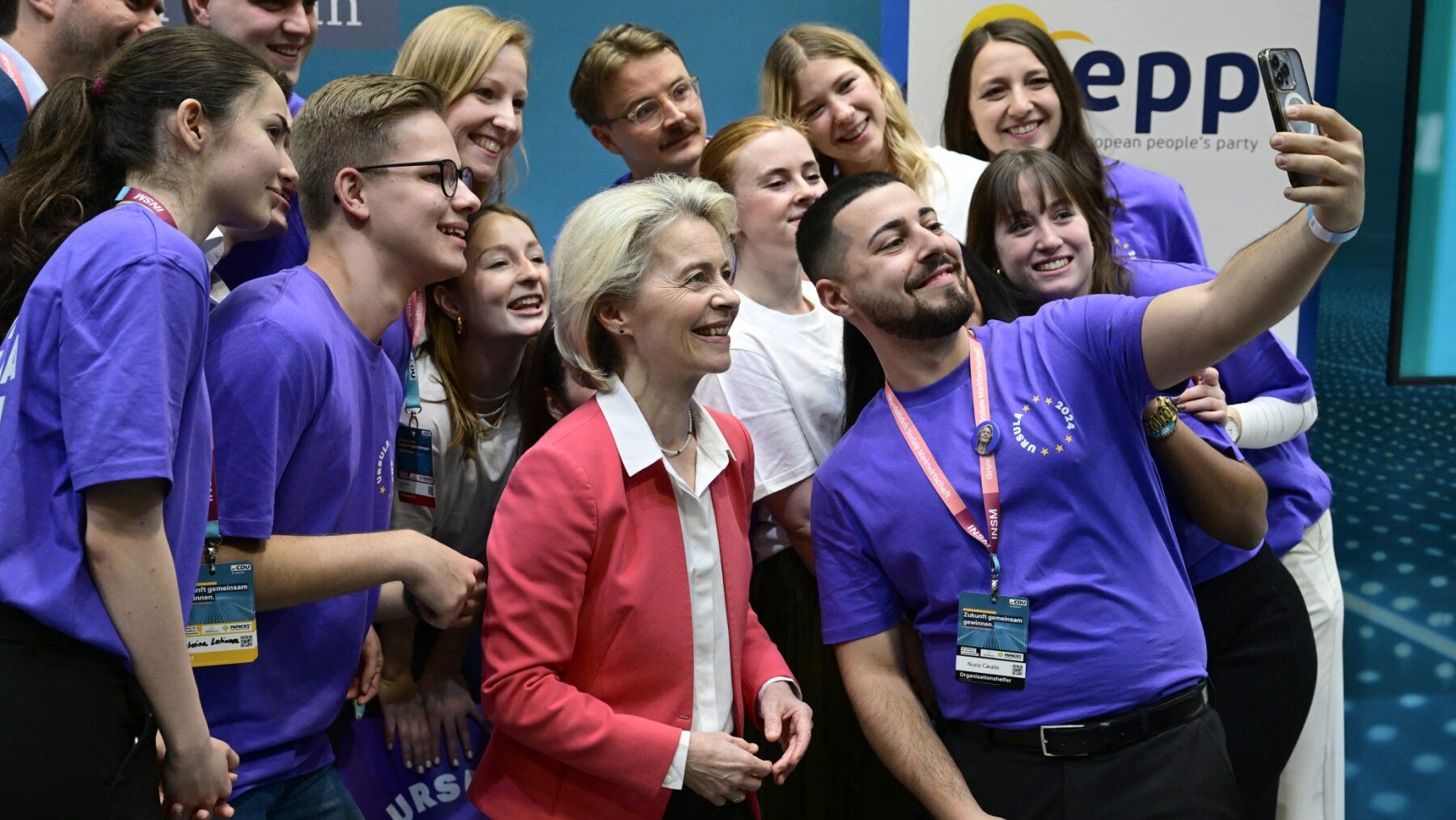
Ursula von der Leyen (C) has a selfie shot in 2024
JOHN MACDOUGALL / AFP
The European Union has come under fire after new guidance revealed that social media influencers invited to cover high-level EU meetings in Brussels must not have publicly expressed views that run contrary to the bloc’s “EU values.”—i.e., its progressive, left-wing agenda.
According to guidance circulated by the Council of the European Union and reported by Politico, member states will be able to nominate influencers to attend and create content during EU leaders’ summits and certain ministerial meetings from July onwards.
However, national governments have been instructed not to select applicants who have “published views against EU values.”
The initiative forms part of an effort to broaden public engagement with EU institutions through platforms such as YouTube, TikTok, and Instagram.
Those selected for the scheme must have a significant audience in their home country and a track record of producing content related to politics and European affairs. They must also be free from major commercial partnerships and cannot be seeking or holding political office.
The guidance immediately drew criticism from nationalist and Eurosceptic politicians.
Gerolf Annemans, an MEP for the Belgian nationalist party Vlaams Belang, reacted sarcastically to the reports, writing on social media: “I would go even further: nothing should be allowed to be questioned.”
Ik zou zelfs meer zeggen : er mag niéts in twijfel worden getrokken.
— Gerolf Annemans (@gannemans) June 25, 2026
Lucas Hartong, a former Dutch MEP for the Party for Freedom (PVV), also criticised the policy. Referring to the guidance, he wrote that “the EU and genuine democracy don’t exactly go hand in hand.”
The Sweden Democrats party similarly condemned the scheme, saying that “the EU elite is becoming increasingly desperate,” highlighting the guidance on excluding influencers whose views are deemed incompatible with EU values.
The policy reflects a broader tendency within EU institutions to marginalise conservative and anti-establishment voices while promoting left-wing ideology and calling it “European values”—even though EU citizens have not signed up to it.
The proposed programme would mean that Brussels would once again be favouring individuals and organisations who are broadly supportive and not at all critical of the EU as a whole, in order to put leftist Brussels institutions in a more positive light.