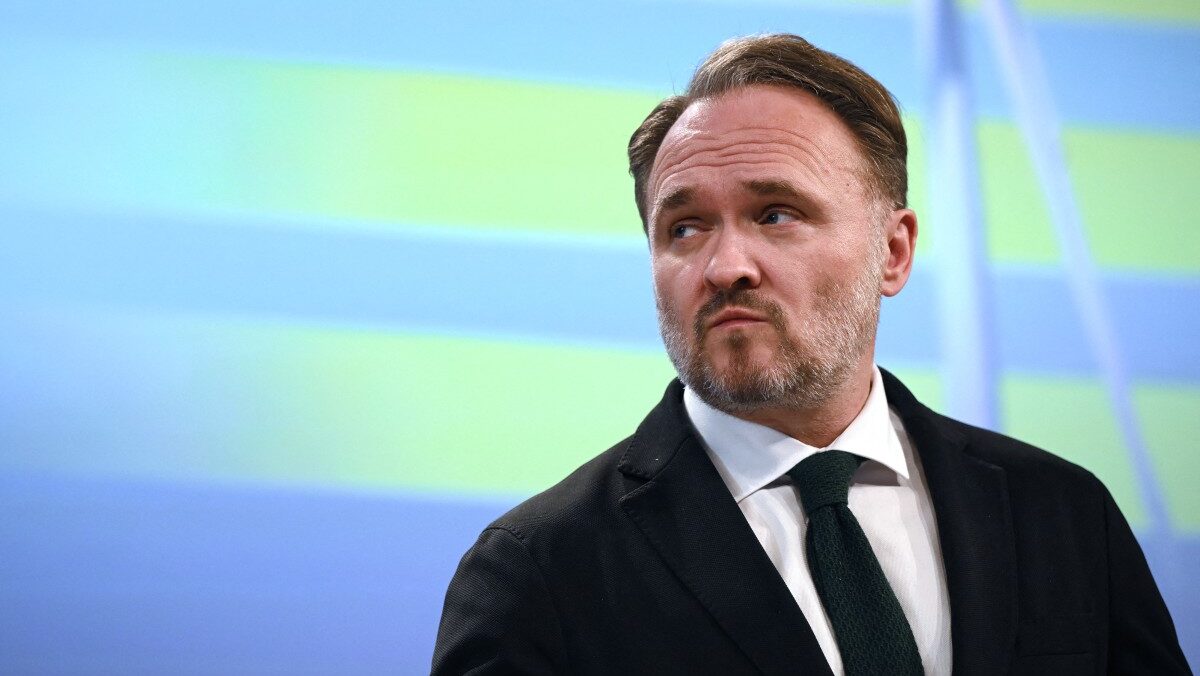
EU Energy Commissioner Dan Jørgensen at a Brussels press conference, October 16, 2025.
Nicolas TUCAT / AFP
Brussels is quietly preparing Europeans for life with less travel, lower speeds, and fewer flights as war in the Middle East threatens to choke global energy supplies.
Remote work where possible, lower motorway speed limits, fewer flights, more public transport, and voluntary limits on private car use in large cities are among the measures now being discussed. The language remains technical, but the direction is clear: coordinated reductions in fuel consumption.
In a letter sent to European capitals on Tuesday, March 31, European Commissioner for Energy Dan Jørgensen urged governments to prepare such measures if the war between the United States, Israel, and Iran continues and the Strait of Hormuz remains effectively blocked.
The recommendations include working from home where possible, reducing speed limits by at least 10 km/h, and discouraging air travel when rail alternatives exist. Measures once associated with climate policy are now being reframed as matters of energy security.
The Commission maintains there is no immediate supply shortage, while warning of a “potentially prolonged disruption” to global energy trade.
The risk stems from the Gulf. More than 20% of the world’s oil and a significant share of liquefied natural gas pass through the Strait of Hormuz. Although the EU imports relatively little crude directly from Iran, it remains exposed to global markets and to refined fuel flows from the region. A large share of Europe’s diesel and jet fuel imports originates in the Gulf.
Markets have already reacted. Since the start of the conflict, Brent crude has risen by more than 50%, climbing above $100 a barrel with spikes beyond $118. European gas prices have also surged sharply. In the first month alone, the EU’s energy bill increased by an estimated €14 billion.
For households, the impact is visible in rising fuel and transport costs. In the United Kingdom, filling an average diesel car now exceeds £100, with prices across major European economies approaching levels last seen after Russia’s invasion of Ukraine.
Higher transport costs are feeding into consumer prices. Food and basic goods are becoming more expensive as distribution costs rise, with eurozone food inflation ticking up again in March.
Policy responses under consideration draw on earlier crisis playbooks. An International Energy Agency framework referenced by Brussels includes measures such as car sharing, reduced speed limits, and limiting non-essential travel. More stringent options—price caps, windfall taxes on energy companies, and targeted public support—are also being discussed if conditions worsen.
The broader concern is macroeconomic. European Economy Commissioner Valdis Dombrovskis has warned inflation could exceed 3% this year, with growth weakening if the conflict persists. In such a scenario, the eurozone risks sliding towards stagflation.
Europe also enters this period with less room to manoeuvre than in 2022. Gas storage levels remain relatively low, and parts of the economy have yet to fully recover from the previous energy shock. At the same time, the EU continues to rule out Russia as a reliable supplier, despite existing infrastructure.