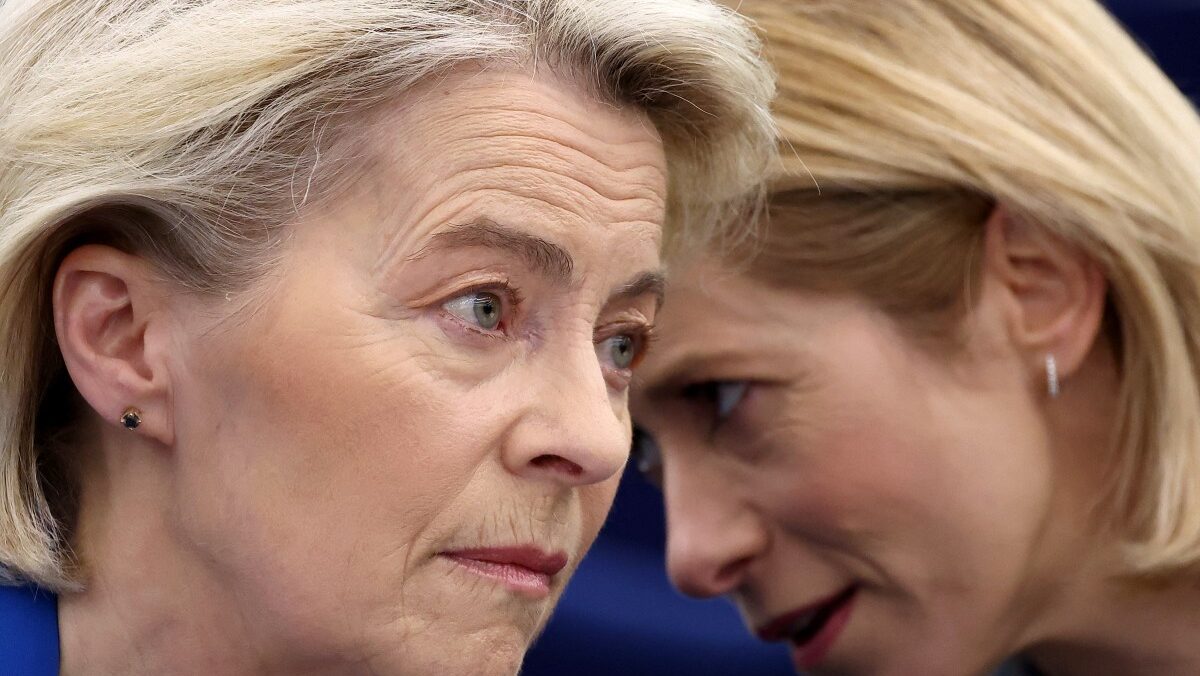
European Commission president Ursula von der Leyen (L) speaks with EU foreign policy chief Kaja Kallas
FREDERICK FLORIN / AFP
The planned departure of Belén Martínez Carbonell from a key role in the EU’s diplomatic service is not just a staff change. It could shift who really controls Europe’s foreign policy.
Carbonell, appointed in February 2025 by Kaja Kallas, the EU’s top foreign policy official, is expected to leave after little more than a year in the job, possibly for a post in Latin America. As secretary-general of the EU’s foreign service, she was in charge of how it actually runs—overseeing staff, budgets, and embassies around the world. In simple terms, she helped keep EU foreign policy working day to day.
Her exit comes at a difficult time. The EU is dealing with the war in Ukraine, tensions in the Middle East, sanctions on Russia, and rising global competition. But while the workload has grown, the system has not. The EU’s diplomatic arm is being asked to do more without the structure or resources of a full national foreign ministry.
At the same time, a quiet power struggle is underway in Brussels—between Kallas and Commission president Ursula von der Leyen.
Kallas has tried to strengthen the EU’s diplomatic service so it can act more independently. One sign of this was her attempt to bring back Martin Selmayr, a powerful Brussels insider, into a senior role. The idea was to install someone strong enough to push back against the European Commission’s growing influence over foreign policy.
That plan was blocked. Von der Leyen’s team did not want a competing centre of power. In recent years, the Commission has taken a bigger role in areas like sanctions, defence policy, and relations with other countries—areas that were supposed to be shared with, or led by, the diplomatic service. The rules have not formally changed, but in practice, the Commission is taking the lead more often.
Carbonell helped hold this system together. She worked between the Commission, the diplomatic service, and EU countries, smoothing over tensions and keeping things functioning. Without her, those internal rivalries are likely to become more visible.
Who replaces her will matter. If Kallas gets her choice, the diplomatic service may regain some control. If the Commission shapes the decision, it will tighten its grip even further. And if EU countries settle on a compromise candidate, the power struggle will continue—leaving Europe’s foreign policy more centralised, but still lacking clear leadership.