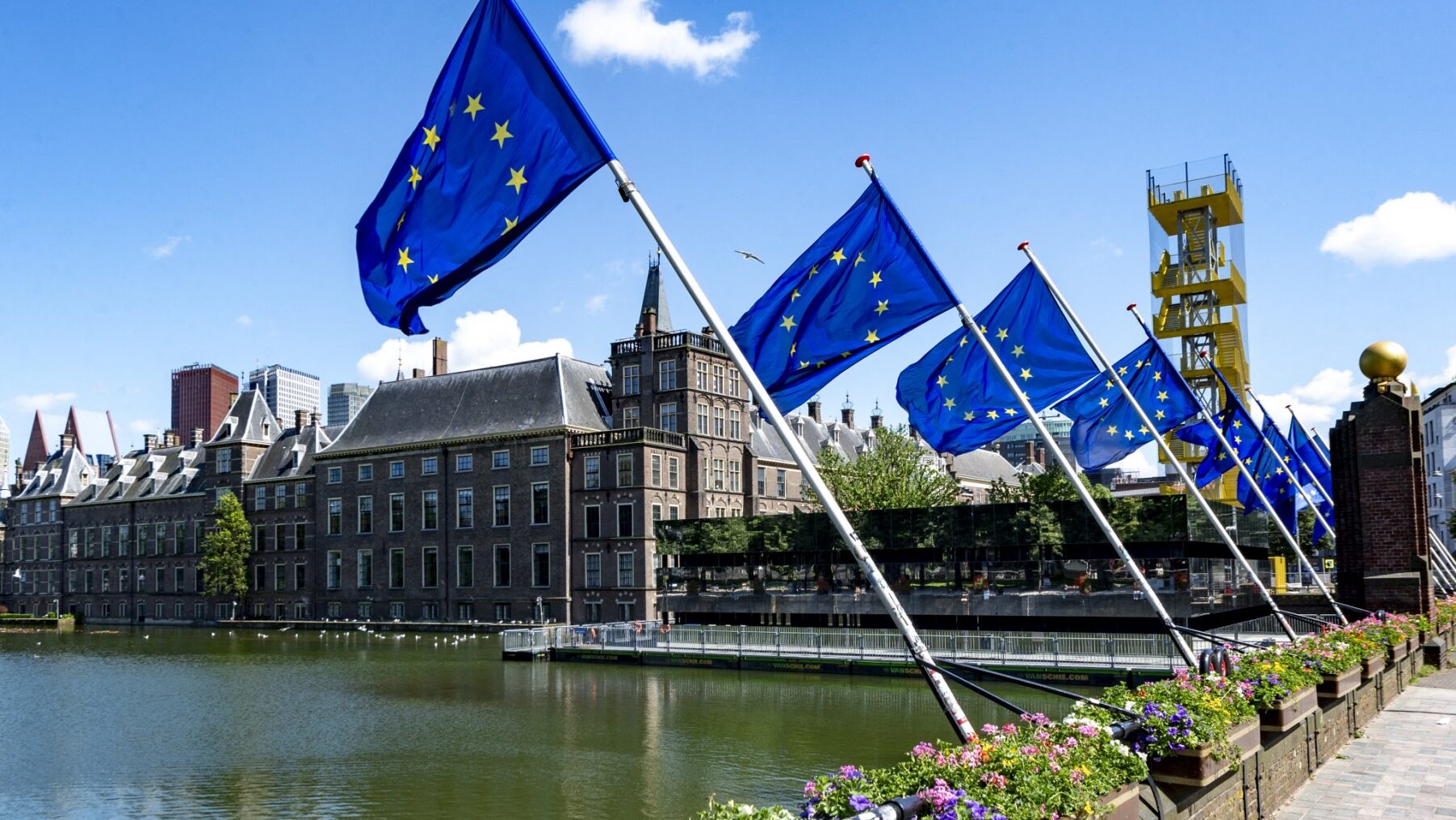
European flags are displayed in The Hague
Nick Gammon / AFP
The Dutch Immigration Service (IND) has just poured cold water on those who believed in the EU narrative that the new Migration Pact, set to come into force later this week, will solve most of Europe’s migration problems.
In a recent interview with the Telegraaf, Rhodia Maas, director of the Dutch Immigration Service (IND), explained that while the Pact introduces more streamlined border procedures, tries to limit secondary movements between Schengen countries, and allows for more flexible deportation policies, this does not mean things will noticeably change.
The Pact also makes applying for asylum in the EU more straightforward, opens new legal immigration pathways, removes member states’ ability to classify countries of origin as “safe” (and therefore suitable for returns), and even redistributes a set number of migrants across the EU member states from frontline countries every year under a mandatory quota system.
This means that ultimately, the number of refugees arriving in Europe and the Netherlands is “totally dependent on the situation in their country of origin” and the wider geopolitical situation, Maas explained.
The director added that it will take around a year to fully implement the Migration Pact in the Netherlands, which already deals with a massive backlog of asylum procedures.
Over 50,000 asylum seekers were waiting in bureaucratic limbo by the end of 2025, and more than half of them had been in the country for over a year, many for three or more. By the end of the year, the average waiting time had risen to 67 weeks, or close to 1.3 years.
According to the IND, implementing the Pact will require officials to prioritize new arrivals, potentially extending waiting times for thousands of asylum seekers whose cases are already pending.
Dutch Migration Minister Bart van den Brink has directed the IND to limit the delay to three years in an effort to bring down the massive reparation payments the country hands out to migrants every year for failing to process their claims in time.
Just last year, the Netherlands handed out a record amount of €79 million to migrants in late asylum processing penalties. That’s twice as much as just one year earlier (€36.8 million) and an over six-fold increase compared with €11 million in 2023.
The rising costs have become a major political issue in the Netherlands, with critics arguing that taxpayers are bearing an increasing financial burden.
They are not only responsible for housing, clothing, and feeding asylum seekers for years while they live in refugee centers, but the government also awards them thousands of euros from their money just for not being quick enough with the paperwork. And with the processing deadlines significantly shortened under the new Migration Pact, late processing penalties are expected to grow even more in the coming period.
Perhaps this is one of the reasons the Dutch are currently at the forefront of a new citizen-led initiative demanding a radically new approach to migration, called the Save Europe Act (SEA). In less than three weeks, the initiative collected over 285,000 signatures out of the one million needed for the EU Commission to consider it, with the Netherlands topping the chart with 50 thousand signatures alone.
If successful, the Save Europe Act will demand that the Commission give back control to member states over border management and deportation issues, ending economic incentives driving illegal migration, as well as a temporary halt on all non-Western immigration to Europe until social and cultural concerns are addressed.