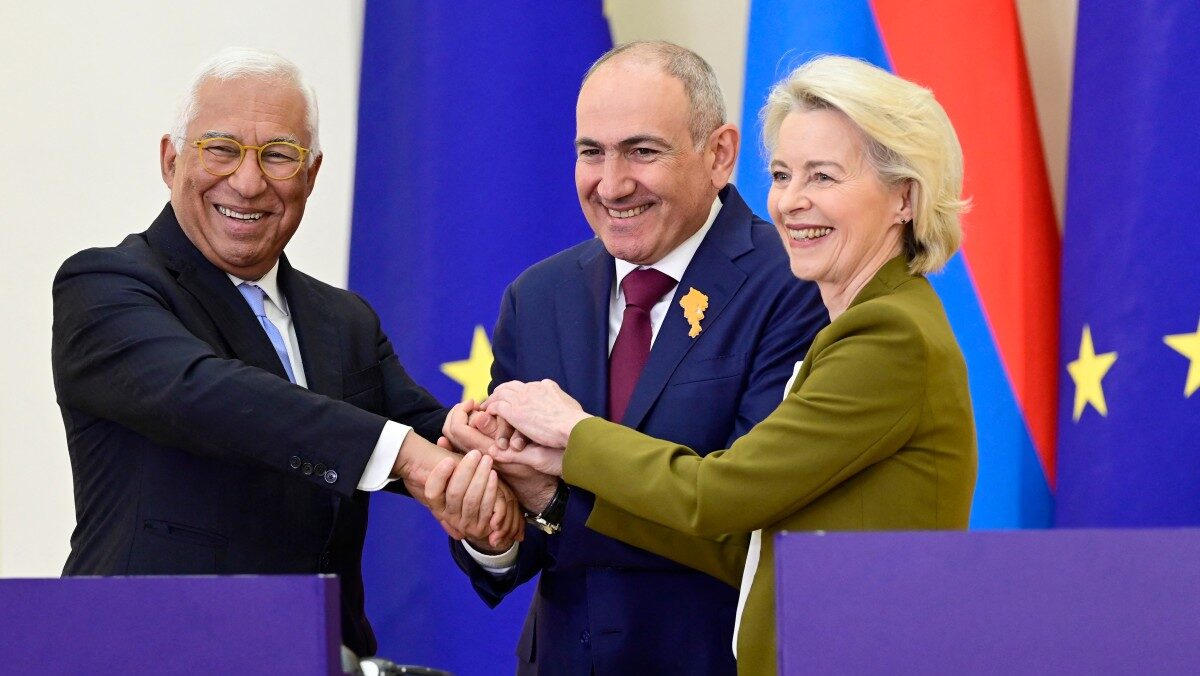
Armenia’s PM Nikol Pashinyan with von der Leyen and Costa at the EU summit in Yerevan, May 5, 2026.
KAREN MINASYAN / AFP
The EU is betting €2.5 billion on Armenia as part of a wider push to move trade and energy into Europe without relying on Russia. At a summit in Yerevan this week, Brussels made clear it sees the country as a new potential transit corridor.
The timing matters. The war in Ukraine has disrupted trade routes that used to pass through Russia. Attacks in the Red Sea have also made shipping between Asia and Europe slower and more expensive. As a result, Brussels is looking for new routes it can depend on.
Armenia is now part of that plan.
The European Commission has included the country in its Global Gateway programme, with around €2.5 billion in planned investment. The money will go into transport links, energy networks, and digital infrastructure. For a small, landlocked country, that is a major commitment.
The EU is not interested in what Armenia produces but in what can pass through it: goods and energy moving along the Middle Corridor—a route linking China and Central Asia to Europe while avoiding Russian territory.
But there is a trade-off. In trying to reduce its reliance on Russia, Europe risks increasing its reliance on other powers, including China.
Trade between the EU and Armenia has already been growing, with the bloc accounting for around 12–13% of Armenia’s trade. New agreements on border control, energy, and digital systems show that closer ties are forming. In simple terms, Brussels is offering investment in return for political alignment.
Armenia, for its part, is starting to move away from Russia. Moscow’s weak response during recent clashes with Azerbaijan has damaged trust between the two countries. Yerevan is now looking to the EU and the United States for support, while also exploring links with countries like India and Iran.
But there are clear limits to how far this can go.
Armenia is still part of the Russian-led Eurasian Economic Union, which restricts its trade options. Much of its trade depends on Georgia, its main route to the Black Sea. And its long-running tensions with Azerbaijan and Turkey remain unresolved, despite some recent signs of progress.
Other countries in the region are also competing for influence. Russia is losing ground but is still present. Azerbaijan and Turkey are pushing to become the main energy routes to Europe. Iran could offer an alternative route, but working with it would create political problems for the EU.
Even small steps forward are uncertain. The recent restart of rail transport for energy between Azerbaijan and Armenia would have been unthinkable a few years ago. But it depends on fragile political agreements.
For now, this new corridor exists more on paper than in reality. Armenia’s location makes it useful but also difficult: the terrain is challenging, infrastructure is limited, and key decisions are often made outside the country.
The EU seems aware of this. Armenia is not a solution on its own but part of a wider strategy. The goal is simple: build more routes, rely less on any single country, and reduce risk.
Whether that works will depend on a region that Brussels does not control—and cannot stabilise.