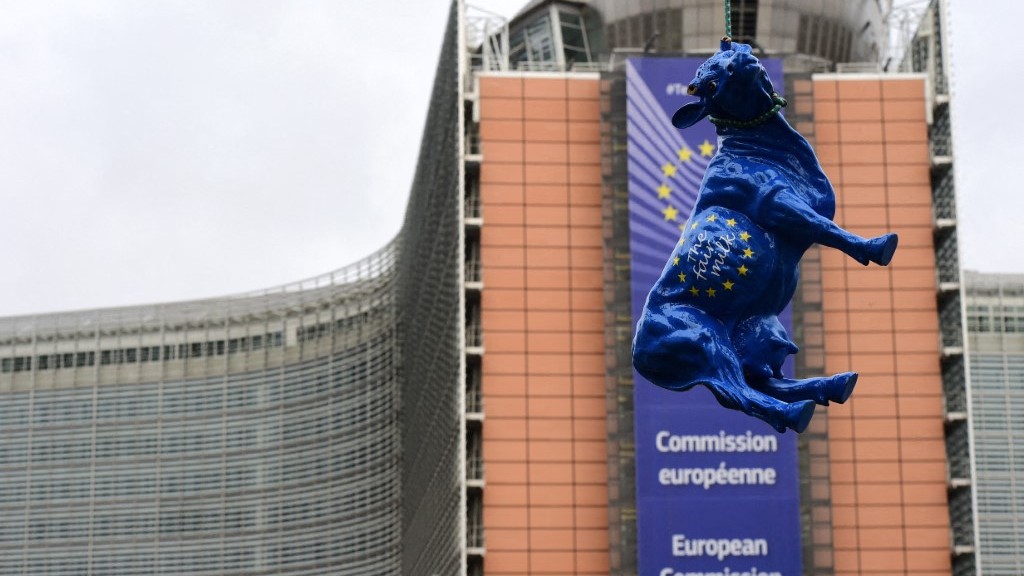
The statue of a cow painted with the European flag colours and with a writing reading “The fair milk” is hung in front of the European Commission building during a farmers demonstration on September 7, 2015, in Brussels.
EMMANUEL DUNAND / AFP
It’s no secret that Europe’s farmers have been in an open war with the European Commission for years, periodically blockading Brussels and other capitals with their tractors to protest the EU’s harmful climate and trade policies that have been killing agriculture and, especially, livestock farming.
But despite its flashy buildings repeatedly being sprayed with manure, the Commission maintained its position that cows are mainly a source of CO2 emissions to be reduced. Until now.
The EU’s new livestock strategy, unveiled in Strasbourg, suddenly forgot that animal farming used to be a problem to solve, and instead treats the sector as critical infrastructure that’s vital to preserving the bloc’s “strategic autonomy.”
“Livestock is not only about agriculture,” Executive Commission VP Raffaele Fitto explained during Tuesday’s press conference. “It is about competitiveness, it is about food security, […] and it is about Europe’s future.”
Agriculture Commissioner Cristophe Hansen—who last year was still trying to defend the reduction of agricultural funds in the EU budget by 25% across the board—offered a bit more insight as to why this sudden shift is happening now.
According to Hansen, the EU’s livestock sector (supporting 7 million jobs and generating €400 billion annually) has been in decline for years and is now “at risk,” with the growing volume of empty farmland increasingly becoming “a security liability.” Without an immediate investment of €18 billion that the sector cannot raise alone, livestock farming—along with Europe’s long-term food security—cannot recover.
The only thing Hansen and Fitto failed to mention is that it was the EU’s very policies that drove livestock farming into the ground.
Aggressive emission reduction directives drawn up in Brussels led to member states increasing taxes, appropriating lands, and even considering the mass culling of herds—up to a third of all cows across the bloc—just to meet climate targets. Hundreds of generational farms from the Netherlands to Ireland were forced to close up shop to escape the inevitable bankruptcy.
Well, better late than never, they say. Suddenly, the EU realized its mistake and, listening to agri-scientists, finally made a distinction in methane—which dissipates from the environment within a decade—and industrial CO2, which lingers for centuries.
But while cows have now become strategic assets that need to be defended, the problem is that the unrealistic EU climate targets are still in place, and there’s no clear strategy for how to achieve them without touching agriculture as well.
The Commission’s own climate advisory board still believes that optimizing technology won’t cut it alone, and maintains its recommendations to reduce livestock numbers, encourage Europeans to take up a more plant-based diet, ramp up taxes on farm emissions, and further cut EU subsidies for farmers.
Surprisingly, the Commission opted to go the opposite way, and instead of discouraging meat consumption, it has launched a bloc-wide campaign to promote eating meat, as long as it’s made in Europe.
The only question now is whether this shift happened way too late, and the damage Brussels caused could still be repaired.