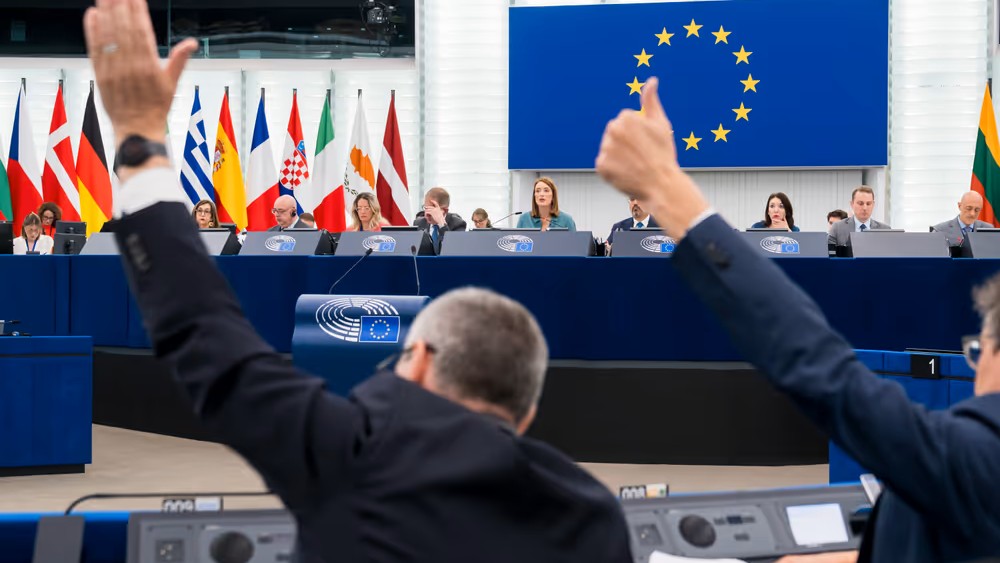
A scene from the voting session of the EP Plenary session in Strasbourg on April 29, 2026
Daina Le Lardic / European Union 2026 – Source: EP
The mainstream majority in the European Parliament increased its pressure on the institution’s leadership, calling for disciplinary action against the national conservative Patriots for Europe (PfE) group over unproven allegations of embezzlement linked to the disbanded Identity and Democracy (ID) group, treated as the Patriots’ predecessor.
The move is largely seen as a politically motivated effort that aims to discredit and neutralize the third biggest group in the European Parliament and the primary opposition force to the center-left ‘Ursula-coalition’ currently calling the shots. If successful, they could even strip the Patriots of vital operational funding in Brussels that their members and staff depend on.
Not only are the Patriots disputing both allegations—wrongdoing by ID and that there’s a legal continuity between ID and PfE—but even the most basic rule of law is being thrown out of the window here: the presumption of innocence before proven otherwise.
In the resolution adopted by the plenary on Wednesday, April 29th, with 441 votes in favor and 131 against, the EP is urging the Parliament’s administration to take “all the necessary measures” against the Patriots without waiting for the conclusion of the ongoing investigation of the European Public Prosecutor’s Office (EPPO).
The resolution, authored by liberal MEP Gerben-Jan Gerbrandy (Renew), even has the audacity to argue that “criminal proceedings should not be automatically used as a generalised justification for possible inaction.” Translation: who needs evidence when we can just punish whoever and whenever we want?
The whole scandal has been ongoing since last summer, when the Parliament’s financial services alleged that the ID group misused over €4.3 million, which might have been wrongly spent on staffers and activities not directly linked to Brussels between 2019 and 2024. Similar allegations were used in France to bar presidential frontrunner Marine Le Pen (RN/PfE) from participating in the 2027 race.
A subsequent political report drawn up in the EP’s budgetary control committee by a member of von der Leyen’s EPP group then linked this allegation to the Patriots, claiming that the PfE must be considered “the substantive economic continuation” of ID, and therefore responsible for paying back the money or risk having its own funds suspended.
In several statements, the Patriots denied any wrongdoing and called the attempts to link the group to any financial responsibilities of an entirely different legal entity unacceptable. “Financial oversight must be conducted objectively and in full accordance with the European Parliament’s rules—not selectively applied for political purposes,” one of PfE’s statements reads.
The group argued against treating the PfE as the legal continuation of ID by pointing out that only 5 of its 14 delegations had ever belonged to the latter, and only 21 of its 85 MEPs were previously part of that group.
“We are not a continuation of ID. This is a new political force that represents millions of Europeans,” the Patriots said. “The suggestion that we were created to avoid paying old debts is baseless and defamatory.”
Patriot MEPs said the obvious goal is to “eliminate [the PfE] from the political arena using bureaucratic instruments reminiscent of totalitarian regimes,” and promised to challenge any action the EP would bring against them in court.
The mainstream elite also knows that their arguments would probably not stand in court, so their new strategy is to prove this legal continuation by pinning the whole thing on one person: former Belgian MEP Philip Claeys, the once-Secretary-General of ID and current Sec-Gen of the Patriots.
On April 24th, Transparency International—an organization which also receives funding from the EU Commission, incidentally—flagged Claeys as the person responsible for the potential misuse and asked the EU’s anti-fraud office (OLAF) to open an investigation against him. OLAF so far said it was only assessing the information, but hasn’t opened any probe yet, and refused to comment on whether it was considering doing so.
But it’s easy to see why shifting focus to the secretary-general is still an attack on the Patriots as a whole. The EP administration cannot suspend or dismiss Claeys, as he is employed by the group, not the institution. But it can, theoretically, establish financial liability using the secretary-general’s past and current positions and then recover or suspend the group’s fundings—which has always been the goal.