Jean-Luc Mélenchon is gaining ground as France’s 2027 presidential race takes shape, exploiting a divided Left and sluggish centrist campaigns. Still deeply unpopular, the chameleon-like Insoumis leader may yet prove far more dangerous than his current ceiling suggests.
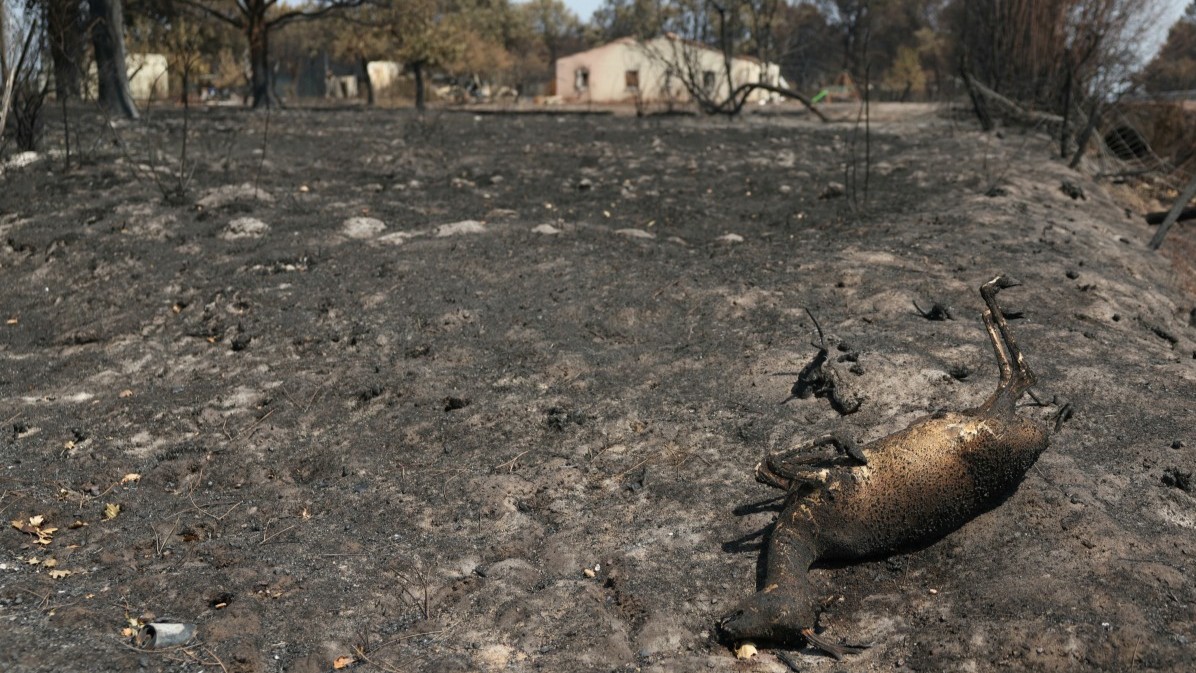
A dead roe deer seen in Andernos-les-Bains, some 40 km from Bordeaux, on July 27, 2026, as a wildfire rages through the forest in Gironde, France.
ALAIN JOCARD / AFP
The massive wildfires that have been ravaging the Gironde region in southwestern France for several days now represent one of the most severe disasters France has experienced since the summer of 2022. This time, however, the scale of the fires is unprecedented: the flames have reached the very outskirts of Bordeaux, a city of nearly one million people, forcing authorities to consider unprecedented evacuation scenarios.
By the morning of July 27th, the main fire—the result of several separate blazes reported since July 23rd—had burned more than 42,000 hectares, while more than 220,000 people had been evacuated in total in the Gironde department, marking what is likely the largest population displacement caused by a natural disaster in metropolitan France in several decades. Authorities emphasize that the fire’s spread is now “generally stable,” though it has not yet been brought under control.
The fire has destroyed numerous homes, businesses, and infrastructure, although the exact extent of the property damage is still being assessed. Several thousand farm animals had to be evacuated or rescued, while wildlife is suffering considerable losses in the forested areas swept by the flames. As a precaution, shelters have also been set up for the pets of evacuated residents. On the ground, looters are taking advantage of residents’ abandoned homes to steal goods: a 45-year-old Tunisian woman, living in the country illegally, was arrested in Gironde with a bag full of jewelry and valuables in an evacuated area. The woman allegedly took advantage of homes abandoned by their occupants to loot them.
The proximity to Bordeaux is the most dramatic aspect of this crisis. Neighbourhoods in the city have been placed on alert, several outlying towns have been evacuated, while the Bordeaux-Mérignac airport remained operational solely because it served as an essential logistics hub for water bombers and rescue teams.
While exceptionally high temperatures, persistent drought, and strong winds created ideal conditions for the spread of the flames, they do not explain how the fires started. Climate change contributes to the intensity of wildfires but does not cause them. Judicial investigations launched in recent days confirm that the fires were started by humans.
One of the fires appears to have been accidentally caused by brush-clearing work carried out near a power line on behalf of the national utility company Enedis. In another area, in La Teste-de-Buch, however, an investigation into arson was launched after a lighter was found at the scene of a suspicious fire. Several people have also been prosecuted for smoking in the forest despite the bans in effect.
Faced with the scale of the disaster, Emmanuel Macron convened an interministerial crisis unit on Monday morning to coordinate the government’s response. From the very first days of the crisis, the president had announced the mobilization of all available resources and requested support from European partners to bolster France’s aerial capabilities.
Several thousand firefighters, military personnel, hundreds of specialized vehicles, and all available Civil Protection air assets are engaged in the fight against the flames.
As after every disaster, the issue of available resources has come to the forefront.
The French fleet officially consists of twelve Canadair aircraft—aircraft capable of refilling with water by landing on a river, a lake, or out at sea—but only five were operational when the fires reached their peak intensity, as several aircraft were grounded for maintenance or repairs. This situation has sparked widespread criticism of the government, which has been accused of failing to adequately plan for the renewal or expansion of the specialized air fleet.
The controversy is longstanding. For several years, numerous parliamentary reports have warned about the aging of the Civil Protection Agency’s aircraft. Successive governments have announced orders for new water-bombing aircraft, but these have been hampered by very long production lead times and industrial difficulties faced by the Canadian manufacturer De Havilland. The much-hyped announcement of an A400M military aircraft has not lived up to its promises: on its own, despite its large cargo-dropping capacity, it is not as effective as a fleet of smaller aircraft taking turns to serve disaster-stricken areas.
To address the crisis, France activated the European Civil Protection Mechanism. No European country currently has a fleet capable of tackling multiple simultaneous megafires on its own. Foreign aerial resources quickly arrived to reinforce French rescue efforts: Slovak Black Hawk water-bombing helicopters, a Croatian Canadair, and several Portuguese and Swedish Air Tractor aircraft joined the operations.
This cooperation is widely highlighted by European institutions as an example of concrete solidarity. However, this example of European collaboration should not be overestimated. This assistance does not mean that the European Union possesses its own firefighting resources: it primarily coordinates the provision of equipment belonging to member states. France also remains a major net contributor to the European budget, providing several billion euros each year. Criticism is therefore directed less at the existence of this cooperation—which is highly useful—than at budgetary priorities: a portion of the financial resources transferred to the European level could have been used to strengthen national firefighting capabilities more quickly.
Another controversy concerns the management of forested areas.
Several local elected officials and representatives of the forestry sector believe that certain environmental restrictions have significantly worsened the situation and made fire management more difficult: the widening of firebreaks, extensive brush clearing, and essential tree felling have been hindered by actions carried out by environmental lobbies, particularly around La Teste-de-Buch. In 2021, elected officials from the Europe Ecology–The Greens party celebrated having secured the suspension of the management plan for the La Teste forest. These political decisions have contributed to an increase in the accumulation of plant fuel.
While climate change significantly increases the risk of wildfires spreading, regular maintenance of forest areas can often help limit their intensity. The current disaster thus illustrates the combination of several aggravating factors: human-caused fires, extreme weather conditions, and inadequate public policies—driven by ideological choices—in the face of a risk that has become structural.