Jean-Luc Mélenchon is gaining ground as France’s 2027 presidential race takes shape, exploiting a divided Left and sluggish centrist campaigns. Still deeply unpopular, the chameleon-like Insoumis leader may yet prove far more dangerous than his current ceiling suggests.
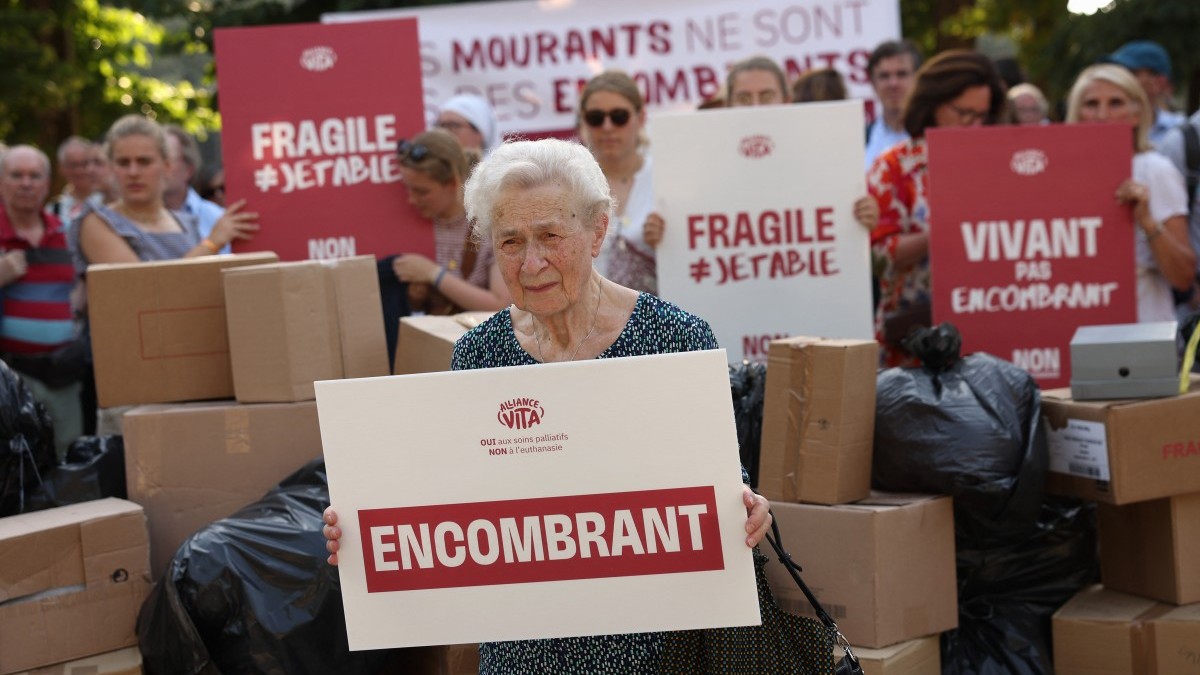
A protester sits with a placard that reads “Burden” during a rally organised by French pro-life organisation Alliance Vita against the new French draft law on euthanasia and assisted suicide at Invalides, in Paris on June 22, 2026.
CHARLOTTE SIEMON / AFP
France’s assisted dying bill has sparked fresh controversy after lawmakers rejected a proposal that would have allowed private healthcare institutions to refuse to carry out euthanasia or assisted suicide on ethical grounds, prompting one Catholic bishop to accuse the government of pursuing “ideological” persecution.
Members of parliament completed their review of the end-of-life legislation on Saturday, voting against the inclusion of a conscience clause for private facilities. As a result, religious and other private healthcare institutions would no longer be able to decline to provide assisted dying services based on their ethical charters if the law is adopted.
Bishop Matthieu Rougé of Nanterre said the decision represented a serious attack on freedom of conscience rather than being an issue of secularism.
According to the bishop, numerous healthcare providers have sought the right to refuse participation in euthanasia or assisted suicide, citing their duty to remain faithful to their founding principles and respect the convictions of the people they serve.
Rougé also expressed disappointment with the government’s handling of the issue, saying ministers had previously indicated their support for such a conscience clause before ultimately opposing every amendment that sought to introduce it.
“This is not a question of secularism but of freedom,” Rougé argued, warning that the legislation reflects what he described as a “totalizing technocratic paradigm” that overrides differing ethical convictions.
Looking ahead to Pope Leo XIV’s scheduled visit to France at the end of September, Rougé suggested the pontiff would likely reaffirm the Church’s long-standing opposition to euthanasia.
He predicted the pope would reiterate that “the first human right is the right to life,” arguing that euthanasia represents a grave moral wrong, while emphasizing care for the sick and disabled rather than assisted death.
Rougé also said he expects the pope to encourage lawmakers to adopt legislation that respects the ethical convictions of both individuals and institutions, while urging Christians to continue serving vulnerable people despite what he described as an increasingly restrictive legal framework.
Echoing arguments made repeatedly by opponents of assisted dying, the bishop insisted that “true fraternity” does not consist of helping people die but rather helping them live.