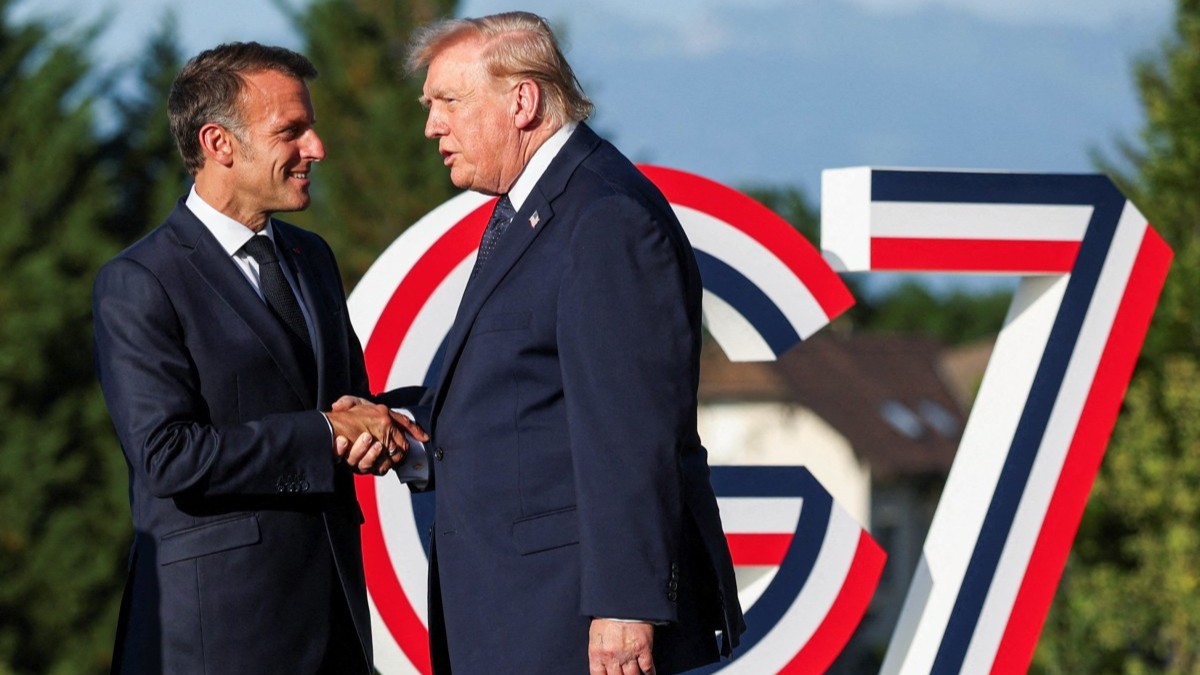
France’s President Emmanuel Macron (L) greets U.S. President Donald Trump during the G7 summit, in Evian, eastern France, on June 15, 2026.
ISABEL INFANTES / POOL / AFP
This year’s G7 summit begins today in France, with the Ukraine war and prospective paths to peace once again being the highest items on the agenda for the leaders of the U.S., the UK, Germany, France, Italy, Japan, and Canada. The presidents of the EU Commission and Council also participate, representing the entire bloc.
Upon arriving in France on June 15th, the first thing President Trump did was to make it clear that he intends to retake control of the Ukraine peace process, given that the Iran war, which took up much of his time and attention since late February, seems to be over.
“Now that this is finished, we are gonna be focusing on [Ukraine] and see if we can get that one done,” Trump said on Monday, sitting next to President Macron, ahead of their bilateral talks. “Twenty-five thousand people a month are dying, mostly soldiers. That shouldn’t happen.”
Now, even though Trump has taken more concrete steps toward peace in Ukraine than everyone else combined, and avoiding further unnecessary deaths should not be a controversial argument, Trump once again working for a compromise is the last thing Europe wanted.
“Having Trump be distracted was not necessarily a bad thing,” one anonymous diplomat told Politico.
Although EU leaders would not admit it officially, they very much enjoyed dealing with the Ukraine war alone. Both because it allowed them to pursue their ‘maximum pressure’ strategy toward Russia—even if it is making hardly any difference—and because it allowed Berlin, Paris, and Brussels to feel like they actually matter.
Germany, France, and the UK, collectively known as the E3, have recently sent their envoys to Russia, which is the first time they have directly engaged with Putin since 2022. Given that Europe maintained a strict ‘we don’t talk to terrorists’ principle for the past few years—actively hindering peace and condemning anyone who didn’t abide by it, like former Hungarian PM Viktor Orbán—these negotiations could have been the icebreaker we’ve all been waiting for.
Problem is, there weren’t any negotiations, really, as the E3 countries used this opportunity to simply reiterate the EU’s demands for an immediate ceasefire, robust security guarantees for Ukraine, full reparations for war damages, and the complete refusal to acknowledge Russia’s territorial gains. The same recipe that led nowhere in four and a half years.
During this G7, Europeans hope they can steer Trump toward backing their hardline stance toward Moscow, but deep down, they know it will not happen. Not only because the U.S. president wants to see results and knows that the EU’s approach will not get him any, but also because the issue ultimately boils down to money, which Europe doesn’t have.
EU Commission President Ursula von der Leyen’s main goal at this summit is to secure enough funding to keep Ukraine and its war effort going. She reminded journalists that the EU has provided Ukraine with a €90 billion “loan” (practically subject to repayment by EU taxpayers, not Kyiv), that will cover about two-thirds of the country’s operational needs for 2026–2027. She also announced a new tranche of EU grants worth €75 million, which is more symbolic than significant at this point. The rest, however, will have to come from somewhere.
“For the remaining third, we need Ukraine’s partners to step up,” von der Leyen stressed. “This will be a topic at this summit.” And while these “partners” technically refer to Canada and Japan as well, everyone knows who she was really talking about.
“It’s important that the other G7 countries, in particular the United States … don’t degrade their position toward Ukraine,” a French official said, referring to both the U.S.’ vital financial contributions as well as Trump’s willingness to play hard with Putin.
Thankfully, that doesn’t seem to be the case, as Trump is more interested in actual negotiations and striking a peace deal that would define his legacy. He already began the work on his 80th birthday the day before, by having lengthy phone calls with both Moscow and Kyiv.
“We had a very good conversation yesterday with President Zelenskyy and President Putin, and maybe we can do something there,” Trump said in France. “I think they are both very open to it,” he added, noting that he was sending special envoys Steve Witkoff and Jared Kushner to Moscow for peace negotiations in the near future.