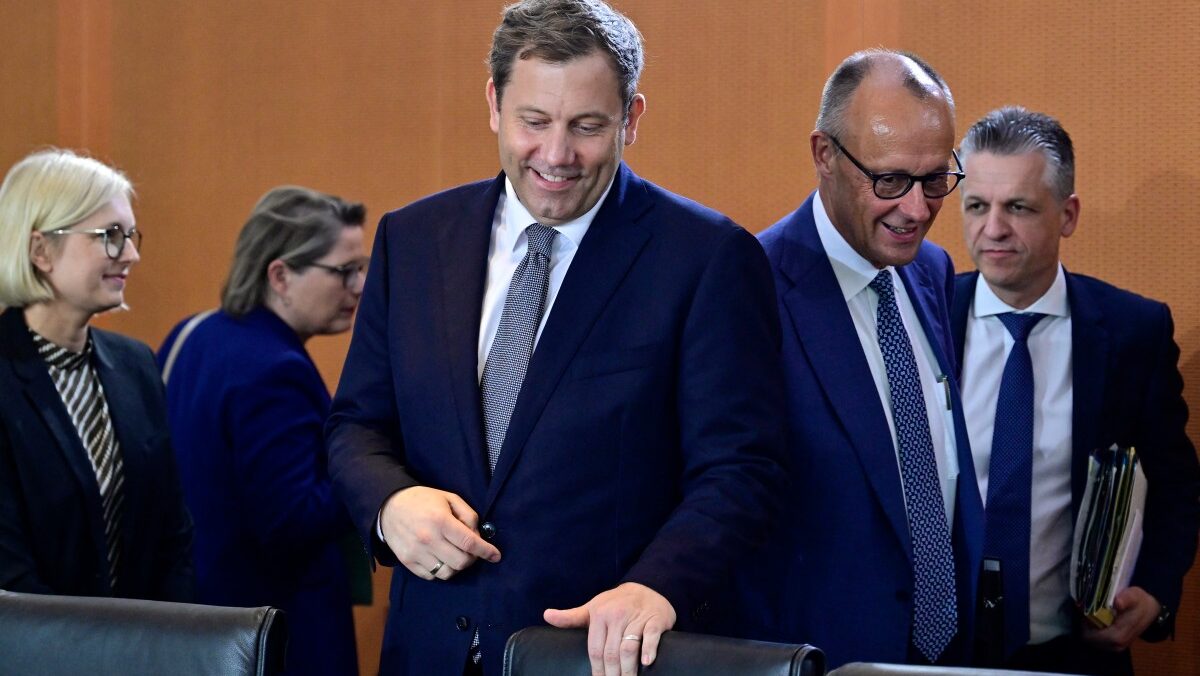
German Vice-Chancellor Lars Klingbeil, SPD (center-left) and Chancellor Friedrich Merz, CDU (center-right).
John MacDougall / AFP
Germany’s finance minister and vice-chancellor, Lars Klingbeil (SPD), has kicked off an uncomfortable debate by unveiling a draft 2027 budget that would add more than €200 billion in new debt, potentially jeopardizing the future of the country’s welfare state.
The total planned borrowing of €203.6 billion for next year is higher than what the government initially projected back in April (€196.5 billion) and is over four times as much as the €50.5 billion debt incurred in 2024 under the previous socialist government.
Over half of the new debt (€118.7 billion) goes into the country’s core budget of €545.3 billion, while the rest is divided into two tranches of special funds: one for infrastructure (€54.9 billion) and another—€30 billion—for defense. Altogether, this means that almost a third of Germany’s total budget for 2027 (over €630 billion) will be financed by loans.
This will raise interest expenditure from the current €30.6 billion to €40.9 billion in 2027, which will then nearly double to €80.7 billion a year by 2030.
Germans are growing increasingly uneasy about the federal government’s mounting debt, especially as the country struggles to finance its generous welfare state in the face of demographic decline and the rising costs of mass immigration.
The single largest item in the 2027 core budget will be ‘labor and social affairs’ at €201.5 billion—which includes everything from pensions to unemployment and childcare benefits—putting the cost of the German welfare state over the €200 billion threshold for the first time ever.
Defense is also among the top priorities and a main reason for the new debt. In the draft budget, the core defense expenditure is set to rise from €82 billion in 2026 to €109 billion next year and to as much as €130 billion with all security-related spending included. The finance ministry said this jump was needed to raise defense spending from the current 2.8% of GDP to the 3.5% NATO target by 2029.
Additionally, Germany is still adamant about being one of the biggest financial supporters of Ukraine. It has already earmarked €11.6 billion for Kyiv in 2027, as well as a further €8.5 billion every year thereafter until 2030. And that is on top of the €90 billion joint EU loan that was recently approved for Ukraine, the biggest part of which (roughly €23 billion) will also have to be repaid by German taxpayers.
The €200 billion in new debt for next year is just the first tranche of the roughly €1 trillion worth of debt Germany plans to incur in the near future to invest primarily in defense and infrastructure as it prepares for a potential war with Russia before the end of the decade.
Taking on loans this massive was unconstitutional until last year, when the outgoing parliament adopted a last-minute constitutional change, after the election but before the new parliament was convened, knowing that the incoming mainstream parties would no longer have the majority needed to pull it off.
In practice, this means that Germany is going into generational debt because of the decision of a parliament that no longer had any democratic mandate to make it.