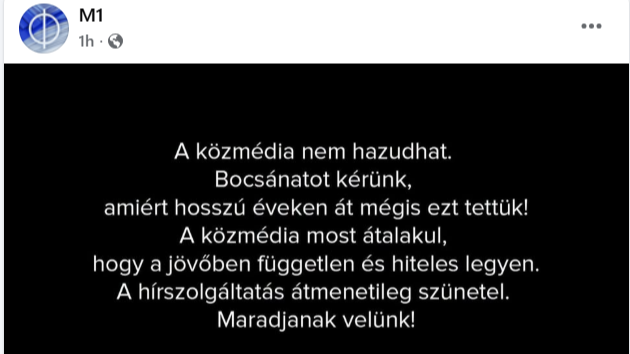
M1’s post on Facebook on July 7, 2026 reads “Public media must not lie. We apologize for having done just that for many years! Public media is now undergoing a transformation to ensure it remains independent, and credible in the future. Our news coverage has been temporarily suspended. Stay tuned!”
Screenshot of M1 Hungarian public news channel’s Facebook post on July 7, 2026
Those who switched to the news channels of Hungarian public television (M1) and public radio (Kossuth Radio) on Tuesday, July 7, found only a black screen or dead silence. András Horváth, Hungarian public media corporation MTVA’s newly appointed interim CEO, said he “immediately halted the propaganda” on his first day in office and suspended news coverage across all public media platforms.
A statement by the communications department of MTVA recalled that since Hungarian Television began broadcasting in 1957, it has shown a black screen only during technical problems and, more rarely, upon the death of a public figure—including when József Antall, Hungary’s first freely elected prime minister, passed away on December 12, 1993.
In a statement, of a content and style unprecedented in post-Communist Hungary, and what conservative pundits have already called out as resembling the practices of North Korea, MTVA said,
Once again, the black screen symbolizes the end of an era. In recent years, public media has fallen under the influence of political power and lost its primary function: providing the public with credible and objective information. Instead, it has become a forum for inciting hatred, and spreading lies. This will change from now on.”
At the time of writing, the following text appears when one switches to the M1news channel:
Public media must not lie. We apologize for having done just that for many years! Public media is now undergoing a transformation to ensure it remains independent, and credible in the future.
Our news coverage has been temporarily suspended. Stay tuned!
According to the statement, at 7:56 p.m., M1 will temporarily resume broadcasting in a new format, featuring films, and no news coverage. Classical music radio channel Bartók Radio’s programming will be temporarily broadcast on Kossuth Radio’s frequency, without news coverage for the time being. As the new news department is established, news programs will gradually resume. The transition will not significantly affect programming other than news coverage on other platforms.
The Magyar government’s policy of revenge has now reached the media, too, after its political rivals and close-to-Fidesz institutions. The question is how long an electorate that decided to oust the preceding administration can be kept busy with this type of theater, and its attention diverted from key issues that the “new Turks” have pledged to resolve during their campaign.