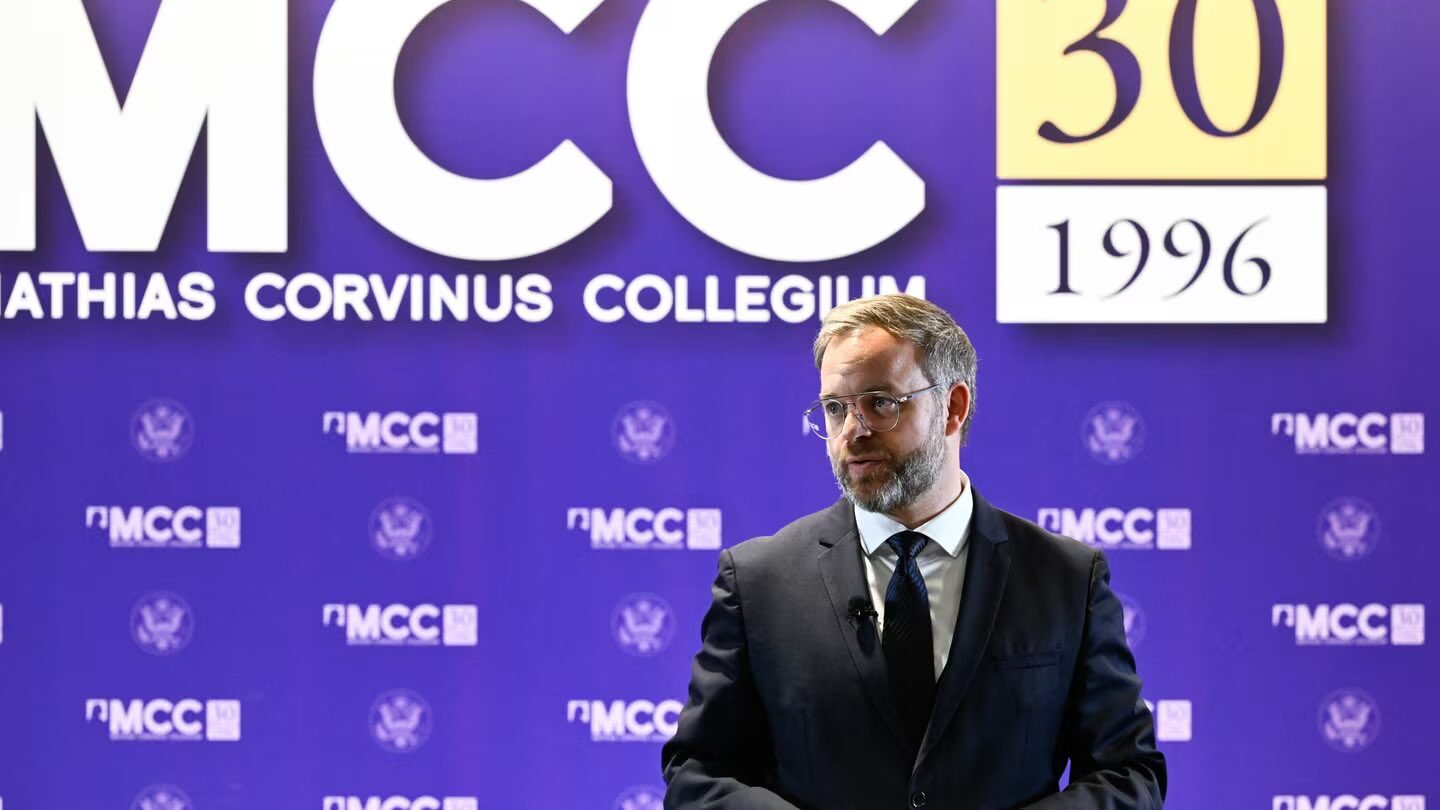
Balázs Orbán has resigned as chairman of the board of trustees of the Mathias Corvinus Collegium (MCC), Hungary’s largest private educational foundation, accusing the new liberal, pro-Brussels government of wanting to “dismantle everything that does not serve its political interests.”
Orbán announced his resignation on Monday, June 29th, after the Hungarian parliament approved constitutional changes that in effect put foundations that operate universities and private education institutions under state control, including the MCC.
The move is part of a wider package of measures aimed at removing officials appointed under the previous conservative government, as well as weakening former prime minister Viktor Orbán’s Fidesz party and any institutions linked to Hungarian conservative movements.
Similar to Donald Tusk’s liberal government in Poland, the Hungarian cabinet led by Péter Magyar is using legal tools to pursue its political opponents—while the EU remains silent.
“I cannot stand by while this work is being dismantled,” Orbán wrote on X, describing MCC as “an extraordinary institution” that has grown into one of Central Europe’s leading educational and think tank communities, with more than 8,000 students.
I resigned as Chairman of the Board of Trustees of @MCC_Budapest .
— Balázs Orbán (@BalazsOrban_HU) June 29, 2026
Hungary’s new liberal, Brussels-backed government is determined to dismantle everything that does not serve its political interests.
First, in the name of “democracy,” it excluded its main political opponent… pic.twitter.com/KPF4IL7UqG
The former political director to ex-prime minister Viktor Orbán accused the government of targeting institutions outside its political control.
The same campaign is now being waged against non-government-affiliated educational institutions and non-liberal civil society. … What they are effectively doing is nationalizing these foundations. Those they cannot nationalize, they will simply deprive of their funding.
The foundation reforms are only one element of a much broader constitutional package imposed by Magyar’s Tisza Party, which has a two-thirds majority capable of altering the constitution.
Parliament has already approved an eight-year limit on the office of prime minister, applied retroactively, preventing Viktor Orbán from returning to office.
A retroactive twelve-year term limit has also been introduced for Members of Parliament, forcing well-known, democratically elected Fidesz politicians to retire, and the government is also pushing to remove President Tamás Sulyok before the end of his constitutional mandate.
Many of these proposals have attracted criticism from even left-wing rights groups, and the Council of Europe’s Venice Commission is expected to examine the proposed amendment to remove Sulyok.
These moves amount to a concentration of power that increasingly resembles developments in Poland under Tusk since 2023, where the government moved rapidly to replace officials appointed by the previous conservative administration across state institutions, public media, and the judiciary.
Several conservative politicians in Poland have been prosecuted and jailed, and a former minister and his deputy had to flee the country, fearing they would not receive a fair trial.
Nevertheless, the EU’s liberal institutions not only did not reprimand the Tusk government but even rewarded their Warsaw ally by unfreezing EU funds that had been blocked under the previous conservative cabinet.
Many in Hungary now expect the same scenario.
The European Commission has already praised Hungarian voters for “choosing democracy” by ousting the four-time democratically elected Viktor Orbán, and steps have already been taken to ensure that the new Hungarian government gets the billions of euros of EU funds that had been frozen during the Orbán era.
Brussels will likely expect major concessions from Budapest on migration policy, Ukraine, and LGBT legislation before these funds are released, and Magyar seems eager to please.