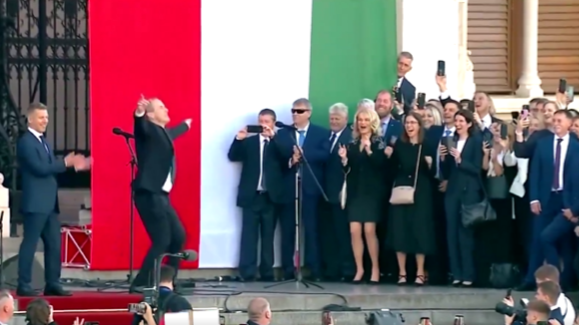
Hungarian health minister candidate Zsolt Hegedűs dances on the steps of the Hungarian Parliament on May 9, 2026
Screenshot of a video on @nexta_tv on X, May 9, 2026
Hungary has changed its government, but, above all, it has changed its alignment. On May 9, parliament elected Péter Magyar as prime minister, bringing sixteen years of Viktor Orbán rule to a close and opening a new phase that, from day one, has sought to mark distance from the previous one both in style and in substance.
The visual messaging speaks for itself. The European Union flag flies again from the parliament, after more than a decade of absence. During the inauguration ceremony, the European anthem, ‘Ode to Joy,’ was played alongside the official symbols of the state.
The EU flag was raised on the facade of the Hungarian Parliament during PM Péter Magyar’s inauguration ceremony pic.twitter.com/t2sGyJKe09
— Daily Romania (@daily_romania) May 9, 2026
The new prime minister announced a review of the constitutional system, term limits for the prime minister, and the creation of an office to investigate the use of public funds over the last two decades.
For Brussels, Hungary had become the main source of friction within the Union, with Budapest using its veto rights to block key decisions on Ukraine, sanctions against Russia, or EU financial packages. In response, the European Commission activated the rule-of-law conditionality mechanism, freezing billions of euros intended for Budapest.
Nearly €17 billion remains frozen pending structural reforms. This is not just a legal conflict. It is a political tool. Access to funds has become a direct lever of alignment within the Union.
The new government has acknowledged this without hesitation. The incoming foreign minister has announced that Hungary will stop using the veto as “political blackmail” and will seek to regain the status of a “predictable” partner within the EU and NATO. The immediate objective is to unblock those funds and rebuild relations damaged during the previous period. It is a doctrinal shift before the government has even started functioning.
In parallel, Budapest has begun lifting blockages that for years defined its foreign policy, including Ukraine’s rapprochement with the European Union—although it still maintains specific conditions regarding the rights of the Hungarian minority. The general line, however, is one of de-escalation with Brussels.
Images from the inauguration have circulated more for their symbolic weight than for their institutional content. The unexpected prominence of Zsolt Hegedűs—a surgeon appointed health minister—whose ‘iconic’ dance on the steps of the Parliament following the oath-taking of the new MPs went viral on the internet, has been interpreted by part of the international press as a reflection of a new political atmosphere. Some media outlets have spoken of a more “open” or “optimistic” Hungary. Indeed—political change requires a change of narrative, and, in Brussels, narratives are rarely spontaneous.
Zsolt Hegedus, the leading candidate for health minister in Hungary's new government, recreated his viral dance complete with air guitar moves on parliament steps as tens of thousands gathered in Budapest for Peter Magyar's inauguration as prime minister https://t.co/bvmvNMY9aU pic.twitter.com/VTuHIWElub
— Reuters (@Reuters) May 9, 2026
For years, the Hungarian public space was dominated by institutional campaigns confronting the European Union. Their gradual disappearance after the elections has been presented as a social relief by the new political environment. At the same time, it represents a reconfiguration of the internal discourse.
Beyond the expected gestures, the decisions taken so far are of major significance. Péter Magyar has announced a political and legal offensive against the previous era, with explicit references to holding those accountable who he says used public resources as a tool of power. He has demanded the resignation of public officials linked to the former executive. In parallel, he has proposed reducing energy dependence on Russia and strengthening integration with European and Atlantic partners.
Hungary is clearly moving from being a ‘disruptive’ actor within the Union to becoming one aligned with its centres of decision-making. That has consequences. Renouncing the systematic use of the veto reduces Budapest’s leverage in a system where major decisions still depend on the balance between states.
At the same time, the potential unfreezing of funds confirms a dynamic Brussels has been consolidating in recent years: financial conditionality as an instrument of political discipline. This is not only about rules. It is about incentives, and the economic one is among the most perverse.
From this perspective, the Hungarian shift can be read in two ways. As an internal correction after a long political cycle or as an accelerated adaptation to a European framework where the margin of autonomy is increasingly negotiated through those economic terms.
Both things may be true. But the liberal international press has already chosen its interpretation. It speaks of “normalisation,” of a “return to European consensus,” of a “new beginning.” This is not neutral language. Neither is the context in which it emerges.