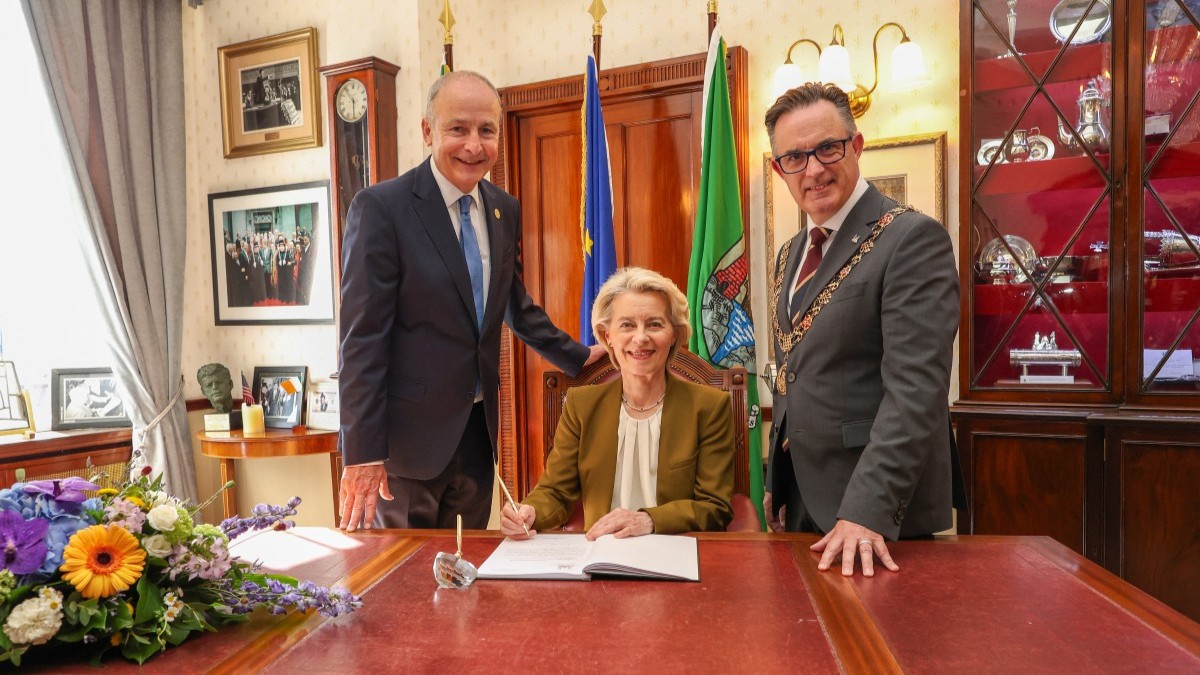
European Commission President Ursula von der Leyen (C) poses with Ireland’s Prime Minister Micheal Martin (L) and Cork Mayor Damian Boylan, in the Mayors parlour, ahead of meetings between the Irish government and the European Commission’s College of Commissioners, at University College Cork (UCC) in Cork, Ireland on July 2, 2026, a day after Ireland took on the rotating EU presidency.
PAUL FAITH / AFP
Ireland has assumed the rotating presidency of the Council of the European Union with three words at the centre of the semester: competitiveness, values, and security.
The mandate, running from July 1 to December 31, 2026, comes amid pressure from the war in Ukraine, instability in the Middle East, and the acceleration of European rearmament. Dublin presents it under the slogan “Strength with unity.”
The Irish presidency is not designed to break with Brussels’ script. Quite the opposite. The role of a Council presidency is to organise meetings, advance legislative files, mediate between member states, and maintain continuity in the European agenda. That institutional definition already sets the tone for the semester: fewer grand announcements and more corridor work, trilogues, and compromises between capitals.
The first front will be economic. Ireland wants to push the ‘One Europe, One Market’ roadmap, focused on regulatory simplification, the single market, open trade, energy, artificial intelligence and digital transformation.
Irish Prime Minister Micheál Martin has presented competitiveness as a condition for the EU to sustain its political ambitions. The reason is the same one conservatives have been putting forward for years before a Commission that has turned a deaf ear: without growth, there is no fiscal room for defence, the energy transition, enlargement or external aid. In other words, it does not matter what one proposes if there is no money to carry it out, and, for that to happen, life must be made easier for citizens.
The second file will be budgetary. The 2028-2034 Multiannual Financial Framework cuts across all the other debates. Ukraine, enlargement, agricultural policy, cohesion, the defence industry, and migration management are all competing for the same pot of money.
Ireland wants to facilitate an agreement before the end of the year, but this is where one of the weakest points of the six-month term emerges: Dublin can chair the negotiations, but it cannot manufacture consensus among governments arriving with increasingly incompatible national interests, especially between predominantly agricultural and industrial countries.
The third pillar is the most political: security, defence, and migration. Under that umbrella, the Commission has grouped the fight against organised crime, migrant smuggling, and arms trafficking, as well as the security of ports and critical infrastructure, together with the full implementation of the Migration and Asylum Pact, including returns and their digitalisation.
Ireland’s own security posture complicates the picture. The country will chair an EU that speaks of preparedness for a possible conflict with Russia, but it is hardly one of the continent’s military pillars. Its policy of neutrality is based on not belonging to military alliances or to common or mutual defence agreements.
Moreover, the European Commission itself recognises that Ireland had the lowest defence spending in the EU in 2023, at 0.2% of GDP, and that Ireland’s 2022 report identified significant gaps in air defence, cybersecurity, and maritime surveillance. The 2026 budget rises to €1.5 billion, but from a very low base.
The contrast with the rest of Europe is clear. Defence spending by member states reached €343 billion in 2024 and was estimated at €381 billion for 2025. Germany and France together accounted for 43.8% of EU military spending in 2024. Ireland can set the agenda, but others provide the hard power.