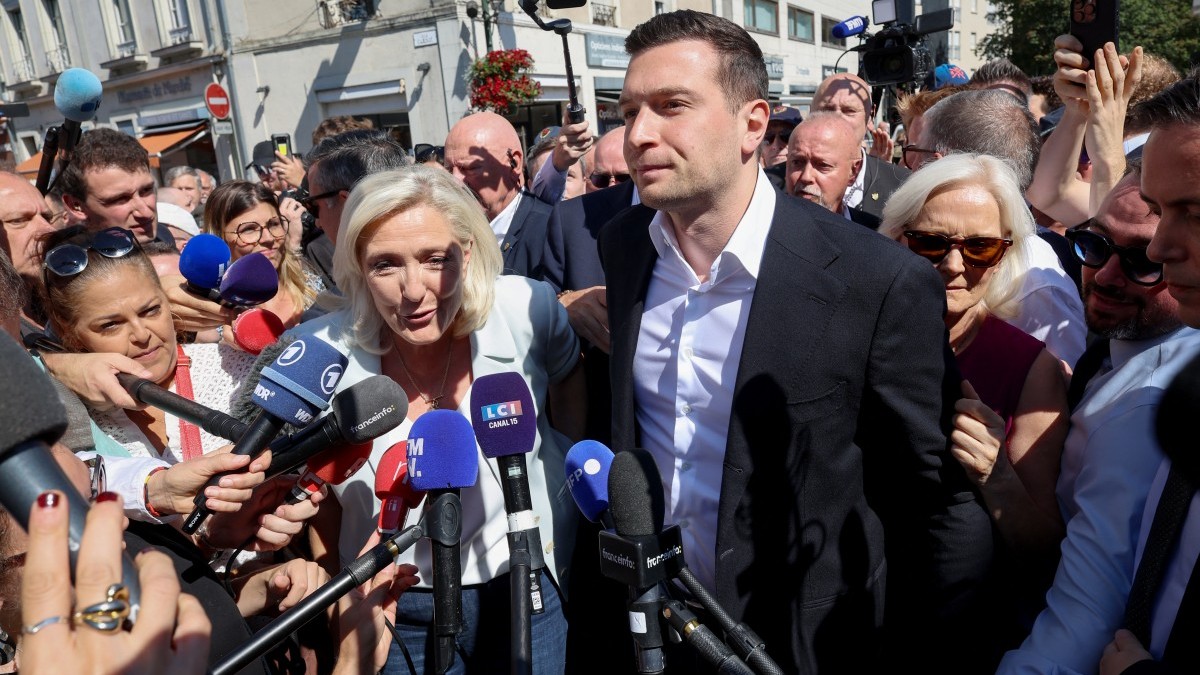
Rassemblement National (RN) party leader Marine Le Pen (C) is surrounded by journalists as she arrives with RN president Jordan Bardella (R) for a campaign gathering in the western central France city of La Fleche on July 8, 2026.
FRED TANNEAU / AFP
The bombshell of Marine Le Pen’s conviction on appeal, followed by the announcement of her candidacy for the presidential election on Tuesday, July 7th, could have had an impact on the popularity of France’s leading opposition party: this was not the case, and the Rassemblement National (RN) has never been so high in the polls. In the meantime, the party is readjusting its strategy, and Jordan Bardella, who has been relegated to the sidelines, must win people over with the party’s programme and his future role.
Contrary to all expectations, the announcement of Marine Le Pen’s conviction on appeal in the trial concerning the misappropriation of public funds relating to her party’s European parliamentary assistants did not immediately deter voters from their voting intentions.
Not only has she consolidated her position—given that polls in recent months had her leading from the first round—but she has even improved her performance to the point where she is in a position to win in the second round, regardless of who the main contender is. Whilst Bardella was considered the frontrunner a few weeks ago, she has now regained that position. According to Frédéric Dabi, director-general of opinion research at pollster Ifop, Marine Le Pen “is benefiting from a twofold effect: the announcement of her candidacy and the clarification of her position to her electorate.” As a result, she is gaining ground among young people, business leaders, as well as Les Républicains (LR) voters and supporters of Zemmour—precisely the groups where Bardella had previously held an advantage.
Her strategy—to capitalise on the opportunity afforded by the appeal to the Court of Cassation to have her sentence suspended so that she can stand for election—therefore appears to be paying off. Depending on the polling organisation, she is polling at around 34–36% of the vote in the first round. In the second round, she is expected to win, by a very wide margin if she faces Jean-Luc Mélenchon—67.5% to 32.5%—or by a narrower margin against the centrist candidate, former prime minister Edouard Philippe—52% to 48%.
Against this backdrop, Philippe is struggling, having fallen sharply—by nearly 4 percentage points in the first round, to 16.5%—which allows Jean-Luc Mélenchon, leader of La France Insoumise (LFI), who is currently polling at 16%, to envisage making it through to the second round.
Mélenchon’s candidacy acts as a foil for the majority of French people, including centrist voters. For the time being, his presence in the second round is Le Pen’s best guarantee of election, provided the vagaries of the legal process do not definitively hinder her march to power. But Mélenchon is a political veteran and a cunning opponent: he is perfectly capable, in the weeks and months ahead, of shifting and toning down his rhetoric sufficiently to reassure voters on the left and in the centre, whilst skilfully waving the spectre of the fascist threat in the hope of securing victory.
In this new landscape, Bardella, the leader of the RN, who was briefly tipped to be the candidate for the national Right, has his work cut out for him in establishing a new position for himself. He opens up in a major interview published on Sunday, July 12th in Le Figaro. In it, he explains his determination to play “a leading role in the campaign” and announces the publication, this autumn, of a third book—having already published two bestsellers.
The key challenge of the campaign ahead will be to establish the idea that it is not a case of ‘RN-Le Pen’ versus ‘RN-Bardella’, but that they intend to work hand in hand on a shared programme—a synthesis of Le Pen’s statist leanings and Bardella’s more entrepreneurial approach. In business circles, discussions are in full swing as to who will prevail within the duo, not without a certain degree of concern: many business leaders had grown accustomed to the Bardella option, whom they saw as likely to adopt a line similar to that of Meloni in Italy—pro-European and business-friendly—and do not welcome the resurgence of Le Pen’s socialist-leaning tendencies. In this delicate balancing act, Bardella intends to make his mark. On the sensitive issue of pensions, for example, he is open about both his loyalty to Le Pen’s vision and his desire to see a degree of capitalisation introduced into the French system—a demand favourably supported by the right-wing bourgeoisie, which otherwise is by nature suspicious of the RN.
Bardella has been quick to reiterate the mission entrusted to him should Le Pen win: to become prime minister and form a government, which he intends to build into a broad coalition extending beyond the confines of the RN and its ally, the Union of the Right for the Republic (UDR). The announcement is appealing, but the wording remains tricky: Bardella speaks of a “national union”—that is, a government spanning from the left to the RN. The UDR president prefers the concept of a “union of the right.” Le Pen, for her part, sticks to a “union of patriots.” As LR MP Julien Aubert points out, “these are not at all the same political, economic and social lines:” so many ambiguities that will need to be cleared up during the campaign—or perhaps not.