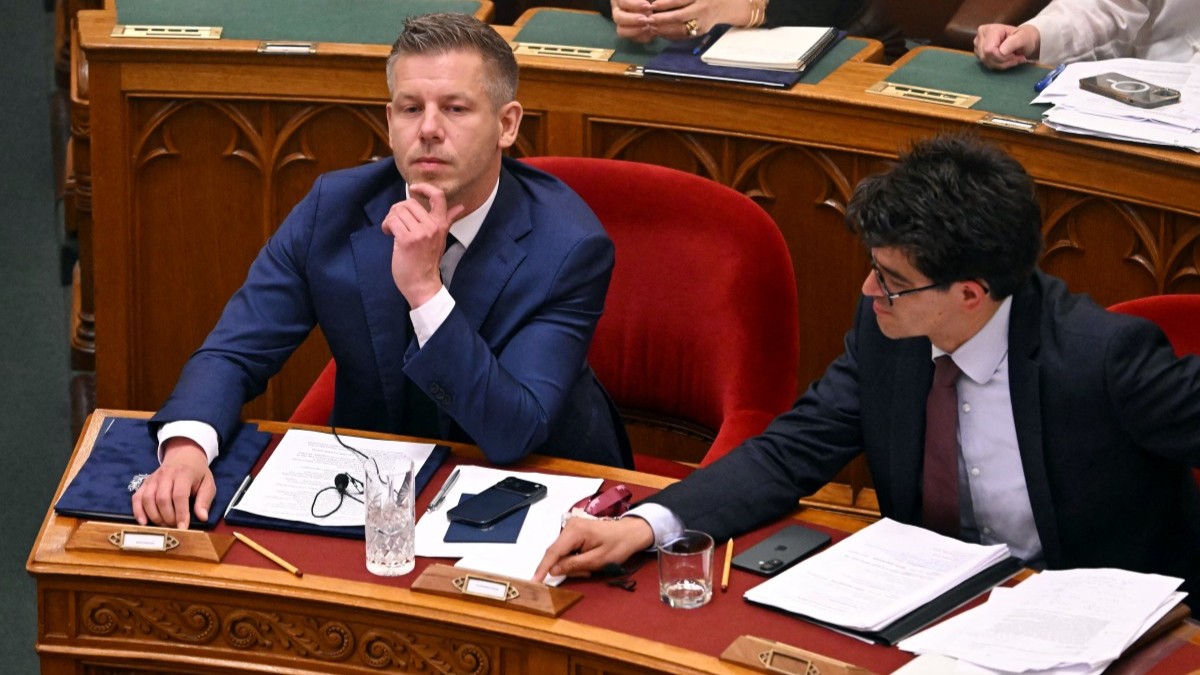
Hungary’s Prime Minister Péter Magyar (L), and Foreign Ministry Parliamentary State Secretary György Velkey (R) vote on an amendment to the constitution in the main hall of the Parliament in Budapest, on June 15, 2026.
ATTILA KISBENEDEK / AFP
Hungarian Prime Minister Péter Magyar has caused a huge uproar after declaring in parliament that his centrist, pro-Brussels government will determine the future content of the conservative weekly Mandiner once it returns to state ownership under newly adopted constitutional changes.
Responding to criticism from conservative Fidesz MP Balázs Orbán during a parliamentary debate on Monday, June 15th, the prime minister said:
I understand that it hurts you that the joke newspaper Mandiner will now return to the state, and we will be its owners; we will have to determine the content that will appear there.
The remark immediately drew criticism from opposition politicians and conservative commentators, who argued that a serving prime minister should not boast about influencing the editorial direction of a newspaper.
Balázs Orbán, chairman of the board of the Mathias Corvinus Collegium (MCC), which is the owner of Mandiner, later wrote on Facebook
Even under communism politicians did not dare to formulate such ambitions so openly.
The exchange took place during the parliamentary debate on the sixteenth amendment to Hungary’s constitution, which was adopted on Monday.
The package of constitutional changes, one of which limits the term of prime ministers to 8 years, includes the abolition of the public-interest asset management foundations, a structure through which the state had transferred universities and other public assets into foundation ownership.
Balázs Orbán argued that the foundation model had served as a guarantee that educational and cultural institutions would remain protected from shifting political priorities. “The foundation system was a safeguard ensuring that resources could not be withdrawn from education, even in the most difficult circumstances,” he told parliament, warning that the new model would provide less long-term stability.
The reform also raises questions about the future ownership of institutions linked to such foundations.
Since January 2025, Mandiner has been owned by the MCC. Under the new constitutional framework, state assets transferred to foundations, together with the returns generated from them, may revert to state ownership if those foundations are dissolved.
Magyar’s comments go beyond the question of ownership and touch directly on editorial independence. They go against the widespread consensus that regardless of political affiliation, newspapers should not face the prospect of their content being “determined” by the government.
Reacting to the prime minister’s remarks, Mandiner journalist Gergely Szilvay revealed that Péter Magyar had also sought to influence the newspaper’s editorial work while serving as head of the Student Loan Centre (Diákhitel Központ) state institution in 2020.
According to Szilvay, Magyar—who held various posts in government agencies for 14 years under the Orbán governments—attempted to extensively rewrite an interview with him, including changes to the questions themselves, and ultimately refused to consent to publication unless his own version was used. The interview was never published.
The debate has also attracted international attention.
Writing in the German daily Die Welt, historian Hubertus Knabe, a professor at the University of Würzburg, argues that the planned dissolution and effective nationalisation of foundation-run institutions risk reviving memories of the communist Rákosi era, when thousands of private and church-run schools and charitable foundations were brought under state control.