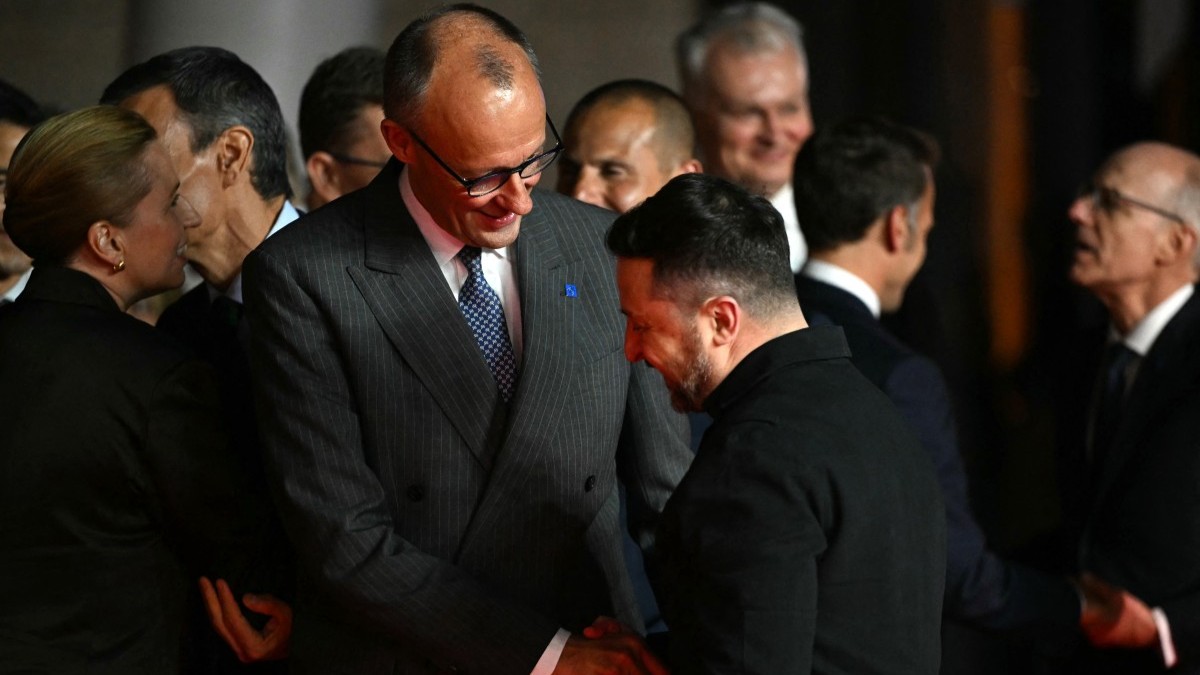
Germany’s Chancellor Friedrich Merz (C) shakes hands with Ukraine’s President Volodymyr Zelensky ahead of an informal meeting of the European Council, in Ayia Napa on April 23, 2026.
NICOLAS TUCAT / AFP
Ukraine’s integration into the European Union has become one of the few major strategic objectives that still enjoys broad consensus in Brussels. The problem emerges when the question shifts to how it should happen and at what speed.
German Chancellor Friedrich Merz’s latest proposal was intended to break that deadlock. In a letter sent to European leaders, Merz suggested creating a form of “associate membership” for Ukraine that would allow Kyiv to gradually enter certain EU structures before full accession—something entirely unprecedented.
The idea is ambitious. Ukraine could participate in meetings of the European Council and other institutions without voting rights, gain gradual access to EU-funded programmes, and even benefit from a political extension of mutual assistance mechanisms linked to European security.
On paper, Merz is trying to build an intermediate solution between Ukraine’s current candidate status and the full accession which nobody in Brussels considers close. The chancellor himself admits there are sufficient legal, economic, and political obstacles preventing Ukraine’s rapid entry.
But the problem is not the intention. It is the method.
The initial reaction in Brussels has been anything but enthusiastic. European diplomats are questioning the legal viability of the proposal and doubt it can be implemented without changing the treaties (something that causes panic among many member states). Others believe the initiative arrived without sufficient coordination and at a politically awkward moment.
The European Commission avoided rejecting it outright. Its response was more ‘elegant’: any innovative solution must respect the principle of merit-based accession, the mechanism that structures the EU enlargement process.
Translated into Brussels language: creativity, yes; bypassing the rules, no. (Although the Commission has no problem doing exactly that when convenient.)
The episode shows the extent to which European consensus on enlargement begins to fracture once concrete decisions reach the ground.
Hungary has blocked the process for two years. Balkan countries are increasingly watching with discomfort as Ukraine receives accelerated pathways while they themselves have been waiting for more than a decade. And within the institutions themselves, different ideas are emerging: only a few months ago, the Commission defended an inverse formula, under which Kyiv would formally join first and receive benefits gradually afterwards. The proposal was received coldly by European capitals.
Now Merz is trying the opposite route. Since arriving at the chancellery, the German leader has sought to project a stronger and more strategic image of European leadership than Olaf Scholz. Yet several of his initiatives have ended up generating doubts rather than support.
In Brussels, some diplomats are already comparing this letter with previous proposals launched by the chancellor that ultimately disappeared amid institutional reservations and political resistance.
Germany remains Europe’s leading economic power, but economic capacity and leadership capacity are not always synonymous. And when even Ukraine starts generating divisions over procedure, the problem stops being Kyiv. The problem begins to lie within the Union itself.