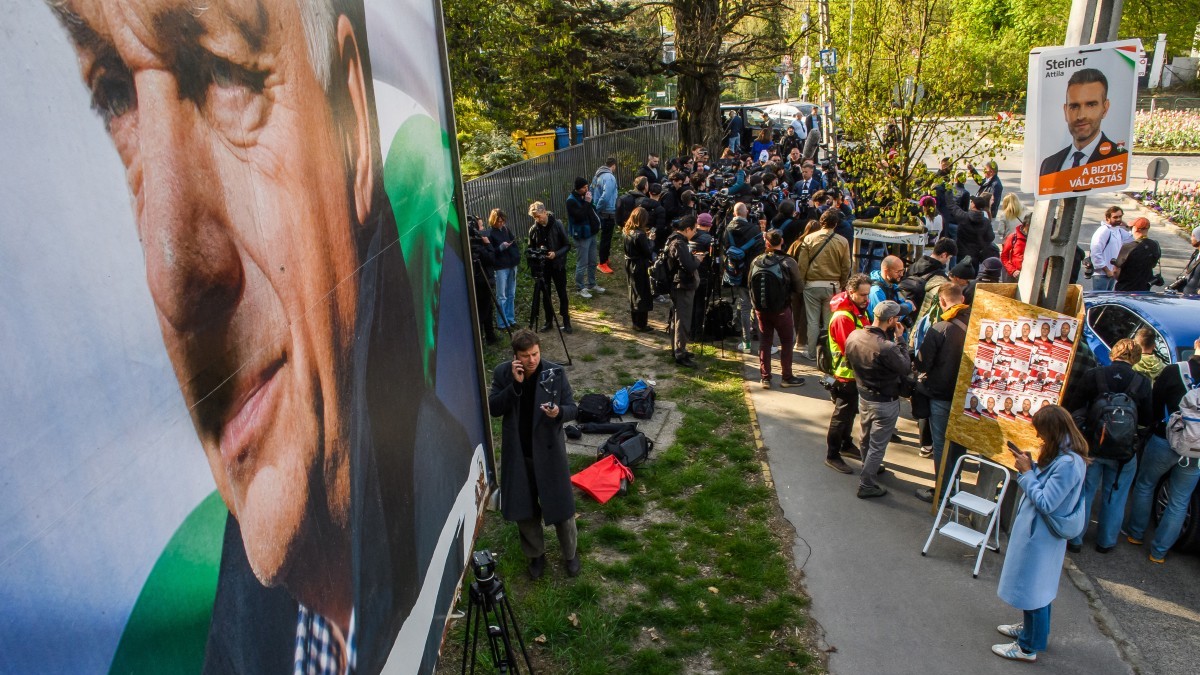
Tisza Party leader Péter Magyar (background, C) talks with journalists after casting his ballot at a polling station in Budapest, with an election poster of Hungary’s Prime Minister Viktor Orbán in the foreground during the parliamentary elections in Hungary, on April 12, 2026.
FEERENC ISZA / AFP
Hungary’s elections are a living example of what happens when a political narrative collides head-on with reality.
For more than a decade, Brussels, much of the Western press and governments at odds with Budapest repeated the same idea: Hungary was no longer a real democracy. Viktor Orbán was portrayed as an authoritarian leader, someone who had tilted the system so heavily in his favour that nobody could ever defeat him.
We were told that elections had been emptied of meaning, that the opposition had no real chance, and that if Orbán ever lost, he simply would not give up power.
Last night, the exact opposite happened.
With turnout approaching 78%—the highest since the fall of communism—Hungarians went to the polls in huge numbers and handed victory to Péter Magyar and Tisza. Orbán’s party lost after sixteen years in government. And only hours later, Orbán appeared publicly to acknowledge what he called a “painful, but clear” defeat, congratulate his rival and announce that Fidesz would move into opposition.
That gesture, which in any other European country would have been regarded as a basic sign of democratic normality, carries greater significance in Hungary because for years, the idea had been built that Orbán would never accept defeat. That he would use the machinery of the state, the courts or any other lever of power to remain in office.
He did not.
Hungary has experienced a peaceful transfer of power through elections. The government lost. The opposition won. The prime minister accepted the result. And the state continues to function.
That does not mean the Hungarian system was never open to legitimate criticism. Every political system eventually faces tensions linked to power and the way it is governed. But that is very different from claiming that Hungary was a disguised dictatorship where a change of government was impossible.
If the system had truly been closed, the opposition would not have won a two-thirds majority. If the country were really an autocracy, there would not have been a massive turnout, an open campaign or a transition publicly accepted by Orbán himself. And if the prime minister had been the kind of leader so often described in Brussels, Hungary would be facing an institutional crisis today. Instead, it is entering a political transition.
Over the last few months, moreover, the Hungarian campaign was marked by constant allegations of foreign interference. The government in Budapest denounced the activity of networks linked to Ukraine, political pressure from Brussels and the growing involvement of European actors favourable to regime change. The European Commission, several Western governments and much of the EU political establishment made clear, more or less explicitly, which candidate they preferred.
The congratulations offered last night leave no doubt about that. As soon as the results became known, Ursula von der Leyen spoke of Hungary’s “return to Europe.”
Hungary has chosen Europe.
— Ursula von der Leyen (@vonderleyen) April 12, 2026
Europe has always chosen Hungary.
A country reclaims its European path.
The Union grows stronger.
Magyarország Európát választotta.
Európa mindig Magyarországot választotta.
Egy ország visszatér az európai útjára.
Az Unió erősebbé válik.
And, let’s not forget, Alex Soros himself chimed in, declaring on election night on X: “The people of Hungary have taken back their country! A resounding rejection of entrenched corruption and foreign interference.”
Donald Tusk celebrated that Budapest had come back to “the right side.” Volodymyr Zelenskyy quickly announced a new phase of cooperation.
The implicit message was obvious: for Brussels, Hungary was only fully acceptable if it stopped being governed by Orbán. The problem was always ideological. Exactly as it was in Poland.
While Orbán kept winning elections, Hungary was described as an authoritarian anomaly. Now that Orbán has lost, the same institutions speak of a return to democracy. Whether Brussels is capable of experiencing cognitive dissonance over that is hard to tell, but what is certain is that its duplicity has been laid bare.