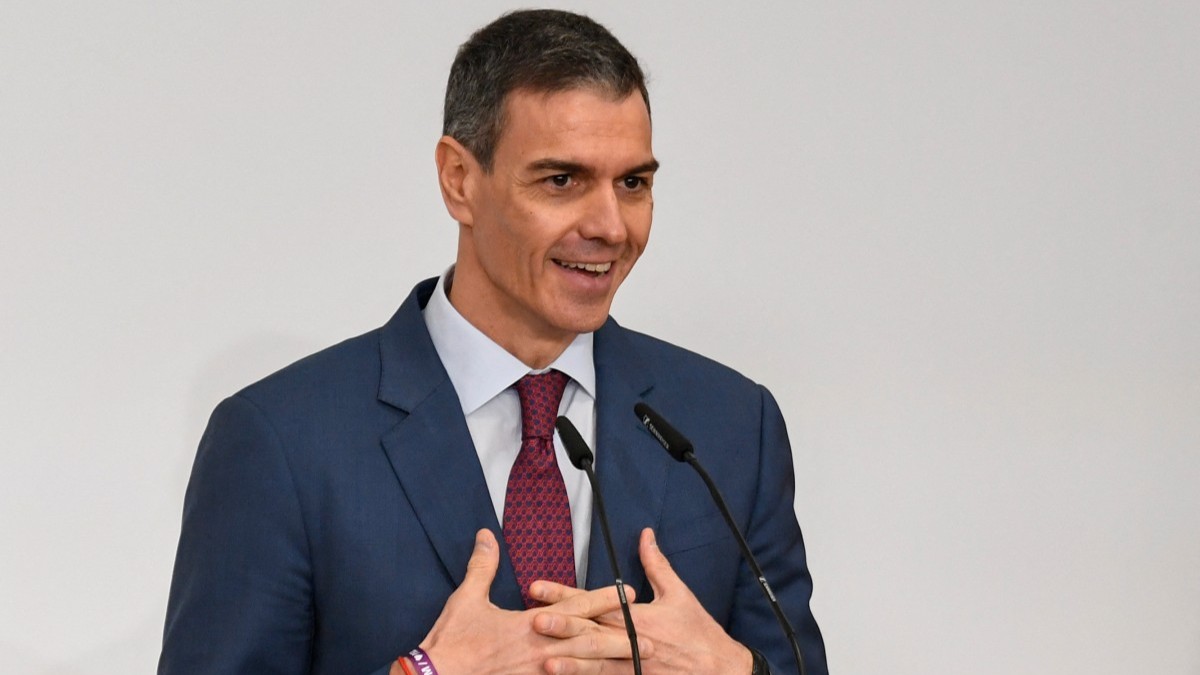
Spain’s Prime Minister Pedro Sánchez gestures during a joint press conference with Portugal’s Prime Minister Luís Montenegro during a Spain-Portugal summit held at the La Rabida Monastery in Palos de la Frontera on March 6, 2026.
CRISTINA QUICLER / AFP
The Spanish government has made definitive the withdrawal of its ambassador to Israel and has thus lowered the level of diplomatic representation in Tel Aviv, a decision that formalizes the bilateral crisis between the two countries that has been dragging on for more than a year and that has worsened with the current escalation in the Middle East.
The Official State Gazette (BOE) published this Wednesday, March 11th, states the recalling of Ana Sálomon as head of the diplomatic mission in Israel, leaving the Spanish embassy under the direction of a chargé d’affaires.
The measure places Spain and Israel in a situation of reciprocity, since the Israeli legation in Madrid has also been headed by a chargé d’affaires since 2024.
Although the ambassador had been recalled for consultations months ago, the government had so far resisted making that withdrawal permanent. The fact that it has been formalized at this moment, in the middle of regional tension following the conflict involving Israel, the United States and Iran, has been interpreted as a political gesture with strong symbolic weight.
The crisis between Madrid and Jerusalem is not recent. Relations began to deteriorate after Spain’s recognition of the Palestinian state in May 2024, a decision that led the government of Benjamin Netanyahu to withdraw its ambassador from Madrid.
Subsequently, the total arms embargo approved by the Spanish executive in 2025, the restrictions on the transit of military material destined for Israel, and the criticism by Prime Minister Pedro Sánchez of Israel’s actions in Gaza intensified the political confrontation.
Tension increased again with the regional war that began at the end of February, when Spain reiterated its rejection of military intervention and denied the use of joint bases with the United States for operations against Iran, a decision that drew criticism both in Israel and in sectors of NATO.
Sources close to the Israeli government consider that the definitive withdrawal of the ambassador constitutes an unfriendly act and attribute it to internal political motives of the Spanish executive.
According to this interpretation, the decision would be linked to President Sánchez’s positioning under the slogan “no to war” and to his attempt to reinforce that message at the international level.
In Jerusalem it is emphasized that the measure could have been taken months earlier, when the ambassador was recalled for consultations, and that the fact of making it official now, in the middle of the regional escalation, reinforces the perception that it is a political message directed both abroad and to Spanish public opinion.
The same sources also point to what they consider an inconsistency in Madrid’s foreign policy. In particular, they question that Spain has taken this diplomatic step in the context of the war against Iran, while during the offensive in Gaza—which the Spanish government itself described as “genocide”—there was no formal rupture of relations.
For sectors of the Israeli executive, this difference reflects a foreign policy conditioned by internal factors and by the need of the Spanish government to maintain a certain ideological positioning within the European debate.