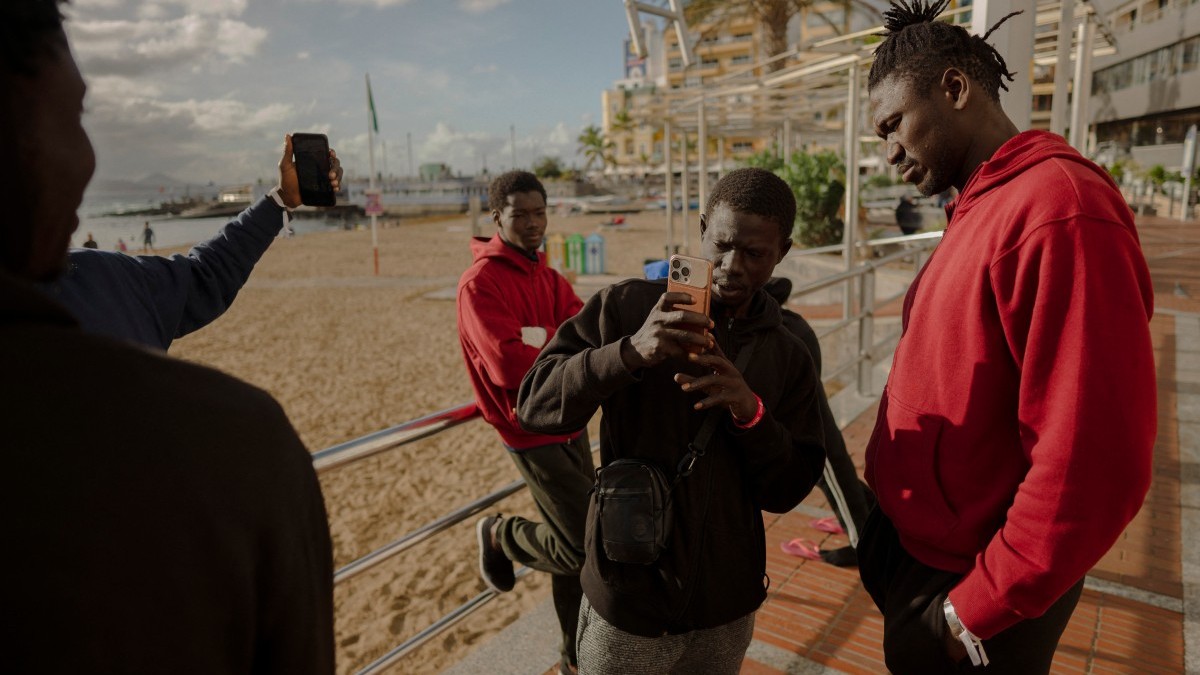
Senegalese men who recently arrived in Gran Canaria after crossing the Atlantic route from Gambia take photos on the beach of Las Canteras in Las Palmas on January 19, 2026.
MICHELE CATTANI / AFP
The extraordinary regularization of illegal immigrants in Spain is entering its final hours with a figure that has already dismantled the initial narrative of the Socialist government.
Pedro Sánchez’ executive presented the process as a limited measure, intended to benefit around 500,000 people. But the count released last Friday had already raised the number of applications to 1.27 million, according to data cited by representatives of immigration officials.
Pending the final tally, the actual volume is approaching three times the political estimate used by the government to justify the measure. This is not a statistical mismatch but a mass administrative transformation in a country with saturated public services, growing health waiting lists that put patients’ health at risk, and an immigration system already overwhelmed before this extraordinary route was opened.
In recent days, several pro-immigration NGOs have intensified their calls for applicants to submit their documents before June 30, even if their files are incomplete. Organizations such as CEAR (Spanish Commission for Refugees) and Cepaim (Consorcio de Entidades para la Acción Integral con Migrantes) have advised immigrants from countries including Mali, Iran, Venezuela, Algeria, and Nigeria to register their applications even if certificates, apostilles, or consular documents are still missing.
What they’re trying to do is enter the process first and complete it later. For these organizations, the aim is to prevent thousands of people from being left out because of ‘bureaucratic obstacles.’ For these groups, it is business.
Spain is not processing a minor correction to its immigration system. It is overseeing an accelerated incorporation of more than one million people into a legal framework with labour, social, administrative, and, in the medium term, political consequences.
Added to this is another parallel route: the Democratic Memory Law, known as the Grandchildren Law, under which 2.4 million people have applied for Spanish nationality from abroad, with Argentina accounting for nearly 40% of the applications. More than 545,000 files have been approved, and around 306,500 registrations already appear in consular records.
The accumulation of both processes has raised alarm among several civil and political organizations, which denounce a profound alteration of the social and electoral census without sufficient public debate. Hazte Oír has announced new actions before European institutions and Spain’s Central Electoral Board over the Grandchildren Law, while maintaining its judicial offensive against the mass regularization. Iustitia Europa has also called for a review of registrations in the Electoral Census of Absent Residents.
The main front, however, is now in the Supreme Court. It is considering whether to refer a preliminary question to the Court of Justice of the European Union over the possible collision between the Spanish decree, the Migration and Asylum Pact, and the Returns Directive. The legal question is whether mere illegal residence for a certain period can become a sufficient basis for obtaining legal residence.
If the Supreme Court takes the matter to Luxembourg, the process could be provisionally suspended until European justice issues a ruling. It would be a major political blow for Sánchez, who has turned immigration into a central part of his government strategy, and would also set a precedent to be followed across the rest of the continent.