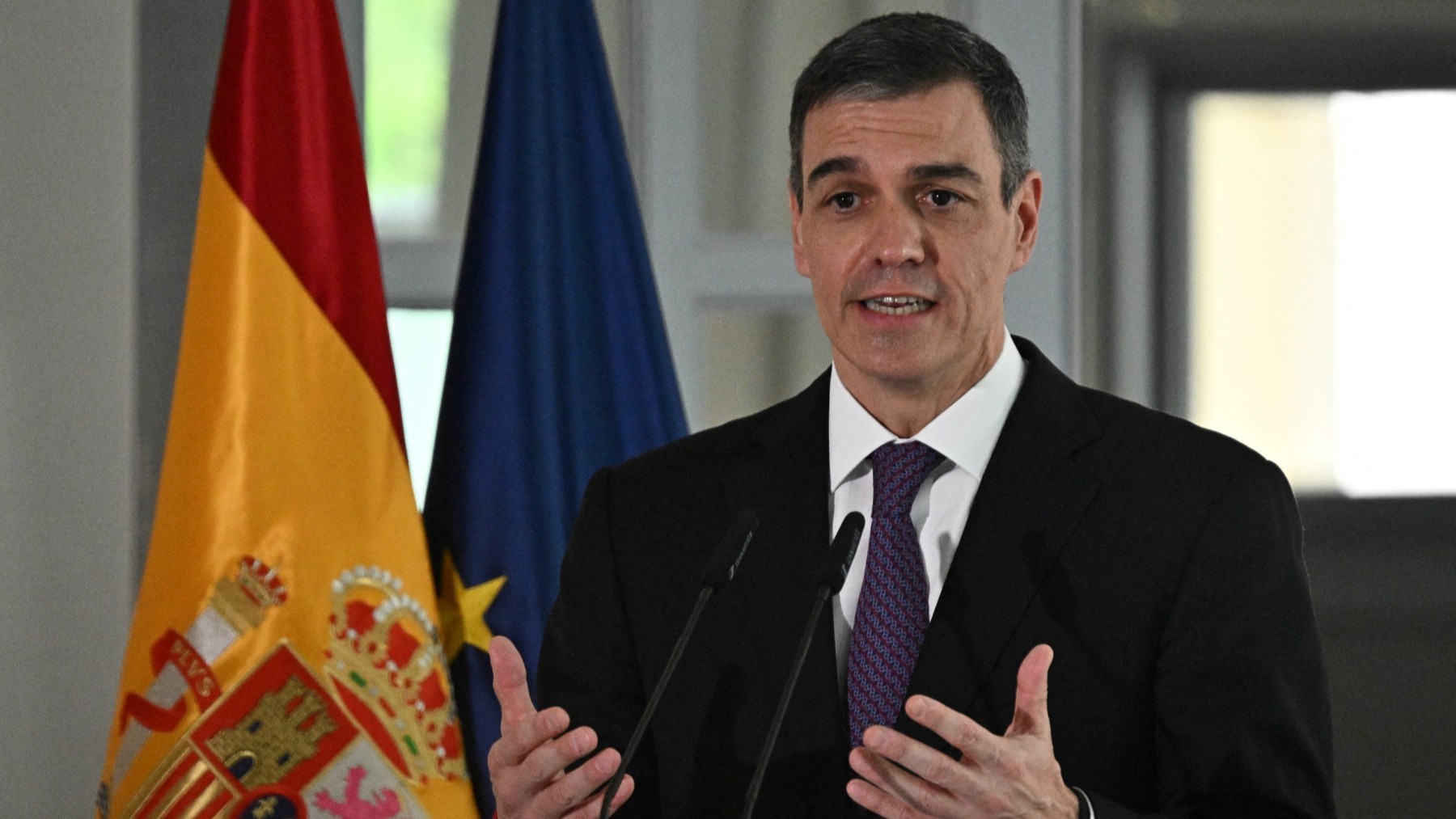
Spanish Prime Minister Pedro Sánchez in Beijing on April 11, 2025, after meeting with Chinese President Xi Jinping
PEDRO PARDO / AFP
The Spanish so-called Grandchildren Law has ceased to be a matter of historical memory and has become a central issue of electoral power.
The mechanism, included in the 2022 Law of Historical Memory, allows Spanish nationality to be granted to descendants of exiles from the Civil War and the Franco era. On paper, it is “historical reparation.” In practice, it is a massive expansion of the electorate abroad at a politically critical moment for Pedro Sánchez.
The figures say it all. According to data released by the government, by March 2026, around 2.4–2.45 million applications had been submitted, with more than 1.2 million files opened, 545,000 approved, and some 306,500 registrations already completed in consular civil registries. Anyone who obtains Spanish nationality also gains, once registered, the right to vote in general elections.
The leader of the centre-right PP, Alberto Núñez Feijóo, has accused Sánchez of “electoral engineering” and of “manufacturing new voters” through an administrative route that could alter the overseas census before the next elections.
The criticism is not aimed only at the legal principle of nationality but at the volume, the timing, and the lack of political control over a process that could incorporate hundreds of thousands—if not millions—of new voters residing outside Spain.
The government defends the measure as historical reparation for the descendants of those who lost their nationality or were forced to leave Spain for political, ideological, or persecution-related reasons under Francisco Franco’s government.
That is the institutional version. But the electoral dimension is what truly matters. The census of Spaniards residing abroad already exceeds 2.7 million, and various journalistic estimates point to a growth rate of around 16,000 new voters per month, with a possible increase of up to 600,000 overseas voters before the next general election.
In an electoral system such as Spain’s, decided by provinces and with many seats allocated by narrow margins, several thousand overseas votes can tip the final seat in key constituencies. Madrid, Barcelona, Valencia, Seville, Málaga, or traditionally tight provinces could see part of the result decided outside national territory.
The most delicate element is political: a large share of the new applicants come from Ibero-America, especially Argentina, Cuba, Mexico, Venezuela, Brazil, and Chile. Many have never lived in Spain, do not pay taxes in Spain, and will not directly suffer the consequences of the policies of the government they help elect. They will, however, have a ballot with the same value as that of a worker, a self-employed person, or a family that lives and works in Spain and bears the tax burden, inflation, legal uncertainty, and institutional deterioration.
That is why the accusation of electoral fraud does not point to classic ballot-box manipulation, but to the accelerated modification of the demos. It is not about counting votes incorrectly, but about changing who votes, when they vote, and from where they vote. And doing so when the PSOE arrives weakened by the corruption cases surrounding the Socialist government and by a domestic electorate increasingly worn down by the exhaustion of the legislature.