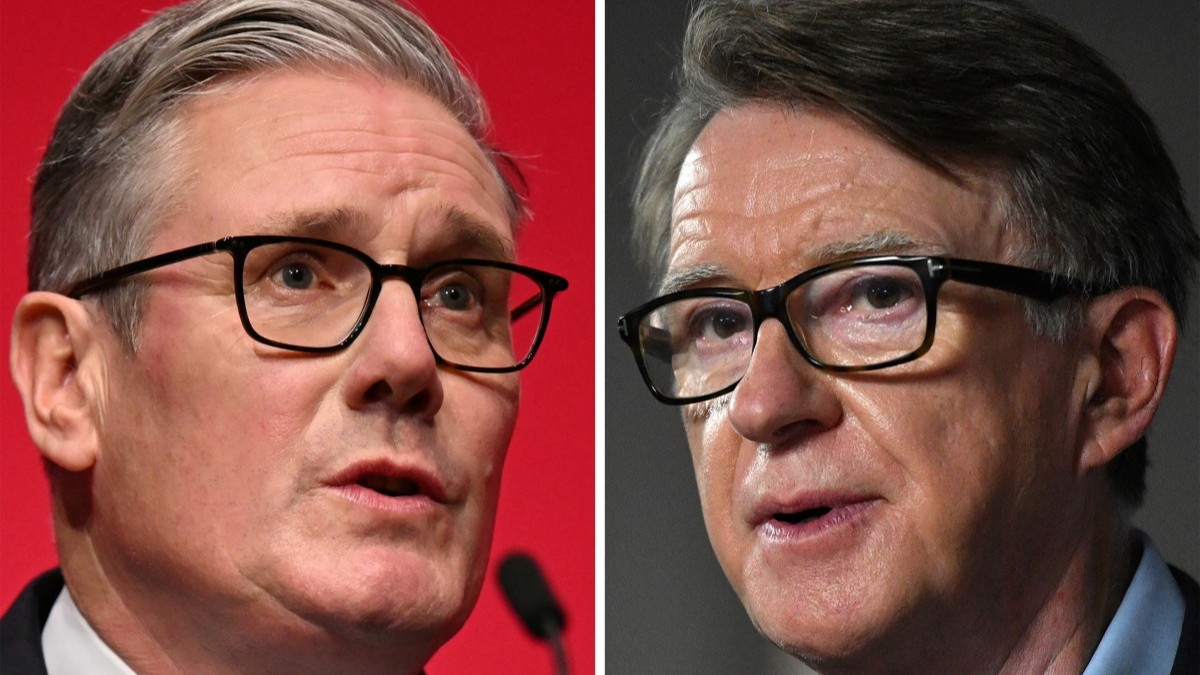
Britain’s Prime Minister Keir Starmer (L) speaks at the annual Labour Party conference in Liverpool on September 30, 2025; British Labour Party politician Peter Mandelson (R) seen on the second day of the annual Labour Party conference in Brighton on September 26, 2021.
OLI SCARFF / AFP
British Prime Minister Keir Starmer is facing mounting pressure to resign over a growing political crisis centred on his decision to appoint Peter Mandelson as ambassador to the United States.
At the heart of the scandal is a simple question: how did a man who reportedly failed top-level security checks end up in one of the most important jobs in British diplomacy?
Mandelson, a senior Labour Party figure, was appointed as Britain’s ambassador to Washington in late 2024.
That role requires the highest level of security clearance, known in the UK as “developed vetting.” This process is designed to assess whether someone can be trusted with highly classified information.
It has now emerged that Mandelson failed that vetting process.
Despite this, officials in the Foreign Office are said to have overridden the security services and allowed the appointment to go ahead anyway.
Mandelson later resigned after further details emerged about his links to disgraced financier Jeffrey Epstein, but the political fallout has only intensified since the vetting failure became public.
The problem for Starmer is not just the appointment itself, but what he said about it afterwards.
On multiple occasions, he told Parliament and the public that Mandelson had gone through proper checks. At one point, he explicitly stated that security vetting had “given him clearance.”
That claim now appears to be false.
Downing Street insists Starmer was not told that Mandelson had failed vetting, and only learned the truth this week. But that defence creates a second problem: either the prime minister was misinformed, or he was not in control of a major government decision.
In politics, both explanations are damning.
In the British system, ministers are bound by strict rules when speaking to Parliament.
If a minister gives incorrect information—even by mistake—they are expected to correct it quickly. Failing to do so can be treated as a serious breach of the ministerial code.
Starmer is now under pressure on this exact point.
According to his own team, he learned on Tuesday that Mandelson had failed vetting. But when he appeared before Parliament the following day, he did not update MPs.
Opposition MPs argue that this failure alone could justify resignation.
There is a strong precedent in British politics for ministers to resign over misleading Parliament—even unintentionally.
The comparison being made in Westminster is with former home secretary Amber Rudd, who stepped down in 2018 after giving inaccurate information to MPs, despite there being no evidence she intended to mislead.
Critics say Starmer’s case could be more serious, because the contradiction between his earlier statements and the new facts is so stark.
At the same time, his decision to sack senior officials—rather than accept personal responsibility—has led to accusations that he is trying to shift the blame.
The scandal is still unfolding.
A parliamentary intelligence committee is expected to review the vetting documents, and more internal government files are due to be released in the coming weeks.
Starmer is also under pressure from his own MPs to give a full explanation.
If new evidence shows that he knew more than he has admitted—or if he fails to give a convincing account—the political damage could quickly become fatal.
The UK is also only weeks away from local and regional elections, which are expected to be catastrophic for Starmer’s Labour Party. A heavy defeat will only add pressure on the prime minister to resign.
This crisis boils down to three possibilities:
None of these is easy to survive politically.
That is why what began as a controversy over one appointment has now become a direct threat to the prime minister’s position.