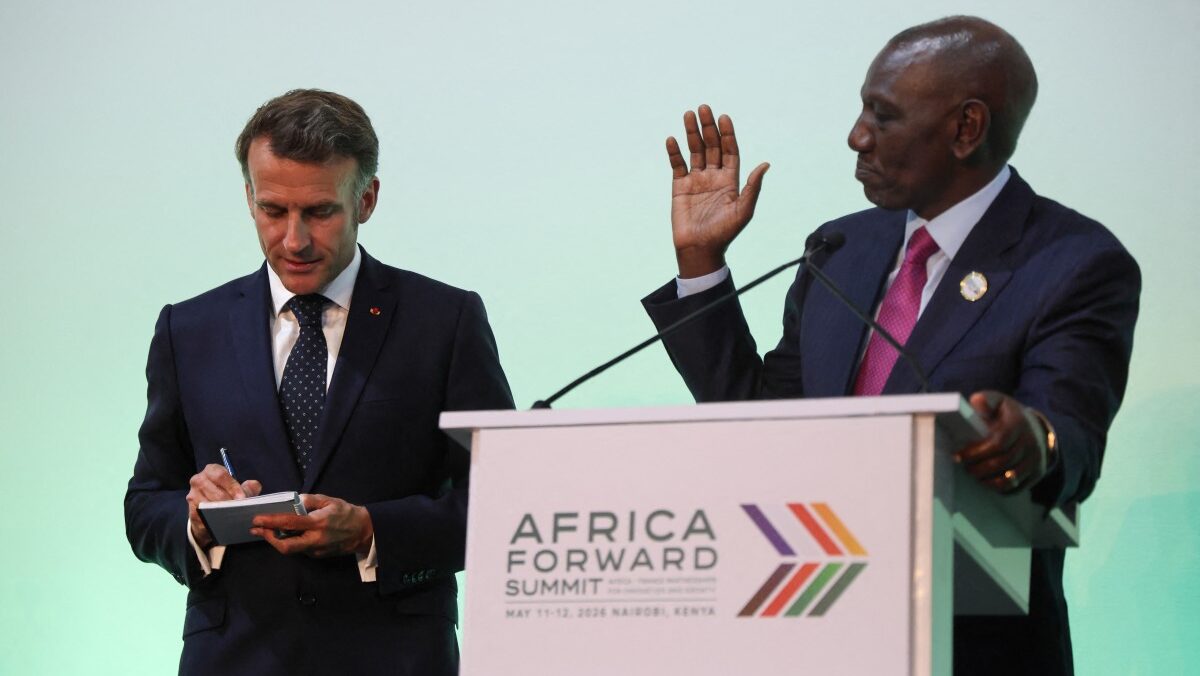
Emmanuel Macron’s visit to Kenya for the ‘Africa Forward’ summit, held in Nairobi on May 11th and 12th, marks an attempt to drastically redefine France’s Africa policy. For the first time, a major Franco-African summit is being held in an English-speaking country, symbolising a strategic shift embraced by the Élysée. Several issues are at stake in this visit: diplomatic recovery, economic repositioning, and an attempt to move away from the heavy legacy of ‘Françafrique.’ But the announcement of €23 billion in investment for Africa is already drawing sharp criticism in France, against a backdrop of extremely tight budgetary constraints.
The choice of Kenya is no coincidence. Unlike Senegal, Côte d’Ivoire, or Gabon, Kenya has no colonial history with France. A former British colony, a regional power in East Africa, and an influential member of the Commonwealth, Nairobi represents an Africa more oriented towards English-speaking markets, new technologies, and international investment. For Macron, the aim is to move away from the historic one-on-one relationship with Francophone Africa, which has become politically toxic following successive crises in the Sahel.
Since 2020, France has indeed suffered a series of major setbacks in Africa. The military juntas in Mali, Burkina Faso, and Niger have expelled French forces. The military withdrawal from Chad and the reduction of the French presence in Senegal have reinforced the impression of a collapse in French influence on the continent. These countries regularly denounce French neo-colonialism, accusing it of political and military interference. Faced with these repeated attacks, the French president has appeared unable to make his mark and reverse the disastrous trend that makes the former power appear as a discredited country in decline. In this context, Kenya appears to be a more neutral partner, less burdened by symbolism, and more compatible with Macron’s rhetoric of a ‘partnership of equals’—at the risk of further deepening the rift with African countries that nevertheless share a common past with France.
This strategy also involves a change in vocabulary. In Nairobi, Emmanuel Macron emphasised that “Africa needs investment more than it needs aid.” He announced the mobilisation of €23 billion in projects, of which €14 billion would come from French companies and €9 billion from African stakeholders. The targeted sectors are the energy transition, digital technology and artificial intelligence, the maritime economy, agriculture, and health. The Élysée Palace claims that these investments could generate more than 250,000 direct jobs in Africa and France.
The French president thus seeks to promote an approach that is more economic than military. It would be giving him far too much credit to see this as an ambition or a vision: there is an opportunistic approach to this choice which smacks of an attempt to cover up his failures elsewhere on the continent. The Nairobi summit highlights businesses, start-ups, young people and technological innovations rather than traditional security cooperation. France is also seeking to compete with China, Turkey, and the Gulf states, which have significantly increased their economic presence in Africa in recent years.
This diplomatic offensive is meeting with strong reservations in France. Both the Left and the Right are criticising an announcement that is out of touch with the domestic situation. The country has a record public debt exceeding 110% of GDP, whilst budget deficits are causing concern in Brussels and among rating agencies. At the same time, French public services are in the throes of a deep crisis: hospitals under strain, schools in difficulty, a shortage of doctors, a deteriorating transport system, and unease amongst local authorities.
Critics also point to the lack of clarity surrounding the announced €23 billion. A large portion of this corresponds to private investment or commitments already negotiated. This is not an immediate public cheque from the French state but a combination of public and private funding, through which the French president easily casts himself as a generous patron and a courageous investor. Nevertheless, in the public eye, the symbolism can be politically explosive: announcing billions for Africa whilst the government is seeking savings in France fuels the recurring criticism levelled at Emmanuel Macron that he is more concerned with his international image than with the daily struggles of the French people. For Jean-Philippe Tanguy, MP for the Rassemblement National, the verdict is clear: Macron is “running on empty,” and France cannot afford to fund Africa. Speaking on CNews, he stated:
Whilst he is fleecing motorists and claiming there is no money left to cut taxes, Emmanuel Macron is playing the good Samaritan in Africa with the French people’s chequebook, to no avail.
The head of state is, however, attempting to justify this policy on strategic grounds. In his view, the fate of Europe and that of Africa are closely linked. Investing in African development would help limit migration crises, open up new markets for French businesses, and strengthen geopolitical stability in the face of growing Chinese or Russian influence. In Nairobi, Macron even acknowledged with irony that European countries no longer “fully have the means” for a traditional policy of official development assistance.
Nevertheless, this trip also resembles a last-ditch effort for Emmanuel Macron. Having promised at the start of his first term to ‘rebuild’ the relationship between France and Africa, his record is widely seen as a diplomatic failure. Despite gestures of remembrance regarding colonisation and the restitution of African artworks, France’s position on the continent has never been so contested since independence.
By choosing Nairobi, Emmanuel Macron is therefore seeking to turn the page on the old Franco-African relations and rebuild influence based on the economy, technology, and regional partnerships. But this strategy comes at a time when France is in an extremely fragile state. The president’s gamble is to convince people that investing in Africa is not an ideological or post-colonial expense but a geopolitical investment in the future of France itself. The success of this approach will depend as much on its actual economic results as on its ability to be accepted by a French public increasingly preoccupied with domestic difficulties. Down South, people are certainly not fooled by his pathological desire to pose as a great man—whom no one listens to anymore.