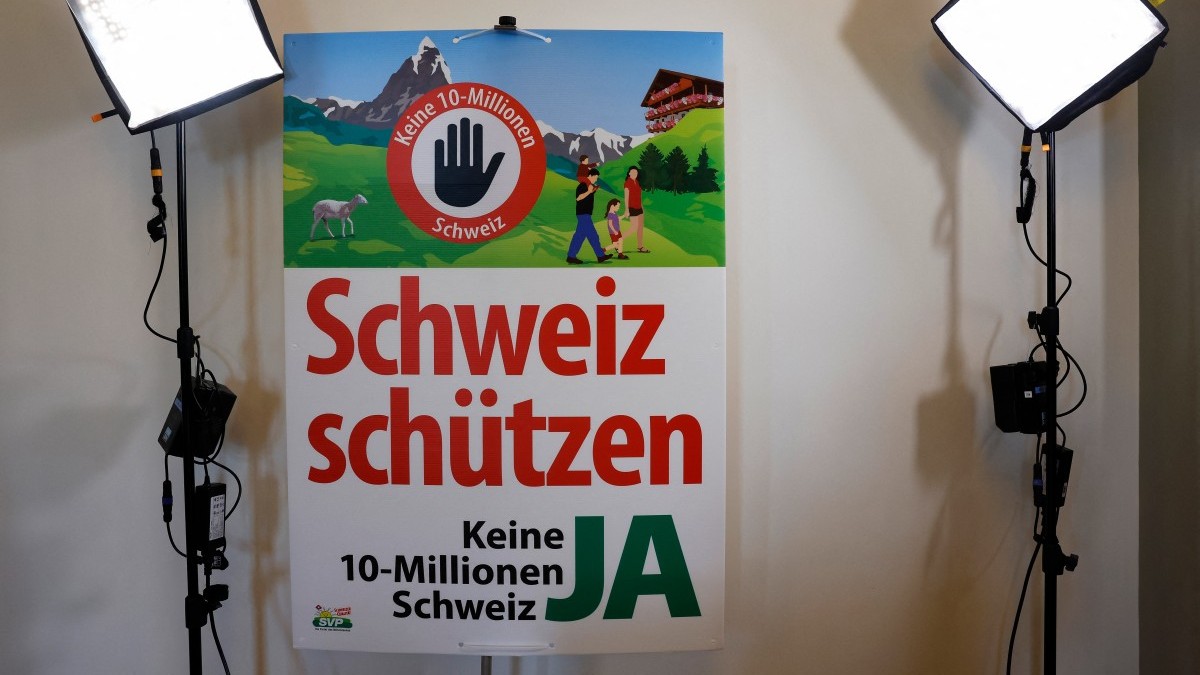
An election placard reading “Protect Switzerland, Not a 10-million Switzerland” as the Swiss vote on a divisive anti-immigration proposal to cap the country’s population in Aarberg on June 14, 2026.
STEFAN VERMUTH / AFP
On Sunday, voters said no to the “No to a Switzerland of Ten Million” initiative, promoted by the Swiss People’s Party (SVP/UDC), which proposed imposing additional restrictions on immigration and asylum if the country’s population reaches 9.5 million inhabitants before 2050. According to preliminary results, around 55% of voters opposed the proposal.
The vote raised the question of how far a society is willing to limit immigration to preserve its economic, social, and territorial model.
The outcome places Switzerland on a path increasingly similar to that followed by many European countries. Despite growing public concern over migration pressures, the majority of voters chose to maintain the current system of free movement with the European Union and avoid any confrontation with Brussels.
The figures explain why the debate has intensified. Switzerland’s population has grown from 7.3 million in 2002 to more than 9.1 million in 2026. Nearly 80% of that growth is attributed to net immigration. Today, more than 27% of the resident population is foreign-born, one of the highest proportions in Western Europe.
During the campaign, the SVP/UDC argued that the country is approaching a saturation point. Rising housing costs, overstretched infrastructure, transport congestion, and difficulties in absorbing new migration flows were among its main arguments. This resonated mainly with rural voters (where foreign-born citizens are less likely to be present in significant numbers), who, with the exception of the French speaking region, said yes to the initiative.
However, the rest of the political spectrum united against the initiative. From the Socialistals to welfare organizations and employers’ associations, all argued that limiting immigration would put entire sectors of the Swiss economy at risk. The same argument as always.
But the decisive factor was probably something else: Switzerland’s relationship with the European Union.
The Agreement on the Free Movement of Persons is one of the pillars of the complex network of bilateral agreements governing relations between Bern and Brussels. A victory for the “Yes” camp would have reopened a dispute that has shaped Swiss foreign policy for years.
Although Swiss accession to the European Union remains extremely unlikely in the short term, the country is gradually deepening its integration with EU structures. The new package of agreements signed in 2026 expands cooperation in areas such as energy, research, health, transport, and the internal market, reinforcing a level of interdependence that would have been politically far more difficult to accept two decades ago.
No one in the Swiss government is currently proposing membership. Public support for joining the EU remains very low, while neutrality, national sovereignty, and direct democracy continue to form a central part of the country’s political identity.
Nevertheless, it is also true that organizations openly advocating future European integration are keeping alive a conversation that for many years remained virtually closed.
Sunday’s referendum does not turn Switzerland into a future EU member state. It does not even bring membership noticeably closer to the visible horizon. But it does confirm something that once seemed impossible: when faced with the choice between confronting Brussels and preserving economic integration, a majority of Swiss voters continue to choose the latter.