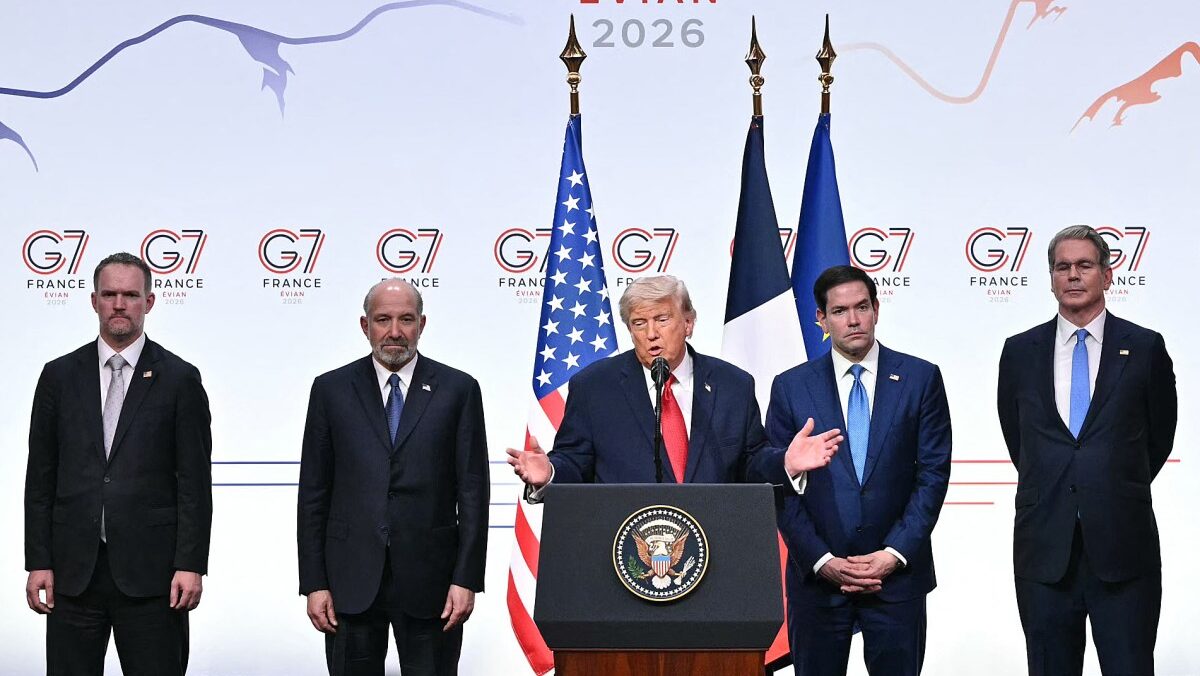
The final day of the G7 summit in Évian produced a rather unusual image: Donald Trump appeared far closer to the European position on Ukraine than many had expected just a few weeks ago.
After months of contradictory messages from Washington, the U.S. president endorsed the G7’s final communiqué, supported new sanctions against Russia, and publicly acknowledged that Moscow is not showing any genuine willingness to negotiate peace.
The shift in tone was welcomed by several European leaders and reinforces a perception that is becoming increasingly widespread in Brussels: U.S. foreign policy continues to depend heavily on immediate tactical objectives, making it difficult to identify a consistent long-term strategic line. Today’s developments point precisely in that direction.
The joint statement approved by G7 leaders reaffirmed support for Ukraine’s territorial integrity and envisages further tightening sanctions against the Russian economy, including measures targeting Moscow’s energy revenues. These sanctions had been eased due to the urgent need for access to crude oil during the most difficult stages of the war against Iran, but now that an agreement with Tehran has reportedly been reached, they appear to be back on the table.
According to German Chancellor Friedrich Merz, reaching a consensus required intense negotiations, but all members ultimately signed the text. Knowing Berlin, however, this may prove to be more rhetoric than concrete action.
Even more significant was the reaction of Emmanuel Macron. The French president said there had been a “very profound change” in the U.S. position and argued that Trump had come to the conclusion that Vladimir Putin currently has no serious intention of negotiating peace.
Trump himself noticeably hardened his rhetoric during the summit. Unlike on previous occasions, he expressed impatience with the prolonged war and supported increasing economic pressure on Russia. Canadian Prime Minister Mark Carney also publicly acknowledged a change in tone from Washington.
The development is particularly striking because it comes after months of mixed signals from the White House regarding Ukraine, sanctions, and possible avenues for negotiations with Moscow. Brussels had spent considerable time trying to persuade Washington to maintain a position closer to the European strategy. At least for now, it appears to have succeeded.
The other major geopolitical issue of the day was the Middle East.
During his final press conference, Trump confirmed that the United States had provided Israel with a copy of the agreement reached with Iran. The statement carries political significance because it contradicts part of the narrative that circulated in recent days suggesting that Israel had been sidelined during the negotiations.
“We did send a copy,” Trump said when asked about the issue, while also insisting that he maintains a good relationship with Benjamin Netanyahu.
The U.S. president expects the final agreement to be signed very soon, possibly on Thursday or Friday in Switzerland. Although he acknowledged that the current document remains a memorandum of understanding, he expressed confidence that the final text would be concluded later this week.
At the same time, he again warned Tehran that the United States would resume military action if Iran failed to honour its commitments.
While the war in Ukraine, the Middle East crisis, critical minerals, and supply chains dominated much of the G7 agenda, Macron chose to bring forward another of his familiar priorities: more regulation. This time, in the field of artificial intelligence.
During the session devoted to digital issues, the French president called for greater regulatory coordination among Western democracies and advocated new measures to oversee the development of these technologies.
The proposal comes at a particularly delicate moment for Europe. The United States is home to most of the world’s leading AI companies (a situation further complicated by the recent controversy surrounding the Mythos model, which was blocked by Washington); China continues to accelerate its technological capabilities at remarkable speed; and the European Union is still struggling to produce home-grown technology champions capable of competing on a global scale.
While Brussels openly acknowledges its lag in strategic sectors such as artificial intelligence, semiconductors, advanced computing, and cybersecurity, parts of the European establishment continue to view additional layers of regulation as the appropriate response.