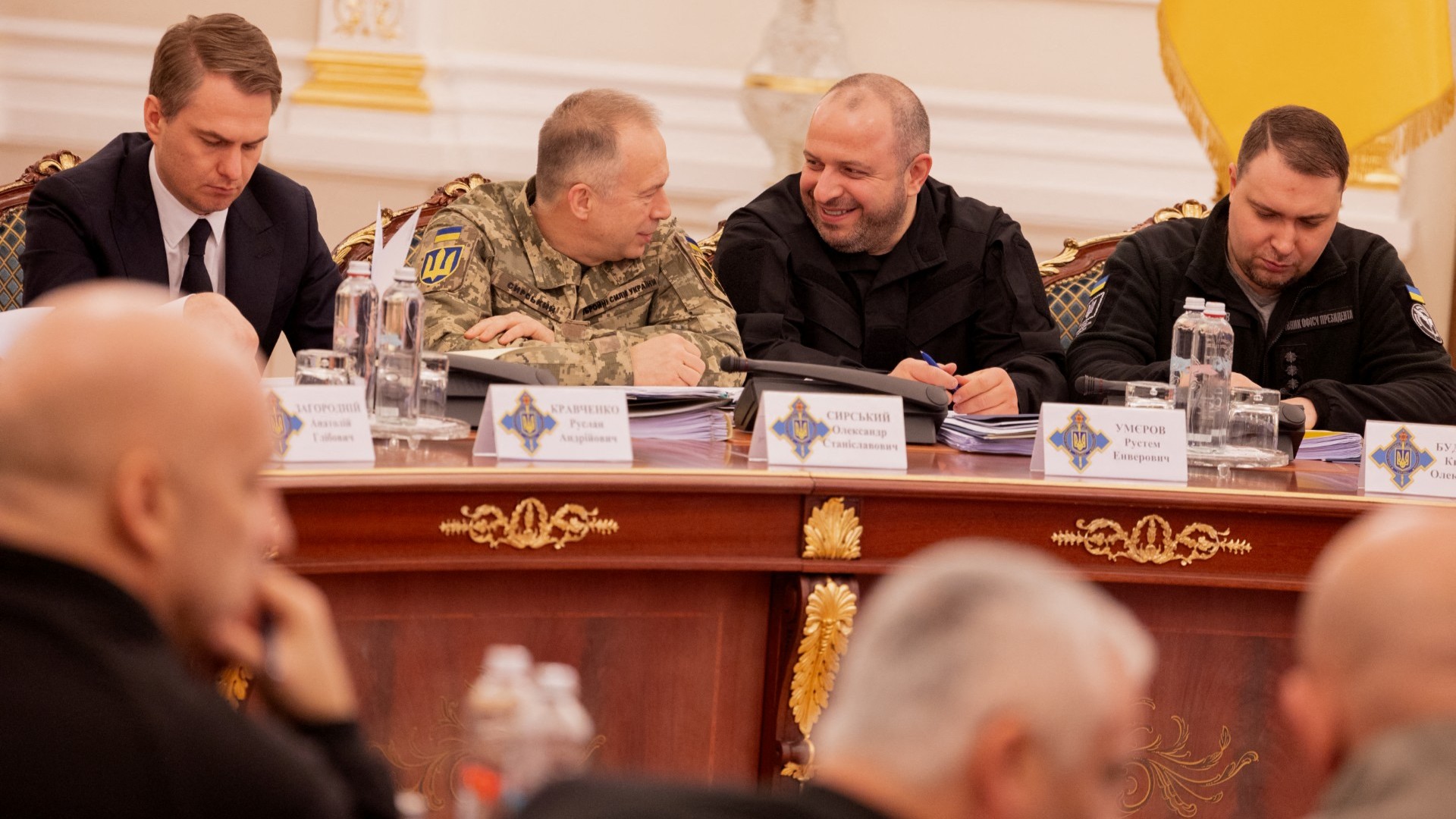
Head of the Office of the President of Ukraine Kyrylo Budanov (1R), Ukraine’s Secretary of the National Security and Defence Council Rustem Umerov (2R) and Commander-in-Chief of the Armed Forces of Ukraine Oleksandr Syrsky (3R) seen before the meeting of the National Security and Defence Council in Kyiv on March 3, 2026
TETIANA DZHAFAROVA / AFP
Ukraine is no longer fighting only for territory. It is also trying to fill the human void left by the war. After years of military casualties, emigration and collapsing birth rates, Kyiv is beginning to accept that rebuilding the country will require bringing in workers from abroad. And Africa is already part of that conversation.
In recent weeks, officials close to the Ukrainian government have proposed “easing” migration rules in order to facilitate the arrival of African labour. At a meeting with business leaders at the beginning of April, Head of the Presidential Office Kyrylo Budanov said that new rules are being prepared for the entry and legalization of foreign workers, including revising the list of “migration-risk” countries to simplify the import of labour. The official argument is economic: there are not enough workers in key sectors such as construction, agriculture and industry, and many companies are unable to fill vacancies.
But the deeper problem is demographic. In 1991, Ukraine had more than 51 million inhabitants. Before the Russian invasion, that figure had already fallen to just over 41 million. Today, once the occupied territories and the more than six million refugees still abroad are excluded, the population effectively under Kyiv’s control may already be below 30 million. The fertility rate, meanwhile, has fallen to around 0.8 children per woman—one of the lowest levels in the world and far below the 2.1 needed to keep the population stable.
That is why, in Ukraine, there is an increasingly open discussion about relying on mass immigration to sustain the economy. Figures from circles close to the government have even suggested that the country may need millions of foreign workers over the coming decades to avoid a structural decline.
This is where the idea of replacement migration appears, even if Kyiv does not use that term. The logic, however, is difficult to deny: if a substantial part of the native population disappears because of war, emigration or demographic collapse, and that gap is filled through immigration, the result is not simply a labour adjustment. It is a profound and lasting transformation of the country.
Until now, Ukraine had been a relatively homogeneous society. Perhaps one of the last in Europe. Introducing large-scale immigration into a heavily militarised country devastated by war and already under social strain could create internal imbalances that would be difficult to manage. Europe has already seen this pattern: mass immigration is presented as a technical answer to demographic decline, but it often ends up generating new cultural, social and political fractures.
The issue becomes even more sensitive if Ukraine eventually joins the European Union. Although accession would not mean an automatic opening of borders, a Ukraine integrated into the EU while simultaneously depending on millions of foreign workers would alter the internal balance of Europe. For several member states, that would mean bringing into the Union not only a country in reconstruction, but also a new eastern migration frontier.
That is the point Brussels avoids stating clearly. The war is presented as a defence of Ukrainian sovereignty, yet its prolongation may push the country towards a large-scale demographic transformation. Ukraine needs workers, yes. What remains to be seen is whether it can find them without ceasing to be, in social, national and cultural terms, the country it claims to be defending.