Italy’s conservative prime minister and Denmark’s centre-left leader said tighter returns policies alone are “not enough”, arguing that respect for European laws must go hand in hand with respect for European values.
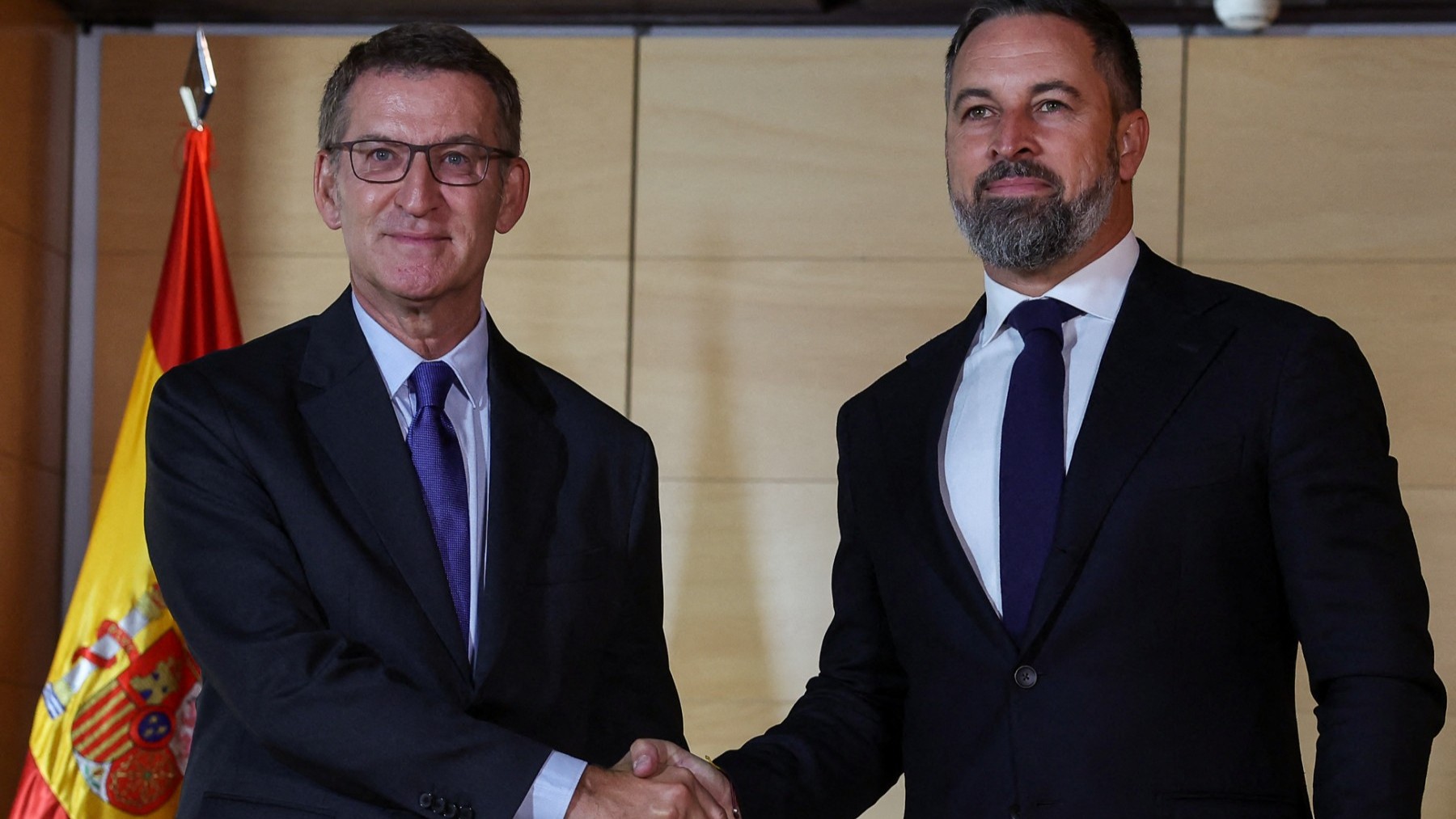
People’s Party (PP) President Alberto Núñez Feijóo (L) shakes hands with VOX far-right party’s leader Santiago Abascal as they arrive for a meeting at the Congress of Deputies in Madrid, on September 5, 2023.
PIERRE-PHILIPPE MARCOU / AFP
The People’s Party (PP) and the nationalist party VOX reached a coalition agreement in the Spanish region of Extremadura on Thursday, allowing PP leader María Guardiola to become regional president next week.
On paper, it is only a regional government. In reality, it may become one of the most important political experiments in Spain before the next national election.
After months of confrontation and mutual distrust, the Spanish Right is trying to rebuild a governing alliance. Extremadura is the first place where that attempt has succeeded.
VOX will enter government with a deputy premiership and two ministries: one responsible for deregulation, family, and social services, and another controlling agriculture, livestock, and environmental policy.
This way, the party will manage precisely the areas where it has built most of its political identity: immigration, bureaucracy, agriculture, national identity and opposition to what it calls the ideological agenda of Brussels.
That makes Extremadura a decisive test for VOX.
For years, the party of Santiago Abascal grew by accusing the PP of abandoning conservative promises once it reached power. Now VOX faces the opposite challenge. It must show that it can govern without losing its identity, and that it can turn slogans into policy.
The agreement includes 74 measures and a detailed timetable. Among the most politically sensitive points are a formal rejection of any redistribution of illegal migrants or unaccompanied migrant minors from other parts of Spain, opposition to the EU-Mercosur trade agreement, tax cuts, priority access to public housing for long-term local residents, and a commitment to reduce subsidies to trade unions and NGOs.
On immigration, the new regional government promises to oppose “by all legal, political, and judicial means” any attempt by the national government to relocate undocumented migrants to Extremadura. It also pledges to stop funding NGOs accused of encouraging illegal immigration, prohibit the burqa and niqab in public buildings, and abolish a programme teaching Arabic language and Moroccan culture in schools.
Economically, the coalition plans to lower regional income tax, cut inheritance taxes, and reduce public spending. It also wants to keep the Almaraz Nuclear Power Plant open and oppose large solar and wind farms on productive agricultural land. The agreement explicitly frames these policies as a defence of local farmers against the EU Green Deal and against the proposed trade agreement between the European Union and Mercosur countries.
This matters well beyond Extremadura.
Spain has become increasingly fragmented politically. The PP can no longer govern alone in many regions, but part of the party still resists relying on VOX. Since the two parties broke apart in several regional governments last year, there has been a growing question inside the Spanish Right on whether cooperation with VOX is still possible. Extremadura is the first answer.
If the coalition works, VOX will be able to present itself not merely as a protest movement but as a party capable of governing. That would strengthen its position in other negotiations already underway, especially in Aragón, where the parties are close to reaching another agreement.
It would also have consequences in Castilla y León, where relations between the PP and VOX remain tense after the collapse of their previous coalition.
But the real political horizon lies further south, in Andalusia, where the regional election is likely to become the decisive contest for the Spanish Right. PP leader Juanma Moreno has so far tried to avoid depending on VOX, presenting himself as a moderate conservative able to win alone. Yet that strategy becomes harder to maintain if VOX returns to government in several regions and proves capable of stable coalitions.
If Extremadura works and Aragón follows, the pressure on Moreno to strike a deal with VOX will grow considerably. Because once a party is already governing elsewhere, refusing to work with it becomes politically more difficult.