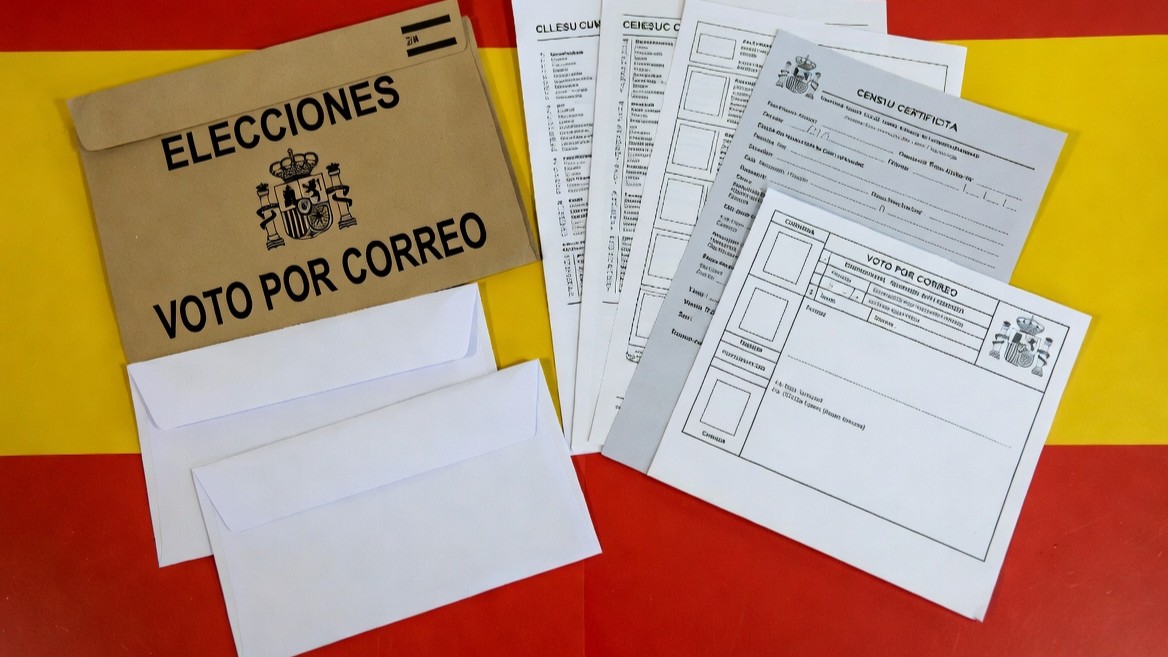
AI-generated image
Grok / europeanconservative.com
In the last four regional elections held in Spain—Extremadura, Aragón, Castilla y León and Andalusia—the PP won comfortably among in-person voters. In all four, the PSOE won among Spaniards registered abroad.
This is not a minor statistical quirk. It is an unprecedented anomaly in Spanish democracy, where domestic and absentee votes have historically moved in the same direction.
The numbers speak for themselves. In Andalusia, Juanma Moreno’s PP swept the polls on 17 May with 53 seats, leaving the PSOE 19 points behind. Yet in the count for the Electoral Roll of Absent Residents (CERA), the Socialists obtained 6,703 votes against the PP’s 6,307.
In the previous Andalusian elections of 2022, before the nationalisation law for grandchildren of exiles came into effect, the PP was the most-voted party among electors living abroad with 1,881 ballots—55 more than the PSOE. Four years later, the swing ran nearly 400 votes in the opposite direction.
The same pattern played out in Extremadura: the PSOE obtained 629 CERA votes against the PP’s 482—enough to retain a seat contested by just 244 votes in the province of Cáceres.
Multiple outlets have reported that the national impact of the CERA vote could be even greater in the next general and regional elections of 2027, when many of those who applied under the so-called “grandchildren’s law”—which has accumulated 2.4 million applications—will be eligible to vote. The CERA roll for the Andalusian elections grew 15% compared to 2022, directly as a result of that legislation. The country with the largest number of registered Andalusian overseas voters is Argentina, with 68,782 enrolled.
This is where the core problem lies. The government has decided to outsource part of the digitisation process for nationality files at the General Consulate of Buenos Aires—which holds exactly 645,052 pending applications—removing a critical phase of the process from direct civil service oversight.
Socialist senator César Mogo, the PSOE’s coordinator for Spaniards abroad, confirmed before the General Council of Spanish Citizenship Abroad that the government is “putting in place the means to accelerate nationality registrations” and has mobilised more than 2,000 additional hires to reinforce the consular network.
The question the data raises is whether this amounts to the deliberate construction of a new electorate. Experts note that fast-tracking the mass naturalisation of potential voters—through private contractors, with declared priority given to the country historically most favourable to the PSOE abroad is neither a standard administrative procedure nor a neutral one.
Postal voting adds another layer of vulnerability to the system. Spain has documented cases of manipulation in local electoral processes. The CERA mechanism operates entirely by post or consular ballot box, without the in-person controls that apply to voting on national territory, making traceability difficult in the event of irregularities. No ongoing investigation has directly linked the PSOE to fraud in overseas voting but the structural incentives for its manipulation are objectively present. Active judicial proceedings on the matter exist in Spain.
Four elections. Four PP victories at the polls. Four PSOE victories abroad.