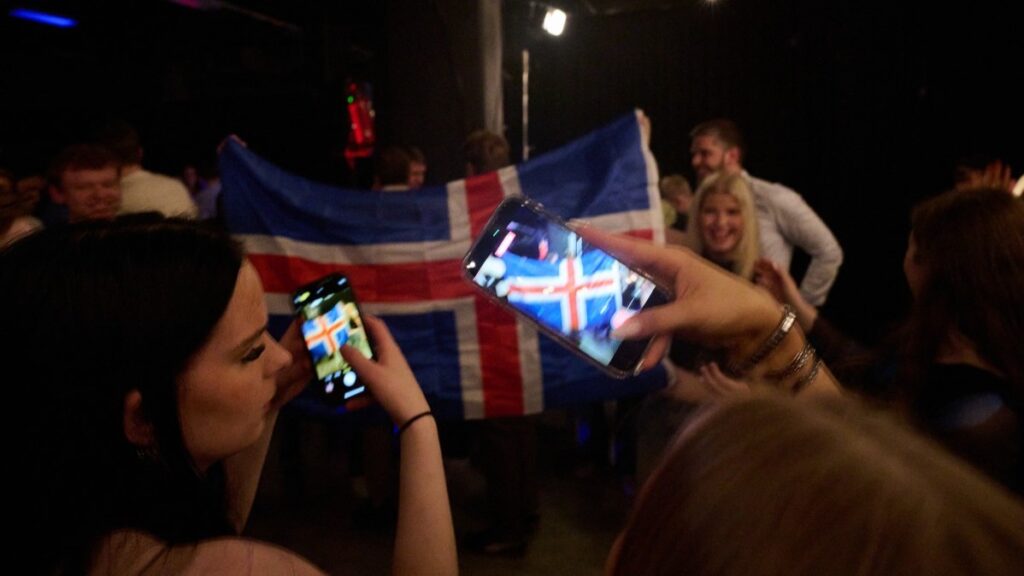
Women take pictures with their mobile phones as supporters wave an Icelandic flag during a referendum night event organised by Sfram Island, the ‘No’ campaign against resuming Iceland’s European Union accession negotiations, in Reykjavík, Iceland, on August 30, 2026.
HALLDÓR KOLBEINS / AFP
“It is generally held that few nations have endured oppression and tyranny with greater politeness than the Icelanders. For centuries … they lived in understanding accommodation with oppression, without ever making an attempt at rebellion. To no nation was the very concept of revolution more alien. Icelanders were always ready to kiss the rod that struck them hardest, and to believe that the most cold-blooded executioner was their truest source of help and their safest refuge.”
So wrote Halldór Laxness in 1933, more than two decades before becoming Iceland’s only Nobel laureate in literature. Ninety-three years later, Icelanders appear to have misplaced some of their famous politeness.
On August 29, 2026, they were asked a modest-sounding question: Should Iceland resume accession negotiations with the European Union?
They were not being asked to join. They were being asked whether Iceland should return to the negotiating table, resume an accession process suspended more than a decade ago, and discover what sort of membership agreement might be available.
The slogan of the ‘Yes’ campaign reduced the proposition to four wonderfully reassuring words: Já til að sjá — Yes, to see.
As if there was a box of chocolates on the EU negotiating table. You never know what you are going to get if you don’t look, right? Why not look? Why not listen? Why not negotiate?
Icelanders’ answer was a resounding Nei.
By 52.8% to 47.2 %, Iceland rejected the proposal to resume accession negotiations, amid a turnout of 82.5%t. Reykjavík supported reopening the talks; the rest of the country did not.
Supporters of renewed negotiations repeatedly emphasized the referendum was not formally a vote on EU membership. A ‘Yes’ would not have put Iceland into the European Union, merely reopened negotiations, allowing Icelanders to examine the eventual agreement before making a final decision. But describing the choice as merely a decision about whether to negotiate understates what was at stake.
Iceland’s modern history is one of acquiring sovereignty and then defending it. After centuries of foreign rule, Iceland obtained home rule from Denmark in 1904, became a sovereign state in 1918, and established the republic in 1944.
Within living memory, Iceland was prepared to confront Britain—one of its closest allies—in the Cod Wars in order to establish control over the waters surrounding the island.
Eighty-two years after establishing their republic, Icelanders were being asked whether to reopen a process whose successful conclusion would ultimately require their country to share powers it presently exercises nationally with the institutions of the European Union.
Supporters of membership have a serious answer to the sovereignty objection. Iceland already participates extensively in European integration. Through the European Economic Area, it belongs to the EU’s Single Market and implements a substantial body of EU legislation, yet it has neither representatives in the European Parliament nor a vote in the Council when that legislation is adopted.
Why, they ask, should Iceland continue accepting European rules without obtaining a seat at the table? It is a legitimate question.
This is the first thing foreign readers need to understand about Iceland’s EU debate. The choice has never been between Europe and isolation.
Iceland is a founding member of NATO, belongs to the European Free Trade Association, participates in the Schengen Area, and, since 1994, has participated in the European Economic Area. Through the EEA, Iceland is part of the Single Market, and participates in its four freedoms: the free movement of goods, services, capital and people.
Icelanders already live, study, work and establish businesses throughout the EEA under its free-movement regime. Much of the economic integration commonly associated with EU membership is therefore already part of everyday Icelandic life.
There is an obvious democratic weakness in this arrangement. Much EU legislation relevant to the EEA eventually becomes applicable in Iceland, while Iceland does not vote when the Union adopts that legislation. Iceland participates in expert work and has mechanisms for influencing legislation during its preparation, but it is not an EU member and therefore has no commissioner, no members of the European Parliament, and no vote in the Council.
That is perhaps the most persuasive argument advanced by supporters of full membership: Iceland already pays part of the price of European integration without receiving the political representation of an EU member.
But the EEA is not the European Union. Crucially, it does not incorporate some of the areas in which Iceland has been most determined to retain national control. Iceland is outside the EU customs union and Common Commercial Policy. It retains its own currency and monetary policy. And two areas of enormous economic, cultural and political importance—agriculture and fisheries—remain outside the EU’s Common Agricultural Policy and Common Fisheries Policy.
That is where the apparently simple promise of a “seat at the table” becomes considerably more complicated. Full membership would give Iceland a voice and vote in institutions in which it currently has neither. But it would also extend European integration into areas that Iceland deliberately controls outside the EEA today. The seat does not come free.
There is perhaps no worse country in Europe in which to describe fisheries as merely another “policy area” than Iceland.
The sea is inseparable from the country’s history. For centuries, fish meant survival. In the twentieth century, fisheries became the foundation of Iceland’s transformation from one of Europe’s poorest societies into one of its wealthiest. Control over the surrounding waters consequently became almost synonymous with economic independence itself.
Iceland fought hard for that control. Beginning in the 1950s, Iceland progressively extended its exclusive fishing jurisdiction: first to 12 nautical miles, then to 50 and finally, in 1975, to 200. Britain resisted. What followed became known as the Cod Wars, an extraordinary series of confrontations in which a country with no standing army challenged one of the world’s major naval powers over the right to control the fish in the waters surrounding its shores.
British warships protected trawlers operating in the disputed waters. Icelandic Coast Guard vessels cut British trawl wires. Ships rammed one another. Diplomatic relations deteriorated to the point that Iceland threatened to break relations with Britain and even raised the possibility of closing the strategically vital NATO base at Keflavík at the height of the Cold War.
Iceland won. In 1976, Britain accepted Iceland’s 200-nautical-mile fisheries limit. What had begun as a dispute over cod had become something considerably larger: an assertion by a tiny nation that the natural resources surrounding it belonged first and foremost under its own control.
That history makes the European Union question uniquely difficult in Iceland. Iceland today is outside the EU’s Common Fisheries Policy. It manages fisheries within its jurisdiction under Icelandic law, while stocks shared with other countries are necessarily subject to international agreements.
An Iceland that became a member of the European Union would, by contrast, enter the Common Fisheries Policy (CFP). Fishing opportunities for stocks governed by the CFP are determined within a common European legal and political framework; the Council sets total allowable catches and allocates fishing opportunities among member states, after which individual states distribute their national allocations domestically.
This distinction is sometimes blurred in Iceland’s EU debate. Membership would not mean that a bureaucrat in Brussels would decide whether an individual fisherman in Ísafjörður may take his boat to sea on Tuesday morning. Member states retain important administrative powers, including the domestic allocation of their fishing opportunities. But neither would Iceland retain the system it has today.
The fundamental legal framework within which those decisions are made would no longer be Iceland’s alone. And no existing EU member state has been granted a permanent exemption allowing it simply to remain outside the Common Fisheries Policy.
That is an important fact in the context of Iceland’s recent history. In 1976, Iceland was prepared to jeopardize relations with Britain and threaten the cohesion of NATO in order to secure national control over its fishing grounds.
Half a century later, Icelanders were asked to reopen negotiations whose successful conclusion would ultimately require those same waters to come within the European Union’s common fisheries regime. One need not regard the European Union as an enemy of Iceland to appreciate the historical significance.
Supporters of accession frequently answered such objections with a reassuring word: Negotiation. Iceland, we were told, would never accept an agreement that sacrificed its vital interests. Its fisheries are unique. Its geography is unique. Its dependence upon marine resources is unique. Surely Brussels understands that Iceland must therefore receive a unique settlement.
Perhaps it would.
Accession negotiations are negotiations, after all. Transitional arrangements, technical adaptations and country-specific provisions are commonplace. But there is an important difference between negotiating the terms under which European rules will apply and negotiating whether the fundamental rules will apply at all.
The European Union calls the body of rights and obligations binding upon its members the acquis communautaire. Candidate countries are expected to adopt it. The purpose of accession negotiations is not to allow a candidate to select à la carte which fundamental components of EU membership it wishes to accept.
That distinction is especially important in fisheries. There is no precedent for a member state joining the European Union while receiving a permanent general exemption from the Common Fisheries Policy.
Iceland could therefore have negotiated over the details. It could have fought ferociously over fishing opportunities, access arrangements, transitional periods and recognition of Icelandic circumstances. It might even have obtained a better agreement than skeptics expected.
What it could not reasonably have done was begin negotiations by assuming that Iceland would somehow become the first EU member permitted to enjoy full membership while permanently remaining outside one of the Union’s common policies simply because that policy was politically unacceptable at home.
The question was not whether Iceland could negotiate. Of course it could. The question was what Brussels was capable of conceding without ceasing to apply the rules of the Union itself.
And that is what makes Saturday’s result more interesting than an ordinary rejection of EU membership. Icelanders did not reject an accession treaty. There was no treaty. They did not reject terms offered by Brussels. There were no terms.
They rejected the proposition that Iceland should reopen the process at all.
The ‘Yes’ campaign understood the difficulty and responded with a clever argument. Já til að sjá did not ask Icelanders to fall in love with the European Union. It did not even require them to decide whether membership was desirable.
Just negotiate. Just see. Then decide. It was politically attractive because it appeared to postpone the difficult question. But perhaps that was also its weakness. For Icelanders had seen it before.
Iceland applied for EU membership in 2009 and negotiations began the following year. They were suspended after the change of government in 2013. The debate over fisheries, agriculture, sovereignty and the euro is not new. Nor is the fundamental structure of the European Union an undiscovered country awaiting an Icelandic expedition.
The geography of the result is difficult to ignore. Reykjavík was the only part of Iceland to vote ‘Yes.’ Outside the capital, the proposal was rejected.
That divide should give pause to anyone tempted to dismiss opposition to membership as mere nostalgia or nationalism. The industries most directly affected by some of the unresolved questions of accession—particularly fisheries and agriculture—are disproportionately located outside the capital.
What may look from Reykjavík like an institutional question about Iceland’s influence in Europe can look very different from a fishing village whose economic existence depends upon decisions about the sea.
The temptation now will be to interpret the result as evidence that Iceland has turned its back on Europe. It has done nothing of the sort.
As noted, Iceland remains deeply integrated with Europe through the EEA. It remains in Schengen. It remains a member of NATO and EFTA. Icelanders will continue to live, work, study, trade and travel throughout Europe.
The referendum did not ask whether Iceland was European but whether Iceland wished to restart the process of becoming a member of the European Union. Those are not the same question.
There is something almost wonderfully Icelandic about the result. A nation of fewer than 400,000 people, sitting on a volcanic island in the North Atlantic, was invited to reopen negotiations with a political and economic union of more than 450 million people.
The proposition was deliberately modest. Nobody was asking Iceland to sign away anything. Nobody was asking Iceland to adopt the euro. Nobody was asking Iceland to hand its fisheries to Brussels. Iceland was simply being invited back into the room.
Yes, just to see.
Which brings us back to Halldór Laxness. In 1933 he mocked his countrymen for their remarkable willingness to endure domination politely—to kiss the rod that struck them and convince themselves that whoever wielded it was really their protector.
Ninety-three years later, Iceland was offered no rod at all. Only a chair. A chair at the negotiating table. Icelanders looked at it. And decided they were perfectly comfortable standing.
Nei.