The foremost and largest traditionalist society of Catholic traditionalists was excommunicated by Pope Leo XIV on 2 July, after four bishops were consecrated at a public Mass in Écône, Switzerland, without the permission and in rebellion against the expressed wishes of the Holy See.
The Society of Saint Pius X (SSPX) is known for its rigorous doctrinal, social, and liturgical conservatism. Presenting itself as a bastion of old Catholicism in an institution in which morality and doctrine are not supposed to be able to change, it counts 733 priests, 264 seminarians, and some 600,000 faithful attending its Masses across 77 countries. Founded in 1970 by Archbishop Marcel Lefebvre in reaction to the liberal and modernising reforms of the Second Vatican Council, it has operated an extensive network of schools, seminaries, and chapels on five continents, exercising an influence over the Catholic landscape wholly disproportionate to its formal membership. The SSPX has furthermore played a pivotal role in keeping the old Traditional Latin Mass (TLM) alive—a form which is linguistically, audibly, theologically and orientationally more solemn than modern forms, with emphasis on silence, reverence, seriousness, ancient chant, purification and contrition for sins—during the decades when official Church policy was largely hostile to it.
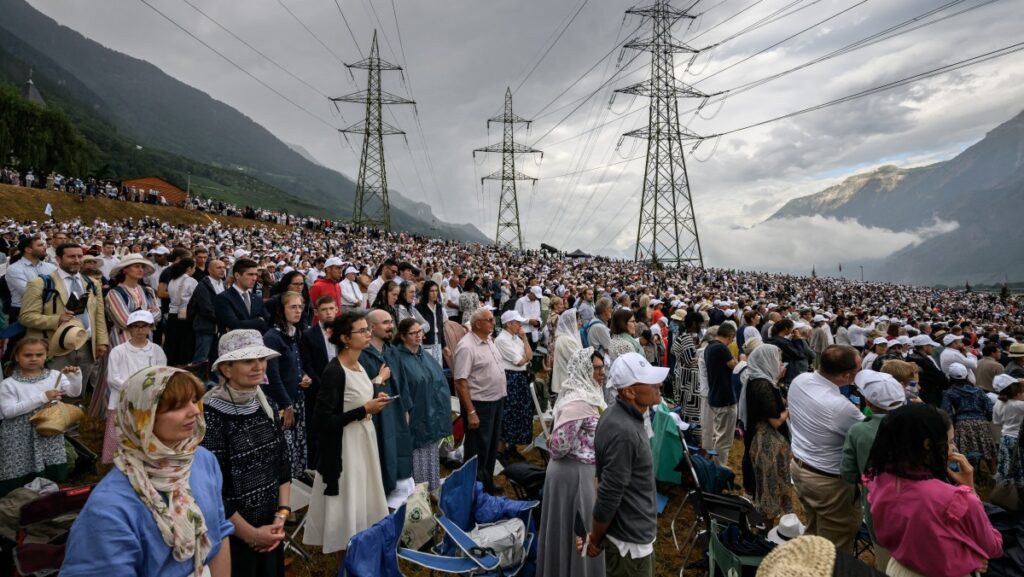
The ceremony itself carried an atmospheric quality noted keenly by observers and in reports. As the four men—Pascal Schreiber (of Switzerland), Michael Goldade (from the United States), and the Frenchmen Michel Poinsinet de Sivry and Marc Hanappier—received the laying on of hands before some 16,600 faithful, clouds gathered over the Swiss Alps, and a torrential downpour fell on the crowd, with thunder and lightning breaking over the hillside. By the close of the Mass, the sun had returned. The newly consecrated bishops processed uphill to the seminary courtyard to applause from the society’s priests. Critics speculated that the sombre atmosphere of defiant chant amidst streaming rainfall in the Swiss Valley may be a sign of divine disapproval—a suggestion dismissed by supporters.
The two presiding bishops were Alfonso de Galarreta and Bernard Fellay—the surviving members of the four consecrated by Lefebvre in 1988, whose own excommunications were lifted by Pope Benedict XVI in 2009. At the point in the liturgy where the papal mandate would normally have been read aloud, an assisting priest instead proclaimed a justification: “From the Second Vatican Council to the present day, the authorities of the Church have been animated by a spirit that is contrary to that of the faith.” Its superior general, Father Davide Pagliarani, in his homily, dismissed Leo’s plea as presenting “a false dilemma between the society’s vision of the faith and its adherence to the Church” and called for the canonisation of Lefebvre—himself a signal of the gulf between the society and any near-term reconciliation.
The SSPX’s position is now complicated according to a Catholic ecclesiological understanding. The new SSPX bishops are recognised as real bishops in the same way Rome recognises those of the Eastern Orthodox Churches, who possess real sacraments and apostolical succession but, due to their illicit character, are said to have broken communion with Rome.
Its longstanding quarrel with Rome, to whose authority it simultaneously claims and defies fidelity, has always centred on what it regards as the 1960s council’s rupture with Tradition, particularly on the question of religious liberty. For decades this produced a situation Rome itself struggled to characterise consistently. Since the SSPX’s founding, it had justified its largely independent operations and organic growth as a response to a state of necessity and crisis in the Church amidst mass apostasy and exodus from the Faith. Typically, when an order or apostolic society in the Church wants to establish a new parish or location, they must be granted jurisdiction from the local bishop and Rome. The SSPX had been acting independently of this, which flouts the normal requirement that a religious institute or order seek jurisdiction from local bishops before establishing parishes and apostolates. However, such an initiative is not without precedent in history for extraordinary circumstances such as during foreign missions. The 1917 Code of Canon Law and theological qualifications by St. Thomas Aquinas did provide concessions for disobedience in such circumstances, which the SSPX uses as its defence.
Yet its situation was never simply that of a condemned organisation. John Paul II excommunicated Lefebvre and the 1988 bishops in Ecclesia Dei adflicta, which also created the Priestly Fraternity of Saint Peter, a similar organisation, as a vehicle for traditionalists willing to remain in communion with Rome. Benedict lifted the excommunications in 2009 and liberated the old Mass through Summorum Pontificum in 2007. Francis, despite his well-documented impatience with what he regarded as the “rigidity” of traditionalists, validated SSPX confessions in 2015 and marriages in 2017—concessions which implicitly acknowledged that the society served real pastoral needs. All of this was formally rescinded on 2 July.
The question of why Rome and the SSPX failed, across four pontificates, to reach the agreement that always seemed theoretically possible admits of a precise answer: the society refused to accept the Second Vatican Council’s teaching on religious liberty as compatible with the Faith, and no pope was willing to concede that it was not. The most recent attempt collapsed in February 2026, when Cardinal Fernández met Pagliarani in Rome and offered dialogue contingent on suspending the planned consecrations. The society declined, publishing a letter stating that seeking full communion was “impracticable due to doctrinal divergences” and announcing its intention to proceed on 1 July—the feast of the Precious Blood and the day after the anniversary of 1988.
On June 30, Pope Leo published a personal letter to Pagliarani—his first direct public communication with the society. “I plead with you and ask you with all my heart: please turn back,” he wrote. “To tear the seamless garment of Christ is a sin of extreme gravity. May the Lord enlighten your consciences and awaken your hearts.” The appeal went unheeded. Leo had told journalists earlier that month: “If they make that choice, I am sorry, but we must move forward.”
The decree signed by Cardinal Fernández on July 2 declared all six bishops—the two consecrators and the four newly ordained—excommunicated latae sententiae (or automatically) and, controversially, went further than the 1988 response by explicitly extending the warning to the society’s clergy and to lay faithful who “formally adhere” to the schism. This now puts its 600,000-some lay Mass attendees in a precarious position, and defections are anticipated.
The confessions and marriages SSPX priests had been granted faculties to witness were simultaneously invalidated. Fernández, when asked about prospects for future dialogue, told journalist Michael Haynes only: “They didn’t consider useful the dialogue we’ve proposed. But we hope in future, thanks to the action of the Holy Spirit, it’ll be possible. I’m sure, but we’ll need time.”
The SSPX is sometimes characterised as a far-right organisation, an association largely traceable to Bishop Richard Williamson—one of the original 1988 bishops—who was charged with Holocaust denial by a German court and expelled by the society itself in 2012 for persistent insubordination. He died in January 2025. His followers represent a fringe: the society’s own mainstream has consistently maintained that his views did not reflect its positions.
Traditionalists more broadly, while often accurately correlated with social and political conservatism, represent something more ecclesiologically significant than their critics allow. They constitute a small fraction of nominal Catholics globally (an estimated 1-2% of masses offered around the world) but make up a strikingly different proportion of regular and weekly massgoers. Research by Professor Stephen Bullivant of St Mary’s University, London, and sociologist Stephen Cranney—whose forthcoming book Trads was discussed with Pope Leo XIV at a private audience in March—documents that TLM communities are among the most demographically vigorous in the Western Church: younger, with higher birth rates, stronger rates of Mass attendance, and a disproportionate contribution to conversions and priestly vocations. Survey data finds that 85% of TLM Catholics believe abortion should always be illegal, and 77% lean Republican in the United States, figures that explain both the movement’s vitality and the hostility it attracts from within the institution it inhabits. Other research has found 98% of TLM Catholics disagree with gay marriage, and nearly all attend weekly, as is required by Church law.
In nations such as France, for example, Catholic traditionalism is correlated strongly with conversions and growth among the youth. Despite their fractional overall size, in France, Ireland, and Czechia, traditionalists have been found to constitute a significant proportion (and often even a majority) of the men and women pursuing vocations as priests and nuns every year, at a time when such figures have collapsed and the Church is short-staffed. Furthermore, such lay traditionalists are politically engaged. In Poland, Krzysztof Bosak of the right-wing Konfederacja party, who is deputy marshal of the Sejm, is a traditional Catholic. As is Victoria Villarruel in Argentina, libertarian-right Javier Milei’s vice president. Villaruel is reported to attend an SSPX chapel in Buenos Aires. In France, Catholic traditionalism is strongly associated with monarchism and political conservatism.
The practical consequences of the excommunication are severe. The SSPX operated 798 Mass centres worldwide, making it the single largest network of TLM provision in existence. It is dominant particularly in Latin America, Africa, and Asia, where alternative traditionalist infrastructure is sparse. The Mass of the Ages database, which tracks traditional Mass availability globally, removed SSPX listings following the excommunication, reducing accessible centres for Catholics in full communion with Rome from approximately 1,832 to 1,034 overnight.
The TLM—the liturgical form in use for most of Western Christian history, under which Catholic missionaries evangelised continents, and which correlates in contemporary research with greater retention of faith across generations—has been substantially reduced in reach. The loss falls most heavily on the developing world, where the FSSP, the Institute of Christ the King Sovereign Priest, and other approved communities have little or no presence.
The Vatican simultaneously published a path of return. A priest wishing to leave the SSPX must write a handwritten letter to the Holy Father, submit signed professions of faith and adherence—including acceptance of the Second Vatican Council and the legitimacy of the post-conciliar Mass—and find a bishop willing to receive him. Lay faithful who formally adhered must submit equivalent documentation to their local bishop. Those who attended SSPX Masses purely for liturgical reasons without formally embracing its doctrinal positions need only approach a priest in full communion with Rome and commit not to return. Canon lawyers confirmed that excommunication requires full awareness and deliberate consent and cannot be presumed automatically for ordinary worshippers, so those unaware of these developments remain without culpable fault and don’t incur grave sin which can put souls in jeopardy at judgement.
A path to full reconciliation has been indicated as still open. What its precise terms might look like beyond the published procedure Rome has not yet clarified, and the society has given no indication it regards the offered terms as acceptable. What is clear is that the traditionalist movement has taken a major blow and that the precedent of 1988 suggests the nature of the response now being called for.
When John Paul II excommunicated Lefebvre, he simultaneously founded the FSSP and the Ecclesia Dei commission to provide for traditionalists who wished to remain inside the Church’s structures. The calls now being made on Pope Leo XIV follow the same logic: that he use this moment not merely to close a door on the SSPX but to open a wider one for the hundreds of thousands of Catholics who love the traditional Mass, hold doctrinal positions Rome has never disputed, and have never had any truck with the society’s defiance of the papacy.
Pope Francis, who famously found traditionalists “rigid”, expressed distaste over their right-wing politics, and whose 2021 Traditionis Custodes heavily restricted TLM celebrations within the mainstream Church, was not a pontiff inclined to extend such a provision. Leo XIV—who permitted the first traditional Mass in St Peter’s Basilica since 2022 in October 2025, celebrating with some 3,000 pilgrims the annual Summorum Pontificum pilgrimage—has, since his election, given no equivalent signals of hostility. Seasoned Vatican watchers are monitoring July 7, the fifth anniversary of Traditionis and the nineteenth of Summorum, for any indication of which way he intends to move.