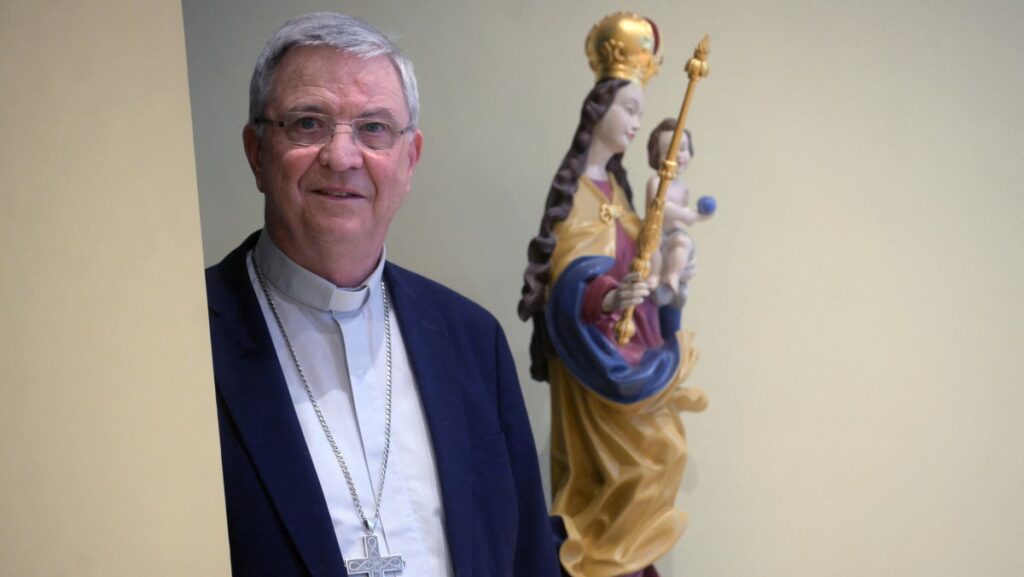
The Bishop of Antwerp, Msgr. Johan Bonny, poses in Antwerp on March 25, 2026.
NICOLAS TUCAT / AFP
In 1922, the German philosopher Carl Schmitt introduced the concept of the “state of exception” in his famous work Political Theology. According to Schmitt, the true sovereign is recognized by one characteristic, namely the capacity to decide on the state of exception. This concept is the starting point of the entire Schmittian theory of political power.
Since—Schmitt argues—law cannot foresee everything and there are numerous situations that law seems incapable of addressing effectively (such as wars, pandemics, civil unrest), the sovereign must be ready to suspend the law and act as if it did not exist. For Schmitt, therefore, the state of exception is a structural element of the very concept of state sovereignty.
However, when we examine the history of modern states, we realize that the state of exception, understood precisely as the suspension of the entire juridical structure in the name of an emergency, is not really an exception, but the norm, almost a permanent technique of governance. Recent history, in particular, shows the truth of this thesis: consider the measures adopted by the United States and the European Union in the aftermath of September 11, the preventive measures adopted during the COVID-19 pandemic, and the likely restrictions that the West has warned about in the near future to address the energy crisis caused by the Israeli-Iranian conflict.
All this reasoning, however, should not be valid when speaking of law in the Catholic Church. At least in theory. This is because ecclesiastical law, or canon law, is not only a true juridical system, but above all a theological discipline, and its presuppositions are therefore notably distinct from modern and Schmittian ones.
An approach to canon law similar to that of state law leads to serious misunderstandings regarding the origin of authority, which for the Church is God, whereas for states it is the people; regarding the purpose of norms, which for the Church is the salvation of souls, whereas for states it is temporal well-being; regarding the subjects of power, which for the Church does not coincide with the entire people of God, whereas for modern states it tends to do so; regarding the sources of power, which for the Church are Scripture, Tradition, and the Magisterium, whereas for states they are generally constitutions.
Moreover, ecclesiastical law is divided into two large parts. On the one hand, divine law, irreformable by definition, and on the other hand, human law, which can be modified. The pope, considered the supreme legislator of the Church, is an absolute sovereign with respect to human ecclesiastical law—not with respect to divine law. This means that he can modify, abrogate, suspend, even violate what human ecclesiastical law prescribes and even the laws he himself has promulgated without anyone being able to reproach him, because he possesses supreme authority and prima sedes a nemine iudicatur, the See of Saint Peter is judged by no one.
On the contrary, should the pope contradict divine law, he would fall into the terrible crime of the heretical pope, a theological-canonical hypothesis that has prompted rivers of ink from great theologians of the past. The pope is, in fact, only a minister, that is, a servant and guardian of that law, and not a sovereign: otherwise it would be as if one claimed to dictate to God what is right and what is wrong.
For these reasons, the state of exception is not contemplated by canon law, because it would imply the suspension of divine law, but this is absurd. The law of the Church contemplates only the state of necessity, something quite different, because it concerns the violation—not suspension—of a particular norm in order to avoid the more serious violation of another, more fundamental norm, usually of divine law, such as the salvation of souls.
However, over recent decades, a way of thinking has established itself within the Catholic Church that treats canon law in the same way as any state law and, therefore, as a system that could contemplate the state of exception. This line of thought has found in the pontificate of Francis a notable theoretical legitimization.
Unlike other post-conciliar pontiffs, Francis did not see the history of the Church as just having occasional crises that Catholics overcome by recovering their identity and mission. but rather as a reality structurally marked by crisis. The life of the Church would, in this perspective, be a permanent crisis.
“A crisis is something that affects everyone and everything,” Francis explained to the Roman Curia in December 2020, in the midst of the pandemic:
Crises are present everywhere and in every age of history, involving ideologies, politics, the economy, technology, ecology and religion. A crisis is a necessary moment in the history of individuals and society. It appears as an extraordinary event that always creates a sense of trepidation, anxiety, upset and uncertainty in the face of decisions to be made.
Francis also distinguished crisis from conflict: the former “generally has a positive outcome,” while the latter “always creates discord and competition, an apparently irreconcilable antagonism.” Reading the Church through the categories of conflict—right and left, progressives and traditionalists—“she becomes fragmented and polarized, distorting and betraying her true nature.” The Church would instead be “a body in continual crisis, precisely because she is alive.”
This vision leads to a conception of crisis that coincides, in its juridical effects, with the Schmittian state of exception. If a crisis is structural and permanent, then a condition of emergency is always in force; and if the emergency is permanent, those who hold authority are always, in principle, legitimized to suspend ordinary norms in its name.
This helps to understand why, on several occasions, Francis governed by setting aside divine law (see Amoris Laetitia, Fiducia supplicans, Dignitas infinita, the modification of the Catechism on the death penalty) and fostering what, in the last Conclave, was perceived by various cardinal electors as a crisis of right. A situation that contributed—not by chance—to the election of a pope with a canonical formation, namely Leo XIV, in the hope that he might restore order, at least from this point of view.
After Francis, the more progressive bishops share this general framework and intend to apply it in even more operational terms. The case of the German Catholic Church is emblematic. The German Synodal Way, to which we have devoted specific analyses here and here, has built its agenda around two declared emergencies—the drama of sexual abuse and the alleged identity obsolescence of the Church—against the backdrop of a set of so-called achievements of the modern world considered irreversible: the scientific worldview, authority founded on consensus, the common good understood as collective progress, the constructivist conception of moral norms, the fluidity of anthropological and sexual identity. The Church, it is said, must take all this into account in order to ‘survive’ and, to do so, its authorities must have the courage to suspend norms, under penalty of extinction. This is exactly the argumentative structure of the state of exception applied to ecclesial life.
An example of extraordinary clarity in this regard is offered by the pastoral letter that the bishop of Antwerp, Johan Bonny, published on March 19, 2026, in which he outlines the “synodal” operational intentions he intends to implement by 2028 for his diocese.
The most interesting point is that Bonny himself uses the term “exception clause,” referring to can. 517 §2 of the Code of Canon Law. This canon allows, in the absence of priests, the pastoral responsibility of a parish to be entrusted to a layperson, under the formal supervision of a priest. Bonny writes in this regard: “a situation cannot continue in which practically the entire pastoral organization of a diocese is based on an exception clause of canon law. This exception clause has become almost the norm in our region.”
Bonny thus admits, involuntarily but precisely, what Schmitt theorized on the political plane: since the exception becomes the norm, the norm must be suspended. However, instead of drawing the canonically correct conclusion—that it is necessary to work to restore the ordinary condition—he uses it as an argument to push in another direction, namely the ordination of married men in the short term (a matter of human ecclesiastical law) and above all—the real long-term objective—the ordination of women (formally prohibited by divine law).
Here we are not simply faced with a theological error or a canonical disobedience on the part of the bishop of Antwerp.
The most disruptive part of the letter is the announcement: “I will do everything possible so that, by 2028, married men may be ordained presbyters in our diocese. I will address them personally and ensure that, by that date, they have acquired the necessary theological formation and pastoral experience.”
Here, Bonny places himself exactly in the position of the sovereign who decides in the state of exception. It is not a synodal proposal nor a formal request to the Holy See: it is a plan established with deadlines and concrete operational modalities, and significantly conducted in a ‘transparent but discreet’ manner, far from media attention, as if to minimize the reaction of higher authority before the process becomes irreversible. The fact that he then mentions the need for “agreements with the Belgian Episcopal Conference and with the Vatican” appears, in this context, as a notification imposed by diplomatic-formal duties, rather than as a genuine request for authorization.
Therefore, although Bonny’s reform concerns something that is technically reformable—the ordination of married men—he intends to carry it forward unilaterally, without authorization, anticipating a decision that belongs only to the pope by divine law, and in doing so he acts as if he could suspend the latter.
This sovereign attitude is supported throughout the letter by a systematic lexicon of emergency, which constitutes the typical argumentative presupposition of the logic of the state of exception. Bonny warns that a synodal process devoid of “concrete short-term changes will dissipate enthusiasm”; he states that “what must be done can no longer be postponed sine die”; he believes that “too many issues have remained unresolved for too long” and that “a bishop cannot wait and see where the ecclesial wind blows. He must assume responsibility, here and now, without easy excuses.”
To justify his decision to ordain married men in defiance of the sanctions and prohibitions of canon law, Bonny indicates popular consensus as an autonomous normative source capable of correcting the pontifical Magisterium: “on this issue the consensus is almost unanimous in all components of the people of God, especially among the most faithful and devout. Such consensus, moreover, is not new; it has existed for many years now. The question is no longer whether the Church can ordain married men as priests, but when it will do so and who will do it. Any delay sounds like an excuse.” And shortly thereafter he adds: “clerical subcultures and lifestyles have had their day.”
Transforming the sensus fidei—or what is presumed as such—into an instrument of pressure on magisterial orientations means applying the logic of the state of exception not only to positive canon law—which the pope can indeed reform—but also to what pertains to divine law, which is irreformable.
We find here the maximum point of distance from the correct canonical notion of the state of necessity: one does not violate a lesser norm in order to safeguard a greater one, but rather invokes sociological pressure to override norms of a higher rank. In other words, the “consensus of the people of God” in a direction contrary to the pontifical Magisterium is pointed out as part of the emergency that should legitimize suspension by the ‘Schmittian sovereign,’ that is—in our case—the bishop.
The consequences for the future are not difficult to foresee. If this logic consolidates, the Catholic Church risks fragmenting not along the visible lines of doctrine, but along the invisible and far more insidious ones of practice: dioceses that ordain married priests, dioceses that do not; dioceses administered by women, dioceses administered by bishops; dioceses that bless homosexual couples, dioceses that do not. A silent fragmentation that would make the problem infinitely more difficult to correct than an openly declared schism.