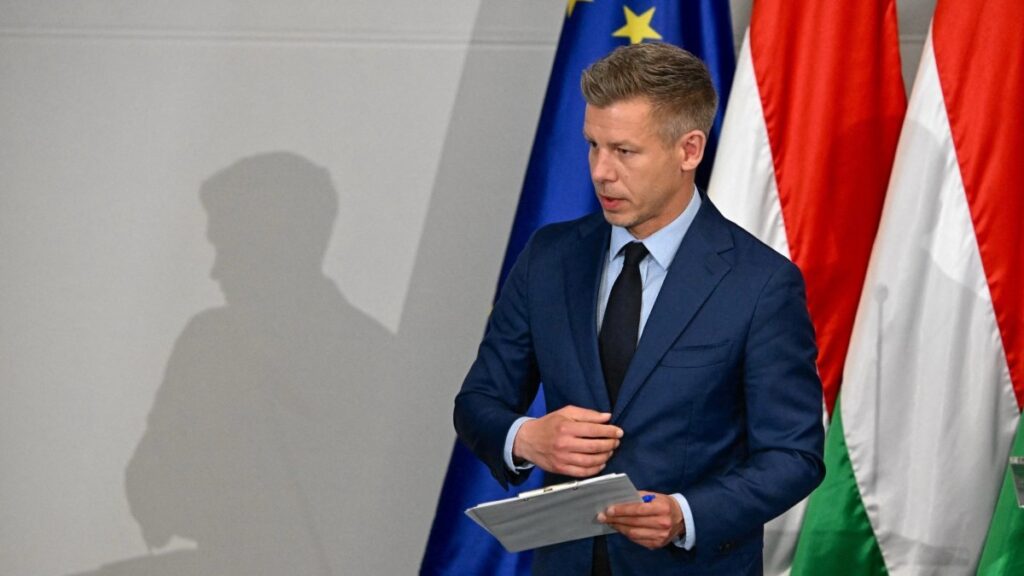
Péter Magyar leaves after a press conference in Budapest, Hungary, on April 20, 2026.
ATTILA KISBENEDEK / AFP
Hungarian politics has shifted gears in a matter of days. Péter Magyar’s electoral victory has not yet translated into a fully formed government, but it has already triggered a series of moves—both domestic and European—that, due to their speed, reveal more than a simple political alternation.
What is at stake is not only Hungary’s direction, but the balance between national sovereignty and European regulatory power.
The first fact is empirical: Brussels has changed its tone. The possibility of unlocking EU funds is back on the table. Institutional pressure is decreasing even before concrete reforms exist. And key figures such as Commission President Ursula von der Leyen have implicitly admitted that the harshness applied against Viktor Orbán’s government may have had direct political effects in the country.
Nothing structural has changed in Hungary yet; what has changed is Brussels’ perception of who governs.
That shift in perception is already translating into decisions. The suspension of the Article 7 procedure—the EU’s main sanctioning tool for rule-of-law breaches—now appears as a real possibility, even though the legal basis has not changed. The message is clear: political evaluation comes before legal assessment.
The institutional context helps explain it. For more than a decade, the relationship between Budapest and Brussels was marked by conflict: migration, rule of law, fiscal sovereignty, family policy. That clash resulted in frozen funds and growing isolation for Hungary within the Council.
Now, the new prime minister promises a change of method: less confrontation, more negotiation, without (apparently) fully abandoning certain pillars such as migration control or the defense of national competencies.
Here lies the first critical turn. Hungary, it seems, is not changing so much in its positions as in the way it presents them. And in Brussels’ logic, that is enough to reconfigure the relationship. At least for now. History shows that the EU always calls in its favors.
Thus, the effects are already visible across several fronts.
In energy, for example, the narrative has shifted immediately. Strategic infrastructures such as the Druzhba oil pipeline—key to Hungary’s energy supply—have moved from being a geopolitical problem to a manageable element. Likewise, controversial industrial projects such as battery factories are no longer framed as structural risks but as assets within Europe’s energy transition. A coincidence?
In foreign policy, the impact is even more direct. The disappearance of the Hungarian veto in key dossiers—especially regarding Ukraine—facilitates decisions blocked for years: financing, sanctions on Russia, coordination within NATO.
Hungary moves from being a disruptive actor to an integrating one. Or at least, that is the expectation in Brussels. But this shift carries internal costs.
The new European environment demands trade-offs. One is already on the table: revising the child protection law, criticized for limiting children’s exposure to content linked to gender education. From Brussels, the message leaves no room for doubt: normalization of relations depends on adapting that legislative framework.
The appointment of an education minister with links to LGBT activism introduces a new layer of tension into Péter Magyar’s narrative. Following a campaign centred on institutional reform and economic management, the appointment has been perceived by his centrist electorate as an unstated ideological shift. The decision is of great importance: education policy has been one of the main battlegrounds between Budapest and Brussels in recent years. If the new government realigns this policy area in line with the Commission’s cultural priorities, it will not only upset the internal balance but also confirm that the rapprochement with the EU is not merely technical, but also normative.
At the same time, the new political power in Budapest has introduced its own institutional tension. Prime Minister-elect Péter Magyar has called for accelerating investigations and arrests against figures linked to the previous government. The intention is to mark a break with the past, but the methods raise concerns.
The political instrumentalization of bodies that are supposed to be independent directly conflicts with the very concept of the rule of law that the EU claims to defend. Therefore, what is happening in Hungary is not a simple change of government. It is a stress test for how the European system functions.
For years, Brussels has maintained that its control mechanisms—financial, legal, political—were neutral. The speed with which they are now being relaxed calls that premise into question. If conditions change before policies do, then the criterion is not strictly normative.
Also, the new Hungarian leadership’s program does not resolve the central question of whether European integration is possible without a full renunciation of sovereignty. Firm migration control, but without open confrontation. Defense of national competences, but within a cooperative framework.
That balance reflects a broader trend across Europe. Positions once considered marginal—on migration, identity, or sovereignty—have gained ground in several member states. Hungary is not an exception and, in many cases, has been one of the drivers of that shift.
The difference now is the language. And the interlocutor.
It remains to be seen whether this change in tone will be enough to sustain the new EU-Hungary relationship or whether, once financial and political ties are normalized, underlying tensions will resurface. Whatever the case, experience suggests that each concession to Brussels is almost impossible to reverse. We will not have to wait long to find out whether this will be the case in Hungary too.