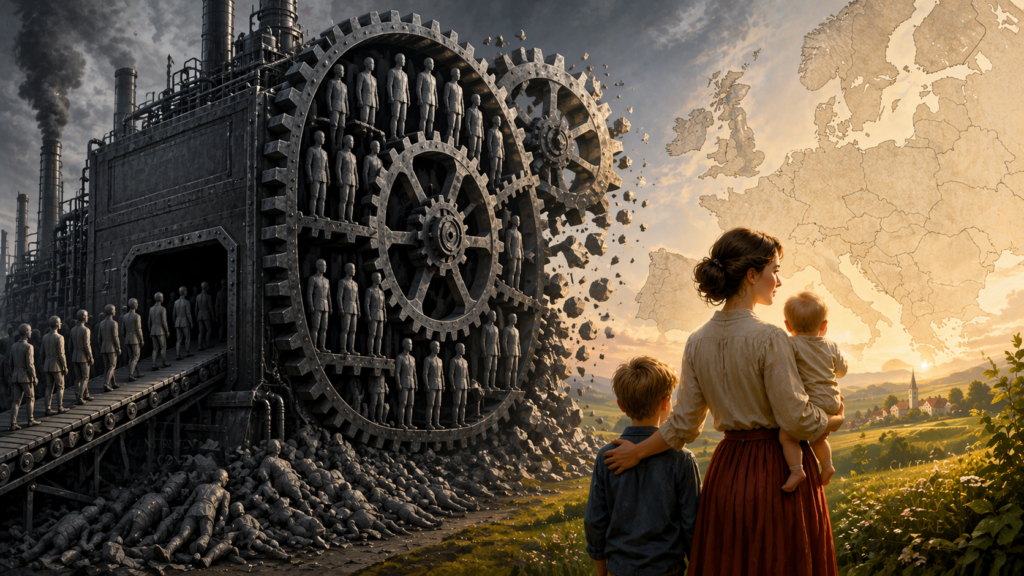
It is well known that socialism is an ideology that ignores the individual and focuses all its attention on the collective. Marx, the preeminent socialist economic theoretician, divided individuals into classes based on the function they have in producing economic value; Lenin, Mao, and others have iterated their own versions of Marxist class theory.
Wherever socialists have carried their ideology to its completion, the result has been the same in terms of the people: in Mao’s China and Stalin’s Soviet, tens of millions of people were starved to death or otherwise killed by the regime; in Pol Pot’s Cambodia, one-quarter of the country’s 8 million people were annihilated in the name of the state’s ideology.
We need to remind ourselves of these atrocities from time to time. By not losing contact with the sordid history of socialism, we can remain vigilant and place current public policy issues in their proper context.
One such issue is the renewed debate over Europe’s demographic future. In recent years, the issue of low fertility rates in EU countries has gotten more attention, even from the political establishment. Sometimes, this attention is marinated in irony, as exemplified by Swedish prime minister Ulf Kristersson. Last spring he took a jab at Russia, alleging such large-scale mismanagement by President Putin that birth rates were plummeting. Only six months earlier, though, Kristersson had himself raised concerns over the plummeting birth rates in Sweden—and he did so in a nationally televised speech.
Kristersson, a nominal conservative, is not the only political leader in Europe who is having difficulties formulating a logical position on the continent’s demographic decline. In a 2024 policy brief, the European Commission tried its best to state that a problem was not a problem, yet it was probably a problem after all.
Meanwhile, Western European leaders sat silent while Europe’s leading national-conservative politician, Hungarian prime minister Viktor Orbán, fought tooth and nail to raise his nation’s fertility rates. Predictably, their efforts at ignoring Hungary’s demographic achievements have not made the fertility rates in the rest of Europe any better. On the contrary, the demographic decline is now rising to crisis level; on April 16th, an article in EUBusiness.com dramatically declared:
The EU population is expected to decline by 11.7 per cent between 2025 and 2100, acccording [sic] to the latest population projections from Eurostat, the EU’s statistics agency. The figures translate to a predicted decrease of 53.0 million people in the EU by the start of the next century.
This means about 50 million fewer residents in the current 27 EU member states by 2100, with a unionwide total just a hair below 400 million.
The population decline is one of the most persistent trends in European society today, yet most of the continent’s political leaders approach the issue with the same ham-fisted ambivalence with which they approach the EU’s notorious economic stagnation, its chronically poor public finances, and even, to some degree, its inability to organize a defense build-up. An important reason for this lack of leadership is that many of Europe’s countries are led by so-called Frankenstein coalitions, whose only goal is to keep conservative and nationalist parties out of political power.
Political deadlock on major policy issues is emblematic for these artificial coalitions, especially when it comes to addressing an issue like demographic decline. This is not surprising, since the socialist side of the political spectrum cannot even agree within itself on whether demographic decline is even a problem.
A sizable portion of the Left believes that population growth is bad for the environment and therefore sees demographic decline as a path to preventing some abstract future climate change catastrophe. Others take the opposite approach to dwindling populations, but instead of arguing for increased birth rates among Europe’s native populations, they propose immigration as the fix-all remedy.
Three arguments stand out among them:
- Racism: the left harbors such contempt for Europe’s native populations that they want immigrants to replace them;
- Fill the jobs: immigration is being marketed as essential to the resiliency of the workforce;
- Tax revenue: among the fiscally minded, population decline erodes tax revenue and causes budget problems for Europe’s lavish welfare states.
The common denominator for all these leftist arguments on demographics, whether they see a declining population as a positive or a negative, is their instrumentalist view of a nation’s population. The mass of people is a tool for socialists to achieve their ideological goals: if they prioritize ‘the environment,’ they advocate a shrinking population; if they prioritize the welfare state, they want the population to grow because they need more taxpayers.
Conservatives have a very different view of demographics. A shrinking population is a problem in itself: it erodes the very essence of a nation, and the nation is inextricably tied to its native population. Children who are born into the cultural, social, historic, and religious context that is a nation embrace that context as they grow up. Their lives, even their personalities, are shaped by their national context; over their lifespan, they contribute to the preservation and evolution of that context.
Nations are quintessential building blocks of human civilization. A native population is quintessential to the nation, which makes a growing or at least sustained population the foundation of the future of human civilization itself.
In other words, conservatives are intrinsically committed to a growing, thriving native population. Socialists, by contrast, view the population as an instrument that can disrupt or further defined policy goals. This makes it problematic—to say the least—for politicians from the different sides to form a mutual understanding on this issue.
At the same time, that is exactly what they need to do. Admittedly, there can never be a mutual understanding between conservatives and the openly anti-civilizational elements of the Left—those who either harbor a racist-driven hostility toward Europe’s native populations or want the human population gone to save the planet. But beyond their most lunatic elements, there is room for conservatives and socialists to talk about such an existential issue as Europe’s currently seemingly inevitable demographic demise.