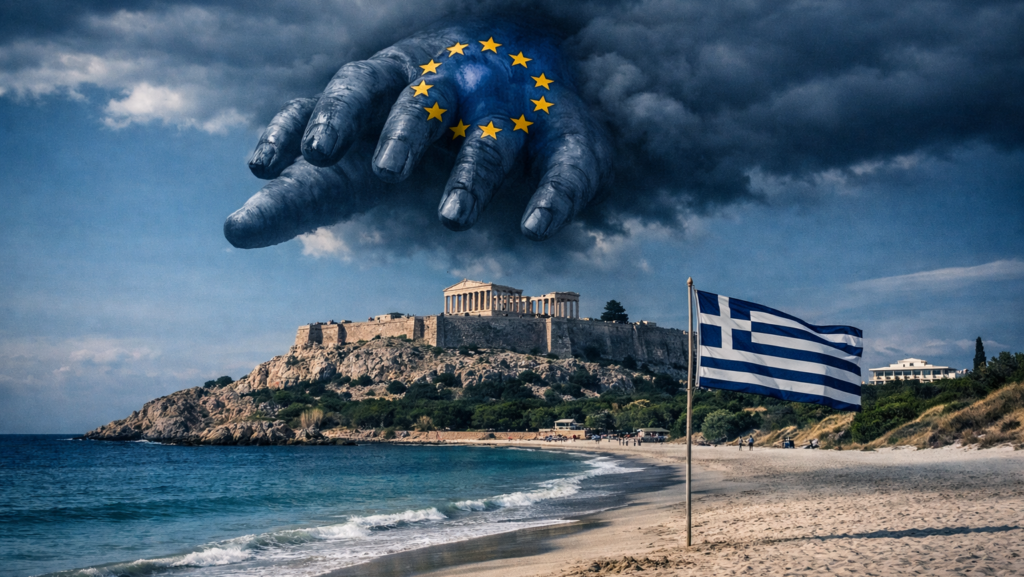
There is good news out of Greece. According to Hellas Journal, the European Commission
is removing Greece from the relevant [fiscal] monitoring category for the first time since the outbreak of the Greek debt crisis
This is the first time in 16 years that the Greek government is free to conduct its own fiscal policy.
Eight years ago, the EU began a gradual relaxation of its Growth Pact enforcement in Greece; in a manner of speaking, 2018 marked a fiscal thaw. That year marked the beginning of a fiscal recovery for Greece; disrupted by the 2020 pandemic, the thaw brought back gradual improvements in the standard of living of a people that—during the most repressive years of Growth Pact enforcement—lost more than a quarter of its per-capita GDP.
We should, of course, be happy for the Greeks who are now free to do their own national business, at least as far as euro- and EU-membership allow them to. But the EU’s heavy austerity hand has been casting an ominous shadow over the country for so long that few Greeks under the age of 40 have any real memories of what it is like to be able to work yourself to a better life.
If there is one lesson to be learned from the past 16 years in Greece, it is that EU powers never improve a country on which they are enforced. If the EU had become what it was originally intended to be—a facilitator of free-market integration and organic unification of Europe—then it would have gone down in history as a civilizational achievement. Instead, soon after the creation of its constitution, the EU began amassing power into its own hands; it has become the very superstate that we EU skeptics of the 1990s feared it would become.
The superstate spirit runs through the entire Eurocracy in Brussels, and nowhere is it more prevalent than in the European Commission. Being the de facto ‘government of Europe,’ the Commission holds the EU member states in various forms of power grips. From regulations to mandatory legislation, from compulsory spending to forced immigration, the EU invades almost every aspect of daily life.
Among the less-debated power tools is the Stability and Growth Pact. Its core edicts force member states to limit their budget deficits to 3% of GDP and their public debt to 60% of GDP. Since the Growth Pact is mostly about taxes and government spending, it is commonly regarded more as a technical instrument than a means of government power.
This is unfortunate. The fiscal rules of the Growth Pact allow the European Commission to wield formidable power over a nation. Wherever enforced, the Pact has made life noticeably more costly to taxpayers. Public services deteriorate as a result of austerity dictates, while member state parliaments have to arrange their very legislative agendas to comply with fiscal dictates from Brussels.
In addition to upsetting domestic economic policy, Growth Pact enforcement leads to rising political tensions. Nowhere was this demonstrated with more chilling clarity than in Greece, where during the harshest Pact enforcement period—2010-2014—extremist parties gained significant foothold in the Greek parliament. For a time during the heaviest austerity policies, Greece was the only country in Europe with an openly Nazi party in its legislature.
Over the years, primarily in 2010-2018, the Commission forced the Greek parliament to pass endless austerity packages. The cumulative effect of them was to raise taxes by 11 percentage points of GDP while social benefits provided by the welfare state were subjected to brutal budget slashes.
For individual Greeks, the slash-and-burn dictates from the EU meant falling into a genuine trap of industrial poverty. When the destruction of the Greek economy reached its peak in 2013, GDP per capita had fallen to €15,900 from its 2007 pre-crisis peak of €21,610—an inflation-adjusted drop of 26%.
Now that the final restrictions on Greek fiscal policy have been lifted, hopefully the country can start rebuilding its prosperity. The improvement in standard of living that has happened in recent years—from the €15,900 low point in 2013 to €19,530 in 2025—equals a 23% gain in 13 years. This improvement is much slower than the 26% loss that happened in less than half that time.
Proponents of the Stability and Growth Pact claim that the improvements seen when the EU winds down or even ends its fiscal proceedings against a member state are the result of Growth Pact enforcement in the first place. Both reality and macroeconomic theory would beg to differ: giving a country a fiscal beating never improves its economy—quite the contrary. There is also a common-sense objection, captured in the ‘beaten dog’ question: If I beat my dog, the dog is unhappy; if I stop beating my dog, the dog is happy. Is the dog happy because I beat it, or because I stopped beating it?
Fiscal austerity—the manifestation of Growth Pact enforcement—shrinks the tax base, causing a problem for government spending not unlike that which Cinderella’s stepsister had when she tried to put on Cinderella’s little glass shoe. With a smaller tax base, even austerity-driven budget cuts cannot guarantee a balanced budget. Therefore, in a manner of speaking, austerity policies prolong the very problem they are intended to solve.
Perhaps this is beginning to dawn on the European Commission. I may be hoping too much, but there is nonetheless this story from Euractiv, June 3rd:
The European Commission has loosened the EU’s fiscal rules to allow countries to reduce their dependence on fossil fuels, as the energy shock unleashed by the Iran war continues to reverberate throughout the bloc’s economies. … The additional fiscal room will apply until 2028 and is capped at a total of 0.6% of annual output
This is not a capitulation by the Commission of any sort. Brussels maintains tight control over fiscal policy by giving member states room for selective deficit spending: in addition to the national defense build-up that—at least in theory—should already be on the way, they can now go a little bit more into debt if the purpose is to reduce their nation’s oil consumption.
With that said, this is yet another retreat from the Growth Pact. It does not amount to a full suspension like the one in 2020, nor does it reach the levels of the ‘greater flexibility’ introduced in 2023, but it is nevertheless an acknowledgment of a macroeconomic fact: the EU’s member states are notoriously incapable of complying with the Pact’s fiscal rules.
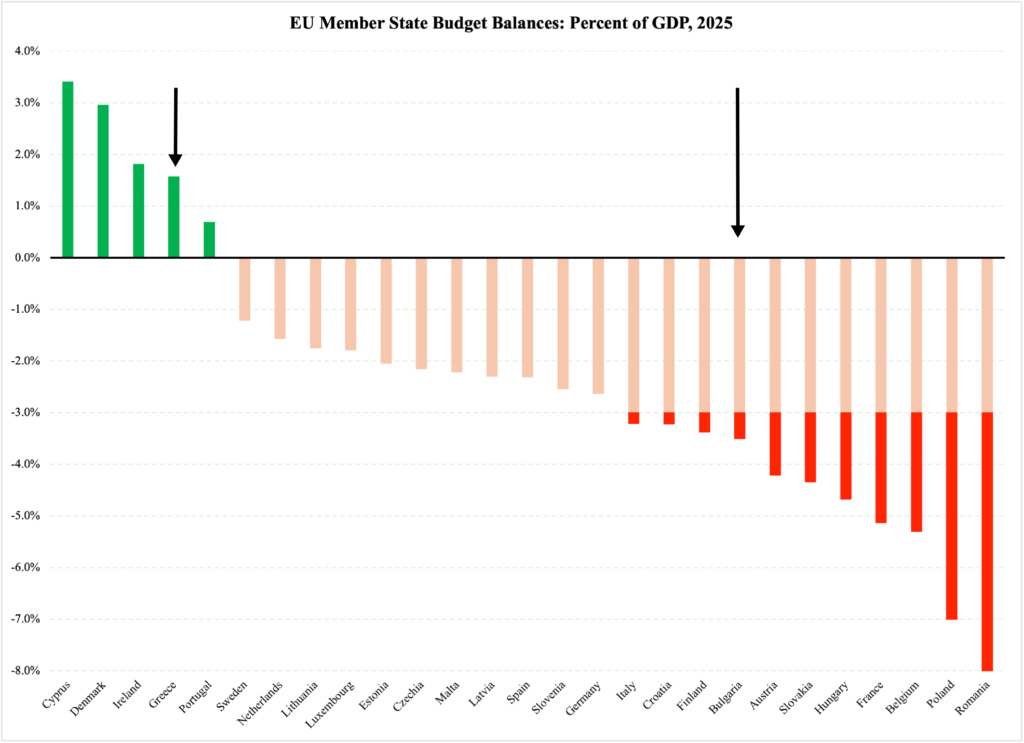
Figure 1 reports the fiscal situation in the EU’s 27 member states last year. Only five of them ran a surplus in their consolidated government budgets—as the short arrow indicates, Greece was one of them. Half of the 22 states with a deficit exceeded the three-percent-of-GDP rule. One of them was Bulgaria—long arrow—which is especially interesting given that they joined the euro zone this year:
Figure 1
One of the strict criteria for euro zone membership is that the consolidated government comply with the Growth Pact’s fiscal rules. Bulgaria has notoriously weak public finances: since joining the EU in 2007, its consolidated government has run a deficit 56% of the time. During one-third of its tenure as an EU member, that deficit has exceeded 3% of GDP.
Since 2022, the Bulgarian government has run a deficit every single quarter; in 2025, that deficit was 3.5% of GDP.
The fact that the EU ignored Bulgaria’s unending budget problems is a tacit recognition that the Growth Pact really is not working. In that sense, it adds to the recurring ‘relaxations’ of the fiscal rules and to the easily observable fact that Greece—the Growth Pact’s longest-suffering victim—began its economic recovery only after the EU began relaxing its austerity enforcement in 2019.
It is time for the EU to let go of its fiscal enforcement powers. That is unlikely to happen, simply because once governments gain power they rarely relinquish it, but it would nevertheless be a blessing for the European economy.