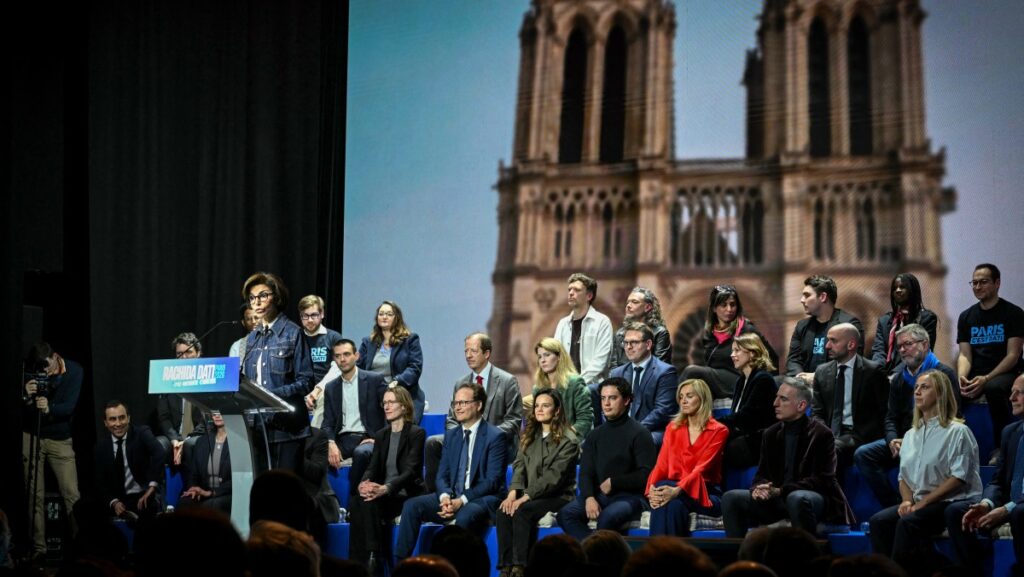
Rachida Dati addresses a campaign meeting at the Elysee Montmartre concert hall in Paris on March 12, 2026, three days ahead of France’s municipal elections first round.
Bertrand GUAY / AFP
With a year to go until the presidential election that will decide who succeeds Emmanuel Macron, the French are set to go to the polls on March 15th and March 22nd to elect their mayors. The vote will be closely scrutinised, as it is widely seen as a test run for the upcoming presidential election and a barometer of the state of the country’s political landscape.
In many towns, this election will have the feel of a rematch. The previous one was held in the midst of the COVID-19 pandemic, which seriously disrupted the voting process: many voters simply did not turn out, which seriously undermined the legitimacy of the mayors elected in those circumstances. Anne Hidalgo, for example, was elected by just 17% of Parisians.
Even before the vote takes place, 68% of municipalities already know who their mayor will be: indeed, a single list is standing in nearly two-thirds of French towns, which are mainly small rural towns. As no turnout threshold or minimum number of votes is required (at least one!), the candidates at the head of these single lists already know they will be elected. In the past, small municipalities with fewer than 1,000 inhabitants benefited from a special exemption, which gave them flexibility: the ability to change the list, remove names or add them—a matter of common sense in small communities where everyone knows one another and where politics is often a matter of good neighbourliness. Since a reform passed in 2025, driven by the centralised Jacobinism that is second nature in France, all municipalities are now subject to the same rules. Another new development: the absolute obligation to present gender-balanced lists, which was not the case previously, has become an insurmountable burden for small municipalities that may not have a pool of women ready to run. This requirement to field an equal number of male and female councillors has prevented many lists from materialising, thereby reinforcing the phenomenon of single-list elections.
The effect of this reform has led to unexpected results. Take the small town of Chalain-le-Comtal, in the Forez region, where a single list is standing—led by a 23-year-old man, Tom Rieu, who has the misfortune of being a member of Marion Maréchal’s party, Identité-Libertés. With no opposition, and no opportunity for residents to alter his list, he is certain to be elected on March 15th, prompting the regional press to run horrified headlines claiming that, for the first time, a rural commune “will fall into the hands of the far right.” On local press forums, however, the view is quite different, and people are delighted that a young man has chosen to commit himself in this way to serving his fellow citizens, in a role that is anything but a sinecure.
The major urban areas of Paris, Lyon and Marseille are receiving particular attention: for the first time in decades, they are set to trial a new electoral system, supposedly more democratic, having previously operated under a special system accused of failing to reflect public opinion in these three cities, the largest in the country.
Other municipalities, where high-profile figures are standing, will be closely watched. This is the case in Nice, where Éric Ciotti, president of the Union of the Right for the Republic (UDR) and an ally of the RN, is standing against the Macronist mayor Christian Estrosi, who comes from the Right but is accused of having betrayed all his past convictions out of opportunism. Ciotti sees a potential victory in Nice as a boost for his future political career; he sees himself as a potential prime minister under Jordan Bardella should the latter win the 2027 presidential election.
Another city attracting attention is Le Havre, where Édouard Philippe, Emmanuel Macron’s former prime minister and tipped as the presidential camp’s favourite candidate for 2027, is standing. For the moment, the man is likely to lose to a communist candidate.
At the national level, the local elections will send interesting signals about the respective dynamics of the political parties. The Greens, who managed to win major municipalities in the last elections held in the midst of the COVID-19 pandemic in 2020, are likely to lose ground, having deeply disappointed—and that is putting it mildly—their voters in cities such as Strasbourg, Bordeaux and Lyon. In Lyon, Mayor Grégory Doucet faces a challenge from a local baron, Jean-Michel Aulas, who would bring to an end a term of office that has left the people of Lyon with memories comparable to those of Parisians under Anne Hidalgo’s rule: a dirtier, less safe city, whose image has deteriorated considerably, and which gives the impression of having become a playground for a radicalised far left running rampant with the blessing of the incumbent teams.
In Paris, the battle is raging. Anne Hidalgo’s chosen successor, the socialist Emmanuel Grégoire, is leading in the polls with over 30%—which nonetheless means that 70% of Parisians want nothing to do with him. But the outcome of the vote is extremely uncertain. Indeed, any candidate who crosses the 10% threshold is guaranteed a place in the second round, and there are many of them—perhaps as many as five candidates, which would lead to a severe fragmentation of the vote. In the second round, the frontrunner will take the Paris city hall thanks to a majority bonus, even if all his opponents combined were to win more votes than him. For right-wing voters, attention is turning to Rachida Dati, the former minister for culture, who has switched from Les Républicains (LR) to Macron’s camp. A seasoned political fighter with strong roots in Paris, she nevertheless suffers from a dreadful reputation, beset by corruption lawsuits, and struggles to retain her team. Sarah Knafo, Éric Zemmour’s partner and MEP for the Reconquête party, intends to steal as many votes from her as possible to establish her legitimacy at national level; however, her progression to the second round—should no agreement between her and Dati materialise—is likely to result in victory for Hidalgo’s successors. The unity of the Right is thus being put to the test—assuming that Rachida Dati, given her background, can still be considered a right-wing candidate today. The RN usually struggles to exceed the 5% threshold in Paris, and this election is unlikely to be an exception.
For Le Pen and Bardella’s party, the municipal elections are eagerly awaited. Given the RN’s impressive results in national polls, the vote will be a test to see whether the party, which is usually weak at the local level, can establish itself in many towns and retain those it has already won—such as Perpignan, which has been led for the past six years by one of the party’s vice-presidents, Louis Aliot. Toulon is well placed to fall into the hands of the RN, with the conservative MP Laure Lavalette. In Marseille, France’s second-largest city, candidate Franck Allisio, who has rallied the national Right behind him—with the backing of a leading figure such as Senator Stéphane Ravier, formerly of Reconquête and now aligned with Maréchal—is in the lead but will need to remain ahead in the second round to win. The stakes will also hinge on the demographics of the electorate: will the RN succeed in persuading pensioners to vote for them in this local election?
With just a few days to go before the first round, Le Pen—who surely already knows deep down that she will be sidelined in 2027—has issued a passionate appeal to her voters, urging them to turn out in droves to take “the first step towards a change of government” as early as March 2026. Her party and its allies are contesting elections in nearly 550 towns with over 3,500 inhabitants. The RN teams are focusing on ‘quality’—iconic towns—rather than quantity. But securing seats on town councils without necessarily winning mayoral seats also represents a longer-term interest for the RN: strengthening its regional network and influencing the indirect Senate elections.