
The European Union has reached the final stage of its much-touted immigration policy overhaul. As we reported on June 13th,
After nearly eleven years in the making, the EU’s flagship asylum and migration management legislation, commonly called the Migration Pact, entered into force on June 12th.
The purpose of the pact
was to introduce a single, harmonized asylum procedure that would ensure that refugees get the exact same treatment, regardless of which member state they apply for asylum [in]
As with all policies that emanate from the EU, the Migration Pact is built around a one-size-fits-all narrative: not only is the problem defined by Brussels, but the solutions are tailored to meet the needs of Brussels, not the member states.
For starters, the entire Migration Pact is designed on the premise that illegal immigration is not a problem in itself; reading all the documents related to the Pact, one easily gets the impression that the Eurocracy considers illegal immigration a perfectly normal, even legal activity. The authors of the Migration Pact conveniently ignore the fact that the asylum process has been unabashedly abused by millions of migrants in the past couple of decades.
As far as Brussels is concerned, the problem with international migration—especially the ‘asylum-seeking’ illegal part—is that it is not handled expeditiously enough. This is why all its proposed solutions aim at making the migration processing system easier for the bureaucracy and more user-friendly for the migrants.
There is no better example of this premise at work than the so-called Reception Conditions Directive, RCD. According to the EU Commission, the purpose of the RCD is to set
minimum standards for the provision of assistance to asylum applicants across the EU. The revised Directive aims at harmonising reception conditions across the EU and ensures that all EU countries provide adequate living conditions for those seeking international protection.
While it is not spelled out in the Directive, it is logical to interpret this as we did in our June 13th article:
In practice, this means refugees arriving in Bulgaria should be treated the same as those in Germany … taking away the incentive for migrants to travel to wealthier member states.
This reading of the Reception Conditions Directive, while admittedly a little bit speculative, nevertheless puts a necessary spotlight on the philosophy behind policymaking in the European Union. It is a problem that illegal immigrants, once they have arrived in the EU, move from one country to the next, but the problem is not that they are illegal immigrants. The problem seems to be instead that they cluster in more ‘generous’ welfare states, where they become a drain on public finances and stir up immigration-skeptic opinions among the local population.
Instead of stopping illegal immigration, the EU chooses to discourage illegal immigrants and legitimate asylum seekers from interstate migration. The instrument is harmonization of the benefits that migrants get; in what seems to be an overt admission that economic incentives drive a big part of the flow of illegals into the EU, the Migration Pact appears to propose a full harmonization of social benefits for migrants.
If the EU and the member states follow through and actually reform their benefits systems, the consequences will be of fiscally disastrous proportions—especially for Europe’s poorest and most vulnerable member states. To see just how big that disaster could become, let us do a little experiment.
We assume that every member state interprets the Reception Conditions Directive as meaning that migrant benefits should keep them out of poverty, i.e., be given benefits that give them a standard of living no less than the individual country’s poverty line. Again, it is not spelled out anywhere in the RCD that this is how benefits are to be calculated, but it lies well in line with the EU’s intentions for migrant benefits reform with the Migration Pact.
Figure 1 reports the poverty threshold for a one-person household in all the 27 EU member states. The thresholds, which are equivalent to 60% of median income for that same household category, are all reported in euros for 2024.
Figure 1
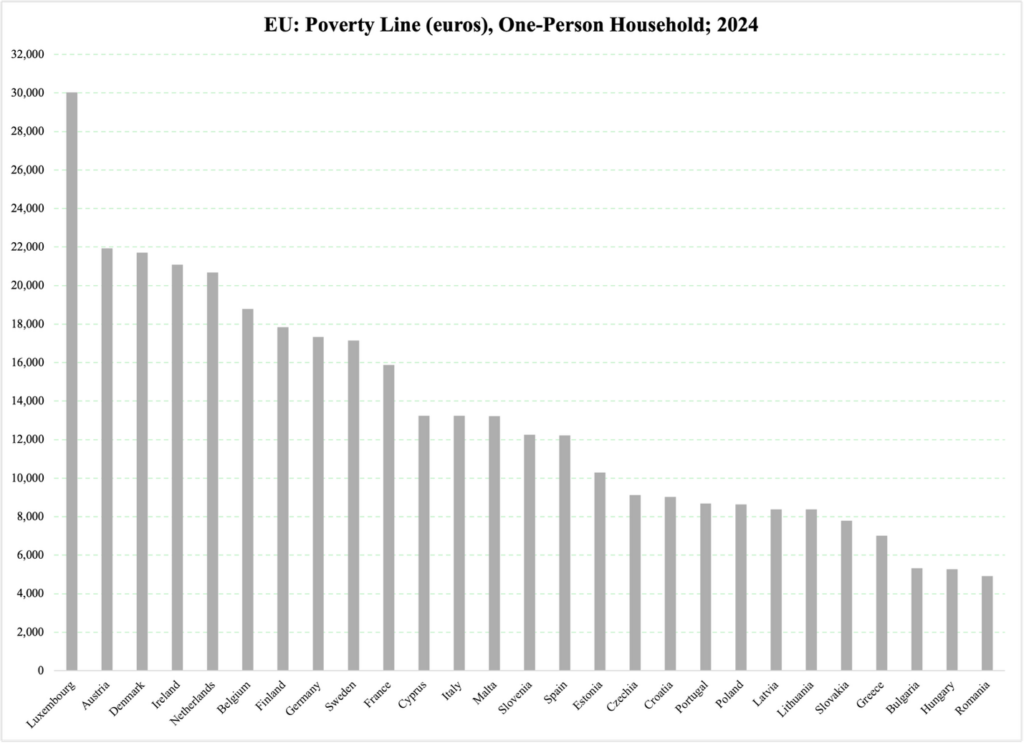
If pre-Migration Pact benefits are as disparate as the poverty lines reported in Figure 1, it is easy to see why there would be an incentive for an illegal immigrant arriving in Romania to come to, say, Luxembourg instead. The Romanian poverty line is only 16% of what it is in Luxembourg; in Greece, the poverty line amounts to 23 cents on the euro compared to Luxembourg.
So long as the goal with social benefits is to alleviate poverty, then, at least in theory, every EU member state has a fair, similar chance at doing so when the poverty line is defined the same way: 60% of median household income. However, if we read the EU’s Migration Pact and its Reception Conditions Directive as requesting a union-wide harmonization of benefits for migrants, the situation changes drastically.
Every asylum seeker or illegal immigrant is now supposed to get the same benefits regardless of which EU member state he resides in. Since there should be no incentive for economic migration within the EU, this means giving out Luxembourg-level benefits across the entire union.
Figure 2 does that. It compares the Luxembourg poverty limit from Figure 1 with the median income for a similarly sized household in each country. This median income is essential, as it gives us an idea of:
- The standard of living of the people who pay the taxes that fund the migrant’s benefits; and
- The potentially explosive burden on public finances as a result of the Migration Pact.
As Figure 2 shows, the Luxembourg poverty line is higher than median household income in 21 EU member states; the second-highest poverty line, which we find in Austria, exceeds median income in 14 countries.
Figure 2
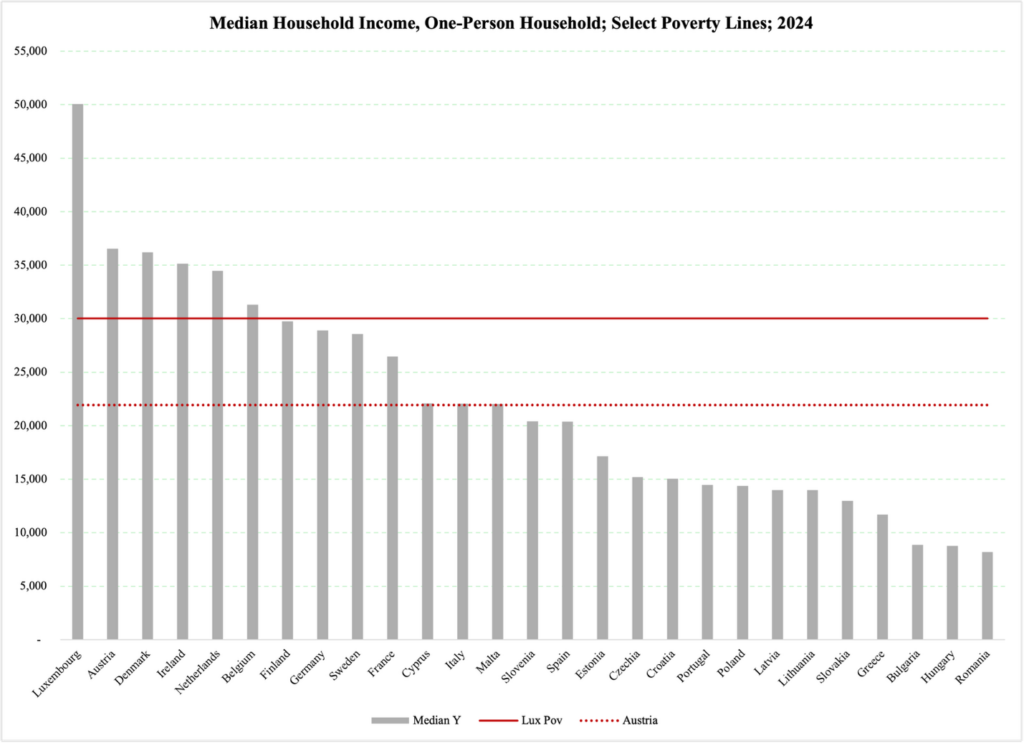
With the Luxembourg poverty limit being more than 200% of median income in nine EU states, the idea of harmonizing benefits across the EU is bound to blow up public finances across Europe. To take one example: the Greek poverty line is €23,000 lower than the one in Luxembourg; if 100,000 migrants came to Greece and were given harmonized EU benefits, it would cost Greek taxpayers €2.3 billion per year—on top of what they are already paying in taxes.
Let me again point out that this is an experimental analysis of the Reception Condition Directive in the EU’s just-launched Migration Pact. The RCD comes with interpretative wiggle room, though it is hard to see how the Pact could be put to work with a benefits reform anywhere less ambitious than what is sketched here. Therefore, until the EU Commission clarifies otherwise, it is prudent and responsible to assume that their goal is complete, highest-level harmonization across all 27 member states.