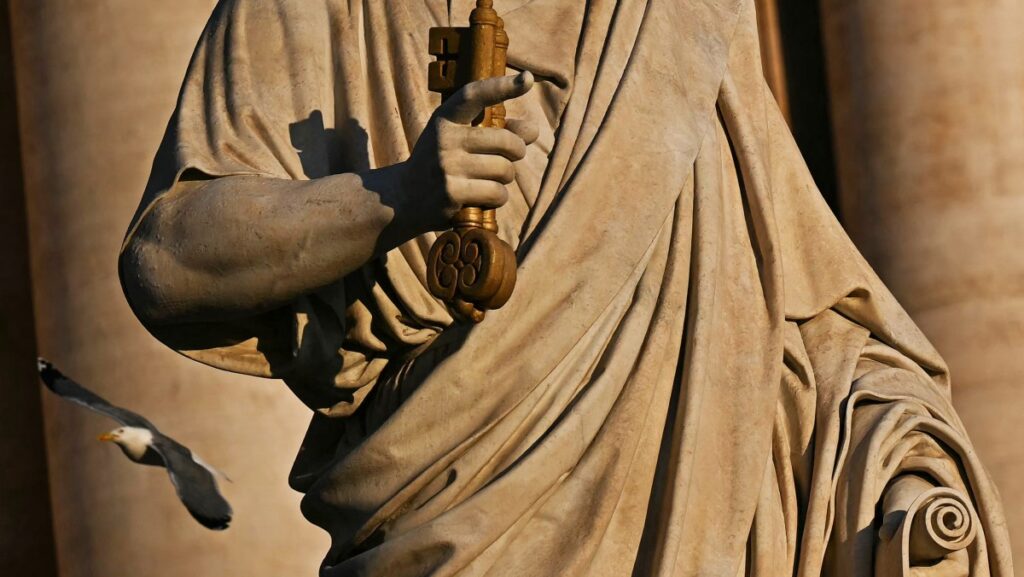
This photograph shows a seagull flying past a statue of Saint Peter at St Peter’s Square in The Vatican, at early morning on April 30, 2025.
Photo: Gabriel Bouys / AFP
Since the death of Pope Francis on April 21st, Rome has once again become the epicenter of the Catholic Church. From today, the Sistine Chapel hosts the conclave, while the 133 cardinal electors concluded the General Congregations yesterday afternoon. These preliminary meetings are where ideas, priorities, and possible names for the next pontiff begin to take shape.
Held behind closed doors and with only a few pauses—such as last Sunday, when cardinals celebrated Mass in their titular churches—the sessions have served as a space for reflection and dialogue among the cardinals. “The Congregation is a chance for us to get to know one another and share experiences. I’m new and didn’t know many of my brother cardinals. These are wonderful days for sharing,” Spanish Cardinal José Cobo explained.
Despite the fraternal spirit of the meetings, tensions have inevitably surfaced. In Cobo’s own words: “There are tensions among the cardinals, but these aren’t confrontations. Working with diversity—well, just like in any family, each person has their own way of thinking”. In fact, one of the Vatican Press Office’s official notes made this concern clear: “A strong concern was expressed about divisions within the Church itself.”
Cardinal Gérald C. Lacroix, Archbishop of Quebec and a long-standing member of the Council of Cardinals—the nine advisers closest to Pope Francis—also addressed the atmosphere in Rome: “This is not a race for leadership! We listen and ask ourselves what the Church needs.” His view summarizes the tone of many of the nearly 200 interventions delivered during the congregations.
But it hasn’t all been new faces: discussions about the Church’s future have been shaped by contributions from senior figures, many over 80 and therefore without voting rights. Among them, Cardinal Fernando Vérgez stood out, offering a detailed review of the current state of the Holy See, informed by his experience at the helm of Vatican City’s Governorate.
However, the most notable intervention came from Cardinal Joseph Zen, aged 93. The Chinese prelate, a fierce critic of Xi Jinping’s regime, travelled to Rome after obtaining a ten-day travel permit. During his speech, Zen made an urgent appeal: “The Church is at a crucial moment of confusion and division, and a grave responsibility now rests on the shoulders of our brother cardinals in the upcoming conclave: to give us a Pope who, with the help of the Holy Spirit, can once again lead us towards harmony and peace.”
Zen also expressed his affection for Pope Francis, while warning of the threats facing the Church: “We must not forget that a so-called ‘Spirit of the Council’ took over much of the narrative, and that ‘the smoke of Satan,’ as Pope Paul VI said, ‘entered through the cracks in the Church,’ or as Pope Benedict XVI described it, ‘the Barque of Peter is taking on water’.” His words have not gone unnoticed by the media.
Amid these stormy times, what does the College of Cardinals expect from the next Holy Father? According to daily briefings from Vatican spokesperson Matteo Bruni, there is consensus around a pope with both human and pastoral qualities: “This is the profile of the future Pope: someone who is present, close, capable of being a bridge and a guide, helping humanity—disoriented and marked by a global crisis—to find communion.”
Two qualities, then, are essential for leading the Church: a deep understanding of its identity and strong pastoral sensitivity. As Cardinal John Ribat, Archbishop of Port Moresby in Papua New Guinea, puts it: “Personal holiness is very important for the next Pope.” A sentiment echoed by many: the Church seeks a man of profound spiritual life, not merely an administrator of ecclesiastical structures.
Not surprisingly, issues such as climate change, war, and the loss of faith have ranked among the cardinals’ top concerns during these sessions. In that context, the closeness to the people that characterized Pope Francis is a quality many hope to preserve. Another Vatican note highlighted this: “The cardinals express the need for a shepherd who is close to the concrete lives of people.”
Monsignor Cristóbal López, Archbishop of Rabat, also called for continuity: “I cannot picture myself in that responsibility, but I do hope that whoever is chosen will be able to consolidate the openings and lines of action that this Pope has begun. They are in their early stages, but must continue.” Like many others, López ruled himself out for the Chair of Peter, but believes the future of the Church will be shaped under the shadow still cast by Francis’ pontificate.
Francis aimed to reach “everyone, everyone, everyone,” and so too must his successor, whose role will extend beyond Catholic borders. At one of last week’s congregations, the Holy See Press Office reported: “The cardinals reaffirmed their commitment and responsibility to support the new Pope, who is called to be a true shepherd —a guide capable of reaching beyond the confines of the Catholic Church alone, promoting dialogue and building relationships with other religious and cultural spheres”.
Indeed, one form of support for the pope-to-be is prayer. From North America, Cardinal Raymond Burke has repeatedly urged the faithful to pray: “I thank all those who have been praying the novena, or who will begin to pray it now. We can trust that Our Lady of Guadalupe will intercede powerfully for the election of a good and holy Pastor for the Universal Church”. Burke, a leading figure in the conservative wing of the College of Cardinals, has been particularly active on social media in recent days.
Moreover, the Jubilee Year of Hope and the desire for bold leadership after Francis have given rise to another recurring theme in the General Congregations: the yearning for a prophetic pope. As one Vatican press release put it: “There were repeated references to the Jubilee and to the desire that the next Pope have a prophetic spirit—able to guide a Church that does not retreat into itself, but knows how to go forth and bring light to a world marked by despair.”
Amid these meetings—held since 22 April—there has also been room for humility and humor. Swedish Cardinal Anders Arborelius remarked with a touch of irony: “It would be fun to have a Swedish Pope, but I think it’s rather unlikely. Very unlikely”. Meanwhile, Spain’s José Cobo added with a smile: “Let’s hope he speaks Spanish—we’re going to try to make the next Pope a Spanish-speaker”.
Although no name has yet emerged, and speculation continues to swirl around various candidates, all signs suggest that Francis’ legacy will cast a long shadow over the path taken by the new successor of Peter. For now, beneath Michelangelo’s frescoes and in the solemn stillness of the Sistine Chapel, the cardinals are locked in. Everything is ready for the vote.