Italy’s conservative prime minister and Denmark’s centre-left leader said tighter returns policies alone are “not enough”, arguing that respect for European laws must go hand in hand with respect for European values.
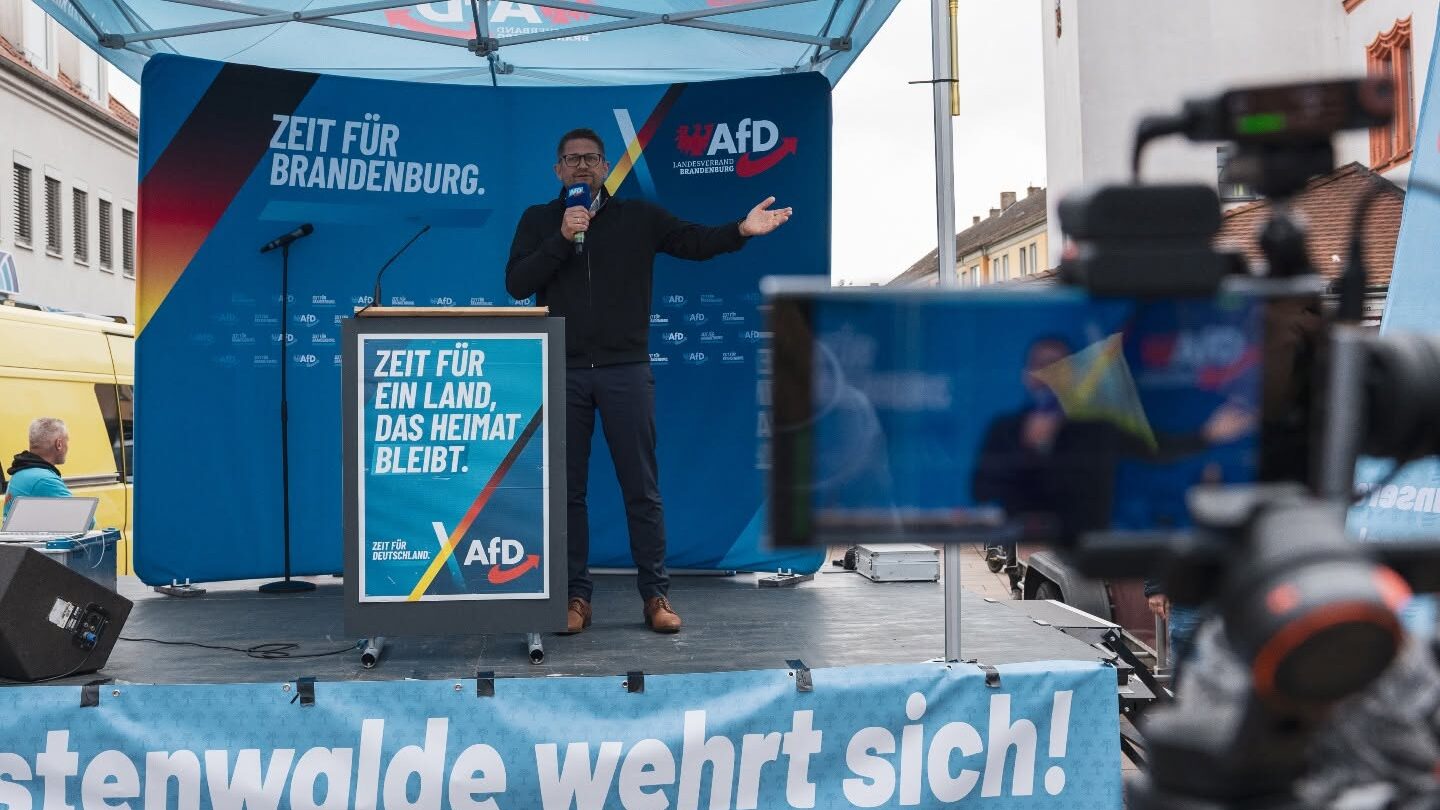
René Springer, AfD, campaigning in Fürstenwalde, Brandenburg, May 2026.
AfD Brandenburg on Facebook, 8 May 2026.
The right-wing Alternative für Deutschland (AfD) has opened up a commanding lead in the eastern German state of Brandenburg, according to a new poll, highlighting the continuing rise of the party across the country.
The survey places the AfD at 37%, 15 percentage points ahead of the Social Democratic Party (SPD) of Prime Minister Dietmar Woidke, which stands at 22%.
Sonntagsfrage zur Landtagswahl in Brandenburg • Infratest dimap / RBB: AfD 37 % | SPD 22 % | CDU 12 % | DIE LINKE 12 % | GRÜNE 6 % | BSW 4 % | Sonstige 7 %
— Wahlrecht.de (@Wahlrecht_de) June 24, 2026
➤ Verlauf: https://t.co/rJsCIU1aQA
🗓️ Nächste Landtagswahl: vsl. Herbst 2029 #ltwbb pic.twitter.com/w9fBIpZV7m
This is the highest level of support ever recorded for the AfD in Brandenburg and puts the party ahead of the combined total of the SPD and its coalition partner, the Christian Democratic Union (CDU), which is polling at 12%.
The figures mark a significant shift since the 2024 state election, when the SPD finished first with 30.9% and the AfD came second with 29.2%. Since then, support for the Social Democrats has fallen sharply, while the AfD has continued to gain ground.
The poll comes amid rising support for the AfD nationwide, with the party set to win elections in two eastern states in September. A recent survey in Saxony-Anhalt has placed the party at a record-breaking 42%, far ahead of its rivals. In Mecklenburg-Vorpommern, the AfD is expected to reach 35%.
Reacting to the Brandenburg figures, AfD Bundestag member René Springer welcomed the result on social media, saying voters wanted a “political change of course.”
While the establishment parties continue to lose public trust, support is growing for policies that place security, prosperity, and the interests of the country’s own population at the centre.
The new poll once again confirms the declining popularity of the establishment parties, whom voters no longer trust to deal with the most pressing issues, such as the migration crisis, the loss of competitiveness, the declining economy, and high energy prices.
NIUS columnist Alexander Kissler described the Brandenburg poll as a “political earthquake” and argued that voters were punishing the CDU for teaming up with the SPD by joining the state government. Many people in Brandenburg had the impression that “remaining in power was more important to the CDU than the well-being of the state,” he added.
NIUS political editor Ralf Schuler said that efforts by mainstream parties to exclude the AfD from power through coalition arrangements had failed to curb the party’s growth and, in some cases, may have strengthened its appeal among voters.
As the AfD continues to grow, the cordon sanitaire imposed by the other parties is beginning to crumble, as it becomes more and more difficult to form a government without the participation of the right-wing party.
According to the latest numbers, even an alliance of the SPD, CDU, and the Greens would not command a majority in Brandenburg, meaning the far-left Die Linke could become essential to any future anti-AfD coalition.
As we recently reported, prominent members of the CDU have advocated for cooperation with the Die Linke, the successor to East Germany’s former Communist ruling party, if it came to a choice between them and the AfD.