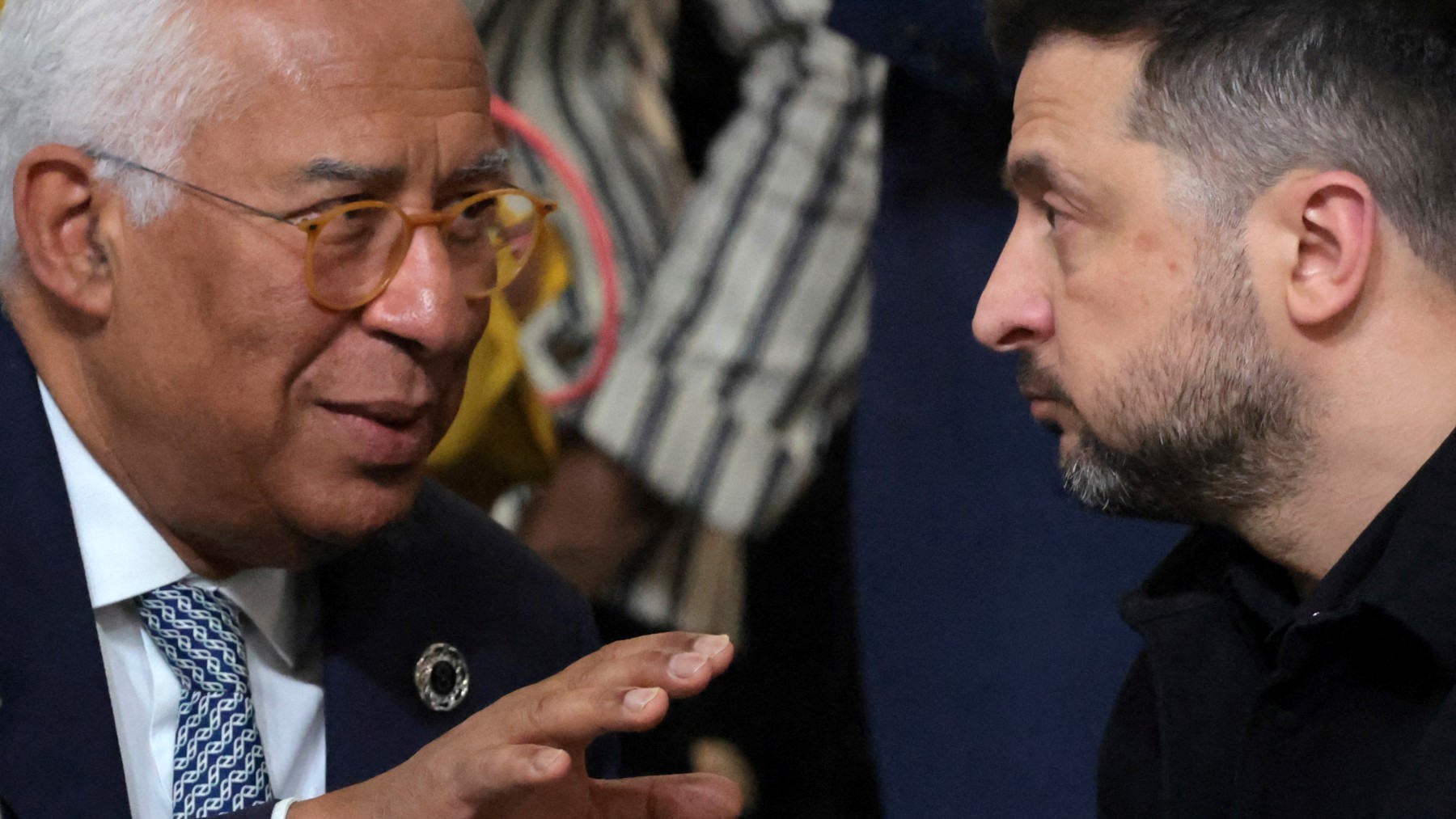
European Council President António Costa and Ukraine’s President Volodymyr Zelensky attend the 8th European Political Community (EPC) summit in Yerevan on May 4, 2026.
LUDOVIC MARIN / AFP
The European Union expects to open “very soon” a new negotiation cluster with Ukraine for its future accession, European Council President António Costa announced on Wednesday, July 8th, after meeting Volodymyr Zelensky in Ankara on the sidelines of the NATO summit.
The message came during an Atlantic meeting focused on security, rearmament and military support for Kyiv, but with Brussels using the moment to keep alive the narrative of European integration.
With President @ZelenskyyUa in Ankara.
— António Costa (@eucopresident) July 8, 2026
We are moving forward on Ukraine’s EU accession. The opening of a new negotiating cluster should be coming soon.
There is growing global momentum to deliver peace through strength: increasing financial, energy and military support for… pic.twitter.com/2i790QV2pp
The expected step concerns cluster 6, dedicated to external relations, foreign policy, security and defence. According to European sources, the formal opening could take place on July 14th, in parallel with Moldova, after the member states move forward with the technical procedure in Coreper.
The accession process is no longer organised as a simple succession of isolated chapters. The current methodology groups the chapters of the EU acquis into six thematic clusters. In total, the process covers 35 technical chapters, ranging from the rule of law and public procurement to agriculture, EU funds, foreign policy and the budget.
Ukraine opened the first cluster, the “fundamentals” cluster, on June 15. That block includes the rule of law, fundamental rights, the functioning of democratic institutions, public administration reform and economic criteria.
The new advance, however, has a more political than technical reading. The external relations cluster allows Brussels to show movement without yet entering the most explosive files: agriculture, cohesion, free movement, the budget and the distribution of power within the Council.
It is there that Ukrainian accession would cease to be a symbolic gesture against Moscow and become an internal reconfiguration of the Union. The question is not only whether Ukraine can adapt to the EU, but whether the EU can absorb Ukraine without changing its own nature. This is the issue that worries more than one member state.
Moreover, every step requires unanimity among the member states. Hungary lifted in June the veto that had held back Kyiv’s progress for years under the new government of Péter Magyar. Budapest has changed its tone, but that will not make the serious issues with Ukraine’s integration go away.
Zelensky needs political signals to sustain European expectations inside a country at war. Brussels needs to show that its promise of accession was not merely emergency rhetoric after the Russian invasion. But between strategic solidarity and full entry into the EU, there is an enormous institutional distance. And the fundamental question has not disappeared: how far is Europe willing to alter its own rules in order to turn Ukraine into a member state.