Henry NICHOLLS / AFP
The leaders of Britain, France, and Germany have once again focused on the war in Ukraine while facing growing political and economic difficulties at home.
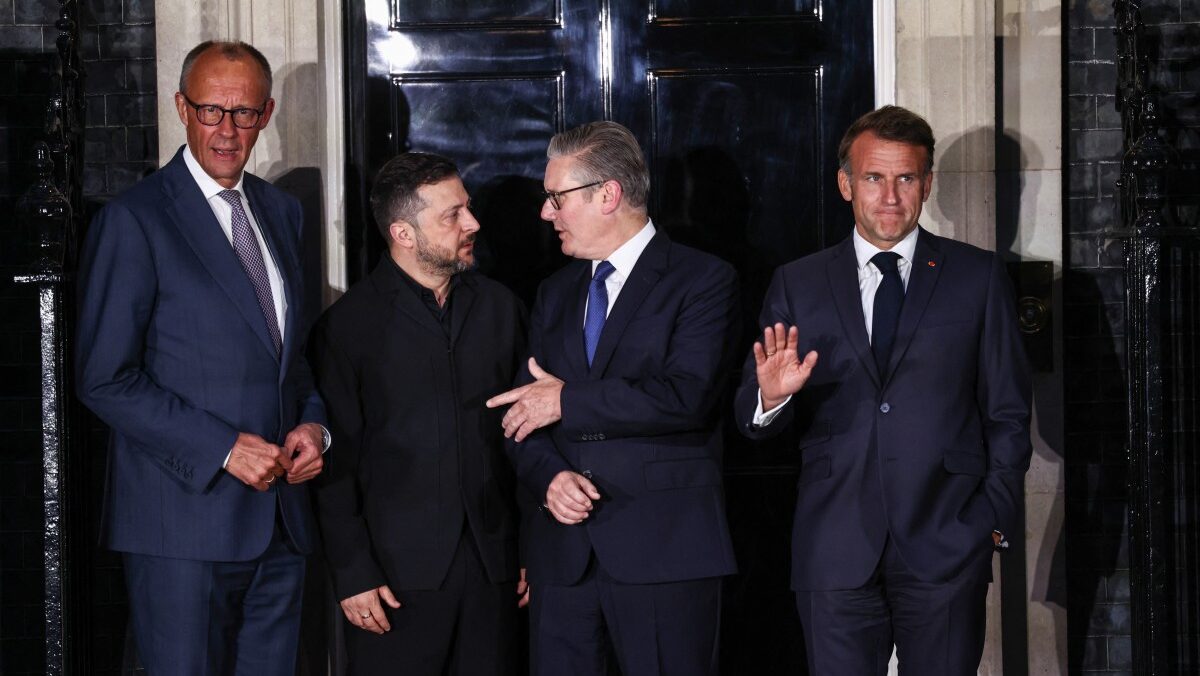
French president Emmanuel Macron, British prime minister Keir Starmer, and German chancellor Friedrich Merz met Ukrainian president Volodymyr Zelensky in London on Sunday, June 7th, where they backed his call for direct ceasefire talks between Ukraine and Russia.
In a joint statement, the four leaders supported a proposal for direct dialogue between Kyiv and Moscow, with active U.S. and European participation. They reiterated that international borders must not be changed by force.
The diplomatic initiative follows Zelensky’s proposal for a face-to-face meeting with Russian president Vladimir Putin. The Ukrainian president insisted that Ukraine would not surrender territory.
The London summit highlighted the extent to which the Ukraine war continues to dominate the foreign policy agenda of Europe’s leading governments. Yet it also took place against the backdrop of mounting domestic pressures in France, Britain, and Germany, where voters remain increasingly focused on issues such as the economy, migration, and public security.
In France, Macron is in the final year of his presidency after nearly a decade in power. His centrist Ensemble alliance has struggled since losing significant ground in the 2024 parliamentary elections, leaving France in a prolonged period of political instability.
Concerns about immigration and integration have also intensified, with recent riots following Paris Saint-Germain’s Champions League victory reigniting debate over social cohesion in many French cities. Polls consistently show the anti-mass immigration National Rally as the strongest political force in the country.
Starmer faces similar headwinds in Britain. Two years after Labour’s election victory, his government has suffered a sharp decline in public support. Tensions have recently been heightened by the case of 18-year-old Henry Nowak, who died after being stabbed in December 2025 while police officers handcuffed him rather than his attacker, a British Sikh man.
Nigel Farage’s Reform UK has overtaken both Labour and the Conservatives in several opinion polls, reflecting growing voter dissatisfaction with the political establishment.
Germany’s Friedrich Merz is also under pressure. His coalition government with the Social Democrats has been marked by internal disagreements and declining popularity. Europe’s largest economy continues to struggle with weak growth, declining industrial competitiveness, and high energy prices.
Migration remains one of the most contentious issues in German politics, with repeated violent crimes involving migrants attracting national attention. Recent cases, including the arrest of a 15-year-old Azerbaijani suspect in connection with a shooting on the island of Sylt and the arrest of an Afghan national linked to a fatal gas explosion in Görlitz, have intensified public debate.
At the same time, support for the anti-immigration Alternative für Deutschland (AfD) has surged, despite efforts by mainstream parties to isolate the movement politically.
The timing of the London summit is likely to reinforce accusations that Europe’s leading politicians are seeking refuge in foreign policy as problems at home continue to mount.