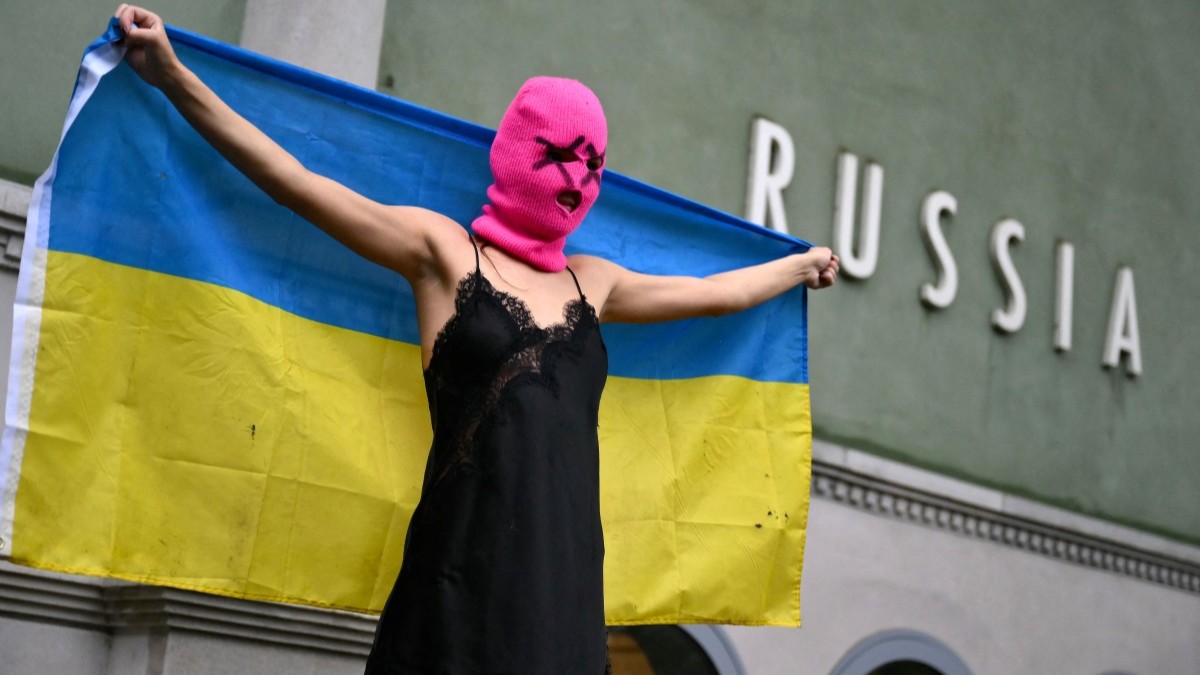
A member of the Pussy Riot activist group holds an Ukrainian flag during a protest against the participation of Russia in the Venice Biennale art show, in front of the Russian pavilion on May 6, 2026 in Venice.
MARCO BERTORELLO / AFP
Brussels has once again turned culture into a political battleground.
The European Commission has sent a second letter to the Fondazione Biennale di Venezia demanding explanations over the reopening of the Russian pavilion at the 61st International Art Exhibition of Venice.The von der Leyen commission is threatening to suspend or cancel a €2 million European grant if the participation is maintained.
The official argument is well known: Russia is waging a war of aggression against Ukraine and should not be given a European cultural platform. Commission Executive Vice-President Henna Virkkunen stated that Europe Day should serve to “celebrate peace,” not for Russia to “shine” at the Biennale. Commissioner Glenn Micallef was more direct on March 10 on X: “European stages must reflect European values” (whatever those values are), a message that runs opposed to the very essence of culture and art.
European stages must reflect European values.
— Glenn Micallef (@GlennMicallef) March 10, 2026
While Russia continues its illegal war of aggression against Ukraine, this is not the moment for Fondazione Biennale to allow Russia to reopen its national pavilion at the 2026 Venice Biennale.
Culture promotes and safeguards… pic.twitter.com/yV1RS4lhRe
The Commission is not merely expressing political disagreement. It is using public funding as a mechanism of pressure to condition the programming of a cultural institution. If the Biennale does not reverse its decision, Brussels will review the grant and could suspend or terminate it. The message conveyed by this stance is that artistic freedom exists only insofar as it aligns with the correct political line—namely, the one defined by the Commission.
The Biennale, chaired by Pietrangelo Buttafuoco, has reacted by stating that any country recognized by Italy may participate and that the institution rejects “any form of exclusion or censorship” in art and culture.
Russia returns to the event for the first time this year since the 2022 invasion of Ukraine, although its pavilion will operate with restricted public access due to the sanctions regime.
Brussels invokes democratic values, open dialogue, diversity and freedom of expression to justify an economic threat against an institution that in fact stands for and defends those exact principles in the cultural sphere. When power defines which art may appear on stage and which must disappear, it is no longer protecting freedom—it is administering it.
The controversy has also triggered an internal crisis. The international jury resigned en bloc following the dispute over the pavilions of Russia and Israel, and the awards will now be left in the hands of the public.
Culture can be propaganda. But it can also be dissent, contradiction, ambiguity and conflict. That was what art is, or, it seems, used to be. If European stages can only reflect values defined by the Commission, the problem is no longer the Russian pavilion. It is a Europe that is beginning to resemble too closely what it claims to oppose.